You Have 30 Minutes. That’s Enough.
Most people assume learning a new language is this massive, time-consuming project. You picture textbooks, grammar drills, maybe a classroom. And then you look at your calendar, work, family, errands and you quietly close the idea. But here’s the thing: conversational Punjabi doesn’t require that kind of commitment. Not even close.
Punjabi is one of the most widely spoken languages in the world, with over 125 million native speakers across India, Pakistan, Canada, the United Kingdom, and beyond. And yet, it’s surprisingly approachable for beginners, especially if you’re not trying to write a thesis in it, but simply trying to connect with people. A family member. A colleague. A neighbor. Maybe just the aunty at the corner store who lights up the moment you say something back to her in her own language.
This guide is built around one core idea: you can make real, meaningful progress in conversational Punjabi with just 20 to 30 minutes a day. No weekend study marathons. No grammar memorization. Just smart, consistent micro-practice that fits into the gaps you already have in your day.
Why Conversational Punjabi and Why Now?
There are a lot of languages you could be learning. So why Punjabi specifically? Well, perhaps the more honest question is: why haven’t more people started already?
Punjabi is the fourth most spoken language in Canada and the UK respectively. In cities like Brampton, Birmingham, and Dubai, you’d be surprised how far a few genuine Punjabi phrases carry you. Professionally, personally, culturally, the language opens doors in ways that English alone simply can’t. And if you have Punjabi heritage but grew up speaking mostly English, this is also about reconnecting with something that was always yours.
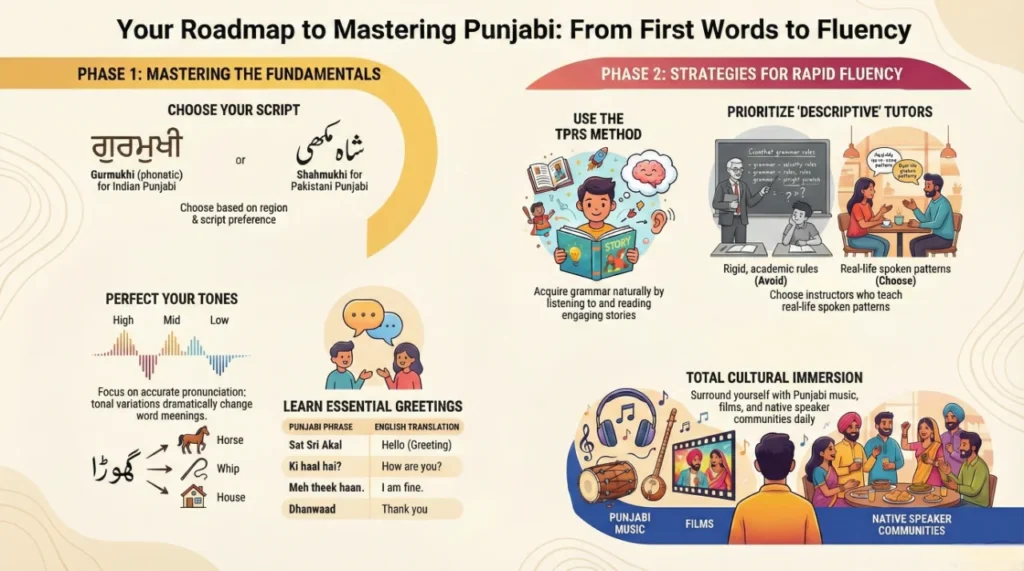
Beyond the practical, there’s the emotional pull. Punjabi is warm. Expressive. Loud in the best way. When someone greets you with ਸਤਿ ਸ੍ਰੀ ਅਕਾਲ (Sat Sri Akal “God is the Eternal Truth”), there’s a weight to it that a simple “hello” doesn’t quite carry. The language reflects the culture: generous, spirited, and genuinely welcoming of anyone willing to try.
The Biggest Myth About Language Learning (And Why Busy People Get It Wrong)
The most damaging myth in language learning is this: you need long, uninterrupted study sessions to make progress. You don’t. Research into spaced repetition and micro-learning consistently shows that shorter, more frequent exposures to material outperform marathon sessions when it comes to long-term retention.
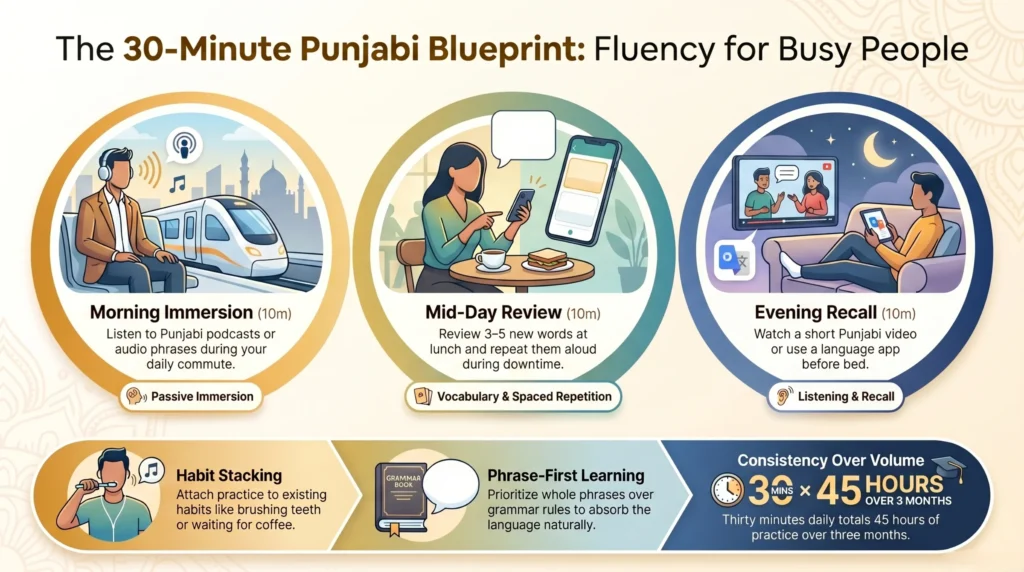
Think about it this way. If you spend 30 minutes every morning reviewing Punjabi phrases during your commute, that’s 2.5 hours per week. Over a month, that’s 15 hours of practice. Over three months? More than 45 hours without ever sitting down to “study” in the traditional sense.
The trick isn’t duration. It’s consistency and context. You want to encounter the same phrase in different situations, slightly spaced out, until it stops feeling like memorization and starts feeling like memory. That’s when you know something is actually sticking.
Your 30-Minute Weekly Punjabi Micro-Routine
Here’s how a realistic, low-pressure weekly schedule might look for someone with a full-time job and about zero free time:
| Time of Day | Duration | Activity | Skill Targeted |
| Morning Commute | 10 min | Listen to Punjabi podcast or audio phrases | Passive immersion |
| Lunch Break | 5 min | Review 3–5 new words / flashcards | Vocabulary building |
| Afternoon (any downtime) | 5 min | Repeat yesterday’s phrases aloud | Spaced repetition |
| Evening Wind-down | 10 min | Watch a 5-min Punjabi YouTube clip or practice with app | Listening + recall |
Essential Conversational Punjabi Phrases: Start Here
Before anything else, before apps, before courses, before YouTube rabbit holes learn these. These are the phrases that come up in nearly every real conversation. Master these ten, and you’ll already feel different walking into a room full of Punjabi speakers.
| Punjabi (Gurmukhi) | Romanised | English | When to Use |
| ਸਤਿ ਸ੍ਰੀ ਅਕਾਲ | Sat Sri Akal | Hello / God is Truth | Universal Sikh greeting |
| ਕੀ ਹਾਲ ਹੈ? | Ki haal ae? | How are you? | Casual check-in |
| ਮੈਂ ਠੀਕ ਹਾਂ | Main theek haan | I’m fine | Standard reply |
| ਹਾਂ ਜੀ / ਨਹੀਂ | Haan ji / Nahi | Yes / No | Basic responses |
| ਧੰਨਵਾਦ | Dhanvaad | Thank you | Gratitude |
| ਮਾਫ਼ ਕਰਨਾ | Maaf karna | Excuse me / I’m sorry | Polite apology |
| ਕਿਰਪਾ ਕਰਕੇ | Kirpa karke | Please | Polite request |
| ਫਿਰ ਮਿਲਦੇ ਹਾਂ | Phir milde haan | See you again | Goodbye variant |
A note on pronunciation: Punjabi is a tonal language, which surprises a lot of beginners. That means the pitch at which you say a word can actually change its meaning. Don’t panic about this early on native speakers are forgiving, especially when they can see you’re genuinely trying. Focus on getting the words right first. Tone comes with exposure.
Everyday Punjabi Phrases for Real Situations
Knowing how to say hello is a start. But what do you say next? Here are phrases built for the moments that actually come up at the market, in a restaurant, or when you’re simply trying to follow a conversation that’s moving faster than you’d like:
| Punjabi (Gurmukhi) | Romanised | English Meaning | Situation |
| ਇਹ ਕਿੰਨੇ ਦਾ ਹੈ? | Eh kinne da ae? | How much does this cost? | Shopping / Market |
| ਮੈਨੂੰ ਭੁੱਖ ਲੱਗੀ ਹੈ | Mainu bhukh laggi hai | I am hungry | Daily life |
| ਪਾਣੀ ਦਿਓ ਜੀ | Paani dio ji | Please give me water | Restaurant / Home |
| ਬਿੱਲ ਦਿਓ | Bill dio | Give me the bill | Restaurant |
| ਹੌਲੀ-ਹੌਲੀ ਬੋਲੋ | Hauli-hauli bolo | Please speak slowly | Conversation aid |
| ਮੈਨੂੰ ਸਮਝ ਨਹੀਂ ਆਈ | Mainu samajh nahi aayi | I don’t understand | Conversation aid |
| ਬਹੁਤ ਵਧੀਆ! | Bahut vadhia! | Excellent! / Very good! | Compliment / Reaction |
| ਚੱਲੋ ਜੀ | Challo ji | Let’s go / Alright then | Casual transition |
That last one ਹੌਲੀ-ਹੌਲੀ ਬੋਲੋ (Hauli-hauli bolo) might be the most useful phrase you learn. Native speakers tend to speak fast. Really fast. Asking them to slow down isn’t rude; it’s practical, and most people genuinely appreciate that you’re trying.
Punjabi Numbers 1–10: Learn These First
Numbers come up in almost every practical scenario prices, time, quantities, addresses. Here they are, with pronunciation guides:
| Punjabi (Gurmukhi) | Romanised Pronunciation | English |
| ੧ — ਇੱਕ | Ikk | One |
| ੨ — ਦੋ | Do | Two |
| ੩ — ਤਿੰਨ | Tinn | Three |
| ੪ — ਚਾਰ | Chaar | Four |
| ੫ — ਪੰਜ | Panj | Five |
| ੬ — ਛੇ | Chhe | Six |
| ੭ — ਸੱਤ | Satt | Seven |
| ੮ — ਅੱਠ | Atth | Eight |
| ੯ — ਨੌਂ | Naun | Nine |
| ੧੦ — ਦਸ | Das | Ten |
Once you have 1–10 solid, the rest of the number system becomes logical. Punjabi numbers follow a fairly consistent pattern that, I think, is actually easier than English in some ways once you’re past the first ten.
5 Strategies That Actually Work When You’re Busy
1. Attach Punjabi to What You Already Do
This is the most effective strategy, full stop. Don’t add Punjabi to your schedule, attach it to habits you already have. Brush your teeth? Say your five phrases. Commute to work? Turn on a Punjabi audio lesson. Waiting for coffee? Review flashcards. You’re not creating new time; you’re using time that was already empty.
2. Learn Phrases, Not Grammar (At First)
Grammar has its place, eventually. But when you’re starting out, learning isolated grammar rules without conversational context is genuinely one of the least effective approaches. Instead, learn whole phrases. “ਮੈਂ ਠੀਕ ਹਾਂ” (Main theek haan I’m fine) teaches you the first person pronoun, a verb, and an adjective simultaneously without you having to think about any of that. The grammar absorbs naturally through use.
3. Use Spaced Repetition Flashcard Apps
Apps like Anki use algorithms to show you words right before you’re about to forget them. It sounds simple, but the science behind it is solid. Five minutes a day with a well-built Punjabi deck is more effective than thirty minutes of random review. The key is daily consistency, even on the days when you only have three minutes.
4. Find a Speaking Partner
Perhaps the most underrated strategy. Even one 20-minute conversation per week with a native or fluent Punjabi speaker accelerates your progress dramatically. It forces active recall, exposes you to real pronunciation, and honestly it’s motivating in a way that solo study simply isn’t. Online communities, language exchange apps, or even a willing family member can work here.
5. Consume Punjabi Media Passively
Punjabi music is everywhere. Bollywood imports it, international artists sample it, and YouTube is full of it. You don’t have to sit down and study a song. Just let it play in the background. Over time, patterns emerge, words start sounding familiar, and your ear adjusts to the rhythm of the language. This is called passive immersion, and it works even when you’re not paying full attention.
Common Mistakes Beginners Make (And How to Avoid Them)
A few things worth flagging, because they come up constantly:
• Waiting until you’re “ready” to speak There is no ready. Start speaking from day one, even if it’s just to yourself.
• Trying to learn Gurmukhi script before learning to speak Script is valuable, but it’s not the bottleneck for conversational fluency. Save it for later.
• Cramming on weekends instead of daily practice Frequency beats volume, every single time.
• Expecting to sound native too soon Accent and nuance take years. Comprehensible and warm is a perfectly valid goal for most people.
• Ignoring the culture Punjabi language and Punjabi culture are inseparable. The more you understand bhangra, langar, Vaisakhi, and the warmth of Punjabi hospitality, the more the language makes sense.
How DesiLingua Fits Into Your Busy Life
DesiLingua was built with exactly this challenge in mind. The platform offers structured conversational Punjabi lessons designed around the reality that most learners aren’t students they’re professionals, parents, heritage speakers, and curious minds who want progress without pressure.
Lessons are short by design. Audio is recorded by native speakers. The curriculum prioritizes spoken, practical Punjabi over written grammar because that’s what actually helps you connect with real people in real conversations. Whether you’re starting from absolute zero or dusting off childhood Punjabi that’s grown rusty, there’s a path forward here.
And unlike rigid course structures, the content is built to work in pieces. Ten minutes here, five minutes there. It adds up.
You Don’t Need Hours. You Need a Start.
The honest truth? Most people who say they don’t have time to learn Punjabi have more time than they think. They just haven’t found a method that fits around their actual life rather than demanding they reshape their life around it.
Fifteen minutes a day. A handful of phrases. Real, human conversations as the goal not textbook perfection. That’s the approach. And if you’re consistent with it, even loosely, you’ll surprise yourself.