Most people who want to learn Urdu don’t want to spend two years studying grammar charts before they can ask someone where the nearest chai dhaba is. They want to talk. To connect. Maybe to impress a friend’s family, or to finally understand what’s being said in a Pakistani drama without relying on subtitles. Whatever your reason, conversational Urdu is absolutely learnable, and it doesn’t have to take forever.
I’ve been teaching Urdu as a native speaker for years, and the question I hear more than any other is: how do I start actually speaking? Not reading. Not writing Nastaliq script. Speaking. So that’s exactly what this guide focuses on practical, honest tips that will get you talking in Urdu sooner than you might expect.
Fair warning: some of what I say here might push back against things you’ve read elsewhere. That’s fine. Language learning isn’t one-size-fits-all, and I’d rather give you the messy truth than a polished list that looks great but doesn’t help you say a single sentence.
Why Conversational Urdu Is Different From Formal or Written Urdu
Here’s something textbooks don’t always tell you: the Urdu people actually speak day-to-day, especially in Pakistan’s cities, is very different from the formal literary Urdu you’ll find in classical poetry or official broadcasts. Spoken Urdu, particularly in Lahore, Karachi, or Islamabad, borrows heavily from Punjabi, English, and regional dialects. You’ll hear things like “meeting pe jana hai” (I have to go to a meeting) or “tension mat lo” (don’t take tension / don’t stress) , a mix that sounds completely natural to a native ear.
This isn’t ‘broken’ Urdu. It’s just how people talk. So when you’re learning conversational Urdu, your goal isn’t linguistic purity, it’s communication. Keep that in mind and you’ll feel a lot less overwhelmed.
Tip 1: Start With High-Frequency Phrases, Not the Alphabet
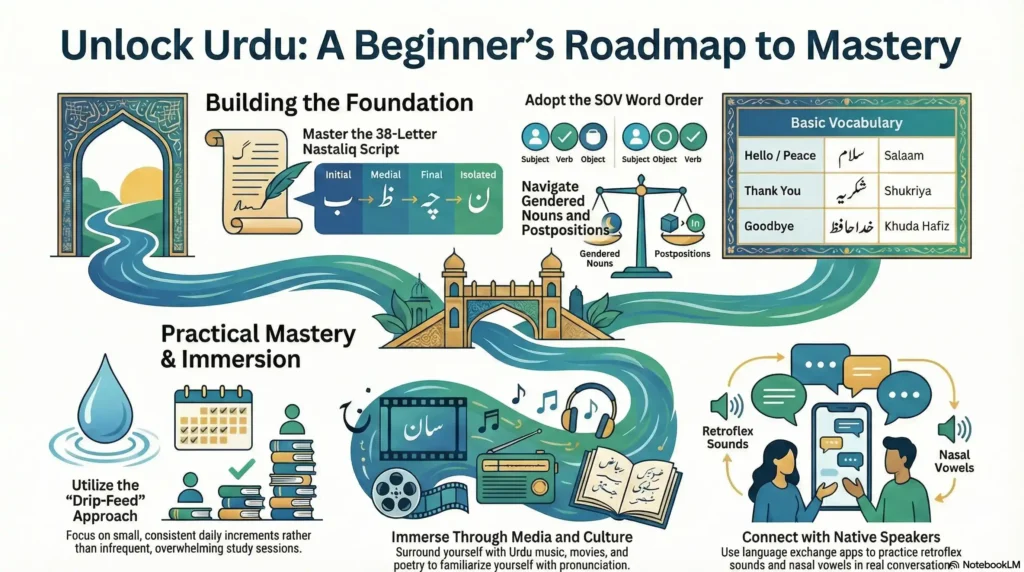
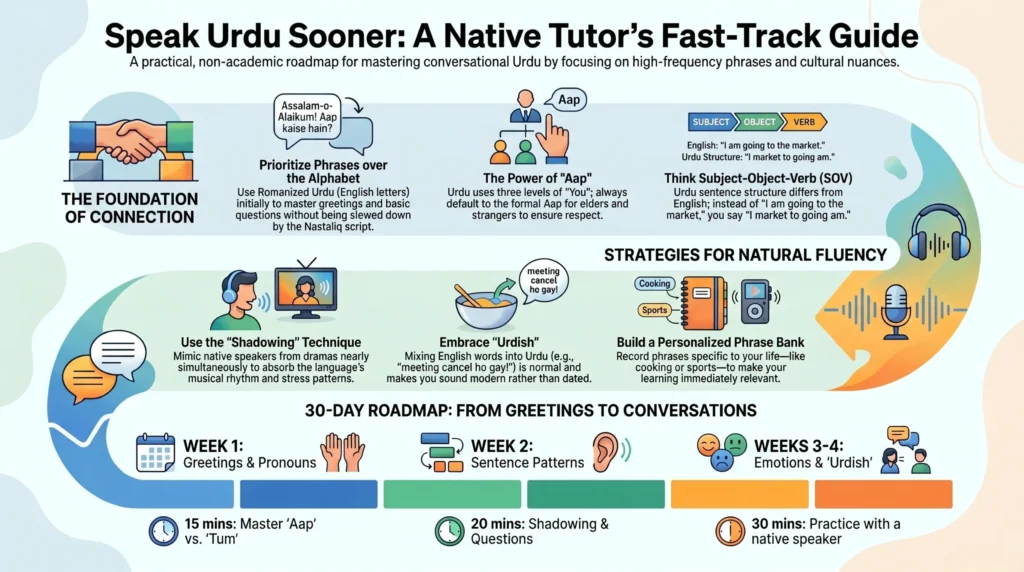
I know, I know. Every structured language course tells you to start with the script. And if you eventually want to read Urdu, yes, learning Nastaliq is important. But if speaking is your priority right now, you can use Romanised Urdu writing Urdu sounds using the English alphabet to get started much faster.
Focus first on phrases you will genuinely use within your first week. Greetings, basic questions, expressions of gratitude and apology. These are your foundation.
Table 1: Essential Urdu Greetings & Daily Phrases
| اردو (Urdu Script) | Romanised Urdu | English Meaning | When to Use |
| السلام علیکم | Assalam-u-Alaikum | Peace be upon you / Hello | Universal greeting, all contexts |
| وعلیکم السلام | Wa Alaikum Assalam | And upon you be peace | Response to the greeting above |
| آپ کیسے ہیں؟ | Aap kaise hain? | How are you? (formal/m) | Formal or with strangers/elders |
| آپ کیسی ہیں؟ | Aap kaisi hain? | How are you? (formal/f) | Formal, addressing a woman |
| میں ٹھیک ہوں، شکریہ | Main theek hoon, shukriya | I’m fine, thank you | Standard response |
| صبح بخیر | Subah bakhair | Good morning | Morning greeting |
| شام بخیر | Sham bakhair | Good evening | Evening greeting |
| خدا حافظ | Khuda Hafiz | Goodbye (formal) | Parting, formal setting |
| بہت شکریہ | Bohat shukriya | Thank you very much | Expressing deep gratitude |
Tip 2: Learn the Formal vs. Informal ‘You’ It Matters More Than You Think
One of the first things that trips up Urdu learners is the three-way distinction for the word ‘you.’ In English you just say ‘you’ and move on. In Urdu, which form you use tells the other person exactly how you see the relationship.
Table 2: Urdu Pronouns Formal vs. Informal
| اردو | Romanised | English | Use With |
| آپ | Aap | You (most formal) | Elders, strangers, bosses, in-laws |
| تم | Tum | You (informal/mid) | Friends, siblings, younger colleagues |
| تُو | Tu | You (intimate/blunt) | Very close friends, children, or insulting if misused |
| میں | Main | I / Me | Always the same no formality distinction |
| ہم | Hum | We | Same no formality distinction |
| وہ | Woh | He / She / They | Same no distinction for gender in Urdu! |
Tip 3: Build Sentences With Simple Structures First
Urdu follows a Subject-Object-Verb (SOV) word order, which is different from English’s Subject-Verb-Object. That means ‘I am going to the market’ becomes, roughly, ‘I market to going am.’ It feels strange at first. Very strange, honestly.
Don’t try to memorize grammar rules as abstract principles. Instead, learn full sentences and let your brain absorb the pattern. Here are some starter sentence structures worth drilling:
Table 3: Common Conversational Sentence Patterns
| اردو | Romanised Urdu | English |
| میرا نام ___ ہے | Mera naam ___ hai | My name is ___ |
| مجھے اردو سیکھنی ہے | Mujhe Urdu seekhni hai | I want to learn Urdu |
| کیا آپ انگریزی بولتے ہیں؟ | Kya aap Angrezi bolte hain? | Do you speak English? |
| مجھے سمجھ نہیں آیا | Mujhe samajh nahi aaya | I didn’t understand |
| ذرا دوبارہ بتائیں | Zara dobara batayein | Please say that again |
| یہ کیا ہے؟ | Yeh kya hai? | What is this? |
| یہ کتنے کا ہے؟ | Yeh kitne ka hai? | How much is this? |
| مجھے بھوک لگی ہے | Mujhe bhook lagi hai | I am hungry |
| مجھے معاف کریں | Mujhe maaf karein | Please excuse me / Sorry |
Tip 4: Use Shadowing to Train Your Ear and Your Mouth
Shadowing is a technique where you listen to a native speaker and repeat what they say almost simultaneously or just a half-second behind. It sounds odd the first time you try it. You’ll feel like you’re mumbling nonsense. But it works surprisingly well for picking up natural rhythm and intonation.
Urdu has a musical quality to it. The stress patterns, the elongated vowels, the way a question rises at the end none of that comes from a textbook. It comes from listening and mimicking obsessively. Pakistani dramas on YouTube are genuinely one of the best free resources for this. Find a scene with everyday dialogue, turn on the Urdu subtitles if available, and just shadow.
I’d suggest doing this for 10–15 minutes a day rather than one hour on weekends. Consistency beats intensity, especially in the early stages.
Tip 5: Learn Urdu Emotion Words Early They Unlock Real Conversation
One thing I’ve noticed is that learners who pick up emotional vocabulary early end up sounding far more natural, far sooner. Urdu is a deeply expressive language. People don’t just say ‘I’m happy’ they say دل خوش ہو گیا (dil khush ho gaya literally, ‘my heart became happy’). That kind of phrase creates an instant human connection.
Table 4: Urdu Emotion & Reaction Phrases
| اردو | Romanised Urdu | English | Feeling Expressed |
| ارے! | Arrey! | Oh! / Hey! | Surprise or mild shock |
| بہت اچھا | Bohat acha | Very good! | Approval / praise |
| مجھے بہت خوشی ہوئی | Mujhe bohat khushi hui | I’m very happy | Joy / pleasure |
| افسوس ہے | Afsos hai | It’s a pity / I’m sorry | Sympathy or regret |
| سچ میں؟ | Sach mein? | Really? / Seriously? | Surprise or disbelief |
| کوئی بات نہیں | Koi baat nahi | No worries / It’s okay | Reassurance |
| دل نہیں چاہتا | Dil nahi chahta | I don’t feel like it | Reluctance, very colloquial |
Tip 6: Don’t Fear ‘Urdish’ The Real Language Spoken Today
There’s a certain purist attitude among some Urdu speakers and language teachers, honestly that mixing English and Urdu is somehow degrading the language. I respectfully disagree. What’s called ‘Urdish’ (Urdu + English) is how millions of educated Pakistanis actually communicate every single day.
Phrases like “meeting cancel ho gayi” (the meeting got cancelled), “traffic mein phans gaya” (got stuck in traffic), or “plan change kar lo” (change the plan) are completely normal in casual speech. Learning to blend in this way makes you sound natural rather than like you stepped out of a 1950s radio broadcast.
Of course, in more formal situations speaking with elders, in religious settings, in official contexts you’d stick to proper Urdu. But for everyday conversation? Don’t stress about it.
Tip 7: Create a ‘Phrase Bank’ You Actually Review
This sounds basic, but I can’t tell you how many of my students never do it. Keep a running list of Urdu phrases that come up in your life specifically. Not a generic vocabulary list you downloaded from the internet your own phrases, based on conversations you’re actually having or want to have.
Maybe you need to talk about cooking with your mother-in-law. Or discuss football. Or make small talk with a colleague from Karachi. Your phrase bank should reflect that. Review it while waiting for tea to brew or sitting in traffic. Spaced repetition, even informal spaced repetition, works.
Quick Reference: Urdu Phrases for Social & Daily Situations
Table 6: Situational Urdu Phrases
| اردو | Romanised | English |
| آپ سے مل کر خوشی ہوئی | Aap se milkar khushi hui | Nice to meet you |
| کیا آپ میری مدد کریں گے؟ | Kya aap meri madad karenge? | Will you help me? |
| یہ کتنے کا ہے؟ | Yeh kitne ka hai? | How much is this? |
| بہت لذیذ ہے | Bohat laziz hai | This is very delicious |
| کیا آپ راستہ بتا سکتے ہیں؟ | Kya aap rasta bata sakte hain? | Can you show me the way? |
| اللہ حافظ | Allah Hafiz | May God protect you / Goodbye |
| مبارک ہو! | Mubarak ho! | Congratulations! |
| عید مبارک! | Eid Mubarak! | Happy Eid! |
| مجھے معاف کر دیں | Mujhe maaf kar dein | Please forgive me |
Common Mistakes Urdu Learners Make (And How to Avoid Them)
A few things I see over and over again that slow learners down:
• Waiting until your Urdu is ‘good enough’ before speaking. It never feels good enough. Speak now, correct later.
• Translating directly from English in your head. Urdu sentence structure is different try to think in Urdu phrases, not translated sentences.
• Using ‘Tu’ (تُو) with someone you don’t know well. It can come across as rude or dismissive. Stick with ‘Aap’ until you’re sure.
• Focusing too much on written Urdu script if your goal is conversation. Script is beautiful and worth learning eventually, but it shouldn’t block your speaking progress.• Giving up because native speakers switch to English. They mean well they’re trying to be helpful. Just smile and keep going in Urdu.

A Realistic 30-Day Conversational Urdu Roadmap
I won’t pretend you’ll be fluent in 30 days. Anyone who says that is selling something. But you can absolutely get to a point where you can greet people comfortably, navigate basic situations, and hold short conversations. Here’s a rough framework:
Table 7: 30-Day Conversational Urdu Learning Plan
| Week | Focus Area | Daily Practice Goal | Milestone |
| Week 1 | Greetings, pronouns, basic phrases | 15 min Tables 1 & 2 in this post | Confidently greet and introduce yourself |
| Week 2 | Sentence patterns, numbers, questions | 20 min shadowing + Table 3 | Ask and answer 5 common questions |
| Week 3 | Emotions, social situations, ‘Urdish’ | 20 min Tables 4 & 6 + drama clips | Have a 2-minute real or role-play conversation |
| Week 4 | Review + fill gaps + speak daily | 30 min practice with native speaker or tutor | Sustain a 5-min casual conversation |
Final Thoughts: Progress Over Perfection
Learning conversational Urdu is one of those things that feels harder than it is at first and then, at some point, something clicks. A native speaker laughs at something you said in Urdu (in a good way, hopefully), or you catch a phrase in a drama before the subtitle appears. Those moments matter more than any test score.
Perhaps the best advice I can give is this: stop waiting to be ready. You learn Urdu by speaking Urdu. Use the tables in this post, pick up a phrase or two a day, find a native speaker to practise with whether through a platform like DesiLingua, a language exchange app, or that one colleague who keeps surprising you with their Urdu. The language is waiting. So is the connection that comes with it.