If you’ve ever wanted to speak Urdu but felt instantly discouraged the moment you saw the script you’re not alone. Most beginners assume learning Urdu means first mastering a complex right-to-left writing system. And honestly, that assumption stops a lot of people before they even start.
Here’s the thing, though. You don’t have to learn the Urdu script to have real, meaningful conversations in Urdu. Not even close. Millions of people across Pakistan, India, and the diaspora speak fluent conversational Urdu without ever learning to read or write in Nastaliq. And with the right approach, you can start speaking within weeks not months.
At DesiLingua, we’ve seen learners go from complete beginners to holding 3-minute conversations in Urdu using Romanised transliteration combined with TPRS-style techniques. This guide shows you exactly how. Whether you’re reconnecting with family roots, planning a trip to Pakistan, or just genuinely curious this method works.
Why You Don’t Need the Urdu Script to Speak Conversationally
Let’s be honest about what “learning Urdu” actually means for most people. If your goal is to chat with relatives, watch Pakistani dramas, order food at a desi restaurant, or communicate during travel you need spoken fluency, not literary literacy. Those are very different targets.
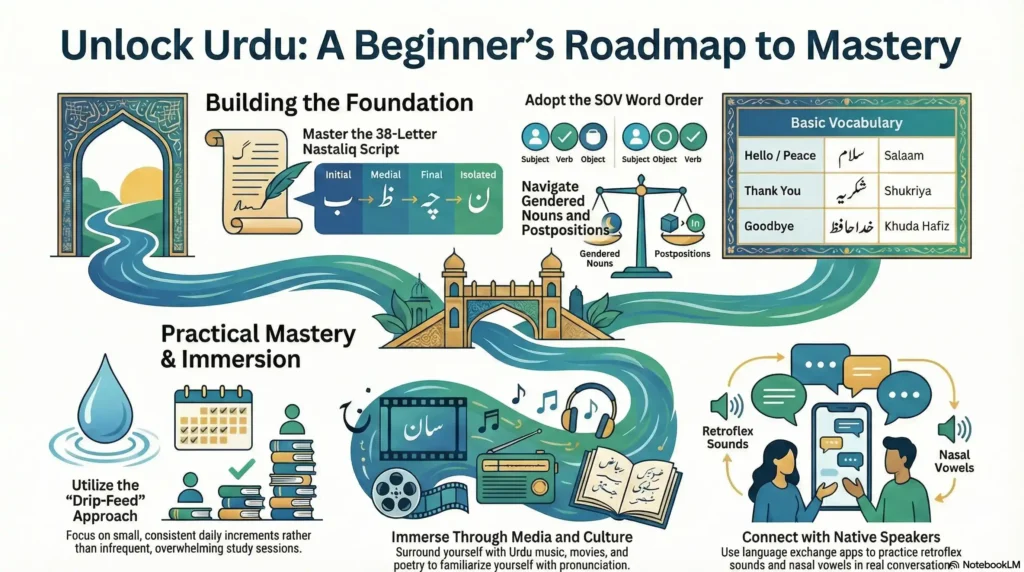
The Urdu script, called Nastaliq, is beautiful. But it’s genuinely difficult. It’s written right to left, letters change shape depending on their position in a word, and short vowels are usually omitted entirely. For beginners, it can feel like hitting a wall.
The spoken language, on the other hand, is surprisingly accessible, especially if you already know Hindi or have any exposure to South Asian languages. Urdu’s conversational vocabulary is largely shared with Hindi, and the sentence structure is logical once you pick up a few patterns. So if you skip the script entirely and focus on sounds and phrases, you can make real progress very fast.
I think what surprises people most is how quickly the spoken patterns start to feel natural. Perhaps because Urdu is genuinely musical it has a rhythm to it that your ear picks up before your brain does.
The Romanised Urdu Method Your Fastest Path to Conversation
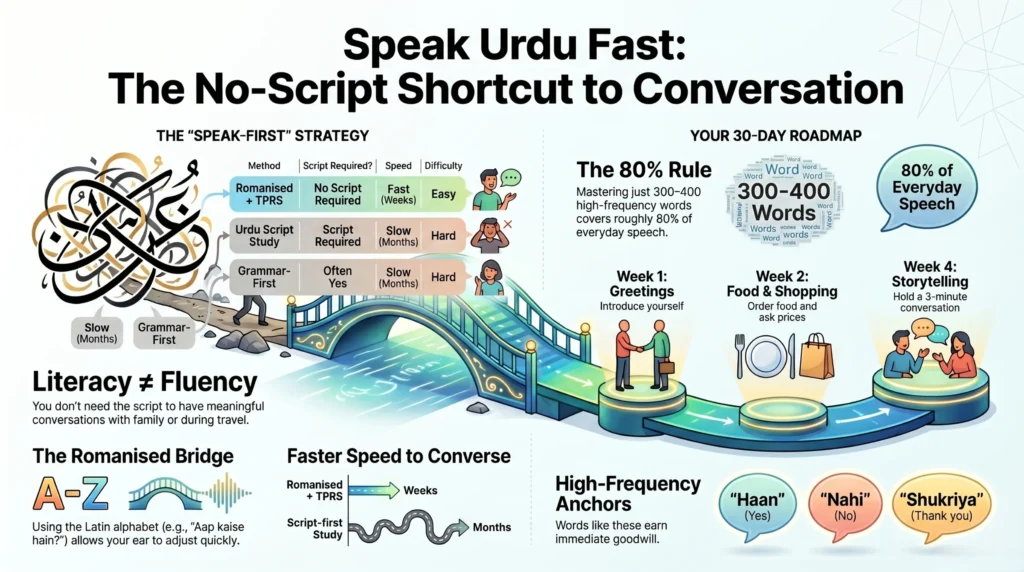
Romanised Urdu is simply Urdu written using the Latin alphabet. Instead of اردو, you write “Urdu.” Instead of آپ کیسے ہیں؟ you write “Aap kaise hain?” and you know exactly how to say it.
At DesiLingua, every lesson comes with three layers: the Urdu script, the Romanised transliteration, and the English meaning. You can lean entirely on the Romanised version while your ear adjusts to the sounds. Over time and this is the interesting part many learners naturally start recognising script patterns without ever formally studying them. It kind of happens on its own.
Romanised Urdu isn’t a shortcut, exactly. It’s more like a bridge. One that gets you speaking first, reading second if reading is even a goal.
High-Frequency Urdu Words You Should Learn First
Before anything else, anchor yourself with the most common Urdu words. These appear in almost every conversation:
| اردو | Romanised | English |
| ہاں | Haan | Yes |
| نہیں | Nahi | No |
| ٹھیک ہے | Theek hai | Okay / Alright |
| بہت | Bohot | Very / A lot |
| اچھا | Acha | Good |
| یہ | Yeh | This |
| وہ | Woh | That / He / She |
| کیا | Kya | What / (question marker) |
| کہاں | Kahan | Where |
| کب | Kab | When |
| کیوں | Kyun | Why |
| کیسے | Kaise | How |
| چاہیے | Chahiye | Need / Want |
| ہے | Hai | Is / Are (present) |
| میں | Main | I / me |
| آپ | Aap | You (formal) |
These words will appear in almost every exchange you have. Learn them first. Everything else builds on them.
Common Conversational Urdu Phrases Script, Romanised & English
Below are the phrases you’ll use constantly. We’ve formatted them in all three layers: Urdu, Romanised Urdu, and English, so you can read whichever version works for you right now.
| اردو | Romanised Urdu | English Meaning | Usage Context |
| آپ کیسے ہیں؟ | Aap kaise hain? | How are you? | Formal greeting |
| شکریہ | Shukriya | Thank you | Any situation |
| معاف کیجیے | Maaf kijiye | Excuse me / Sorry | Polite apology |
| میں سمجھا نہیں | Main samjha nahi | I didn’t understand | Clarification |
| کیا آپ انگریزی بولتے ہیں؟ | Kya aap Angrezi boltay hain? | Do you speak English? | Communication aid |
| میرا نام … ہے | Mera naam … hai | My name is … | Introduction |
| کتنے کا ہے؟ | Kitnay ka hai? | How much does it cost? | Shopping |
| مجھے مدد چاہیے | Mujhe madad chahiye | I need help | Emergency / travel |
A few of these are worth practising out loud immediately. “Aap kaise hain” and “Shukriya” alone will take you far in any social situation. Really. Don’t underestimate how much goodwill a simple “shukriya” earns you.
Method Comparison Which Approach Gets You Speaking Fastest?
Not all Urdu learning methods are created equal. Some are great for literary goals; others are better suited for conversational fluency. Here’s an honest breakdown:
| Method | Script Required? | Speed to Converse | Best For | Difficulty |
| Romanised Urdu | ❌ No | Fast (weeks) | Beginners | Easy |
| TPRS Method | ❌ No | Fast (weeks) | All levels | Easy–Med |
| Grammar-first | ✅ Often yes | Slow (months) | Academic | Hard |
| Urdu Script study | ✅ Yes | Slow (months) | Literacy goals | Hard |
| Audio immersion | ❌ No | Medium (1–3 mo) | Pronunciation | Easy |
| Language exchange | ❌ No | Medium | Fluency boost | Medium |
For most beginners aiming at conversational Urdu, the Romanised + TPRS combination is the clear winner. It removes the script barrier entirely and focuses on patterns that your brain actually absorbs through repetition not rote memorisation.
TPRS The Method Behind Faster Conversational Urdu
TPRS stands for Teaching Proficiency through Reading and Storytelling. It sounds academic but it’s actually the opposite of stuffy classroom learning. The idea is simple: instead of drilling grammar rules, you hear and repeat Urdu through short, compelling stories and repeated patterns.
Your brain is remarkably good at recognising patterns when they appear in context. “Mujhe… chahiye” (I need/want…) used across five different mini-stories feels completely natural to use because you’ve heard it work in five different situations. That’s TPRS.
The structure builds on itself almost invisibly. Same grammar pattern, new vocabulary. New vocabulary, same grammar pattern. It clicks without feeling like work. Well, mostly.
Your 30-Day Conversational Urdu Roadmap (No Script Required)
A plan helps. Not a rigid, punishing one, just a loose framework that keeps you moving forward even on low-motivation days. Here’s a realistic 30-day roadmap:
| Week | Focus Area | Daily Practice | Goal by End of Week |
| Week 1 | Greetings & Introductions | 15 min audio + 5 phrases | Introduce yourself in Urdu |
| Week 2 | Numbers, Food & Shopping | 20 min + role-play | Order food, ask prices |
| Week 3 | Directions & Daily Routines | 25 min + listening | Navigate basic conversations |
| Week 4 | Opinions & Storytelling | 30 min + speaking | Hold a 3-min conversation |
Missing a day won’t ruin anything. The goal isn’t perfection it’s momentum. Even 10 minutes of audio while commuting counts.
Common Mistakes Beginners Make And How to Avoid Them
A few things tend to slow people down. Worth mentioning, because some of these are surprisingly common:
• Trying to learn script before speaking this delays conversational confidence by months for most learners
• Memorising vocabulary lists in isolation words without context fade quickly; learn them in phrases
• Skipping pronunciation practice Urdu has sounds (like ڑ and خ) that don’t exist in English; ear training early prevents bad habits
• Perfectionism many learners hesitate to speak until they’re ‘ready.’ You’ll never feel ready. Start broken, fix later.
• Treating it like a school subject grammar tables and conjugation charts are rarely the fastest path to conversation
There’s a strange phase most learners hit around weeks 3–4 where you understand more than you can say. You recognise phrases, follow parts of conversations, but freeze when it’s your turn to speak. That’s not a setback. That’s actually a sign that your passive comprehension is ahead of your active production which is completely normal and usually means a speaking breakthrough is close.
How Long Does It Actually Take to Learn Conversational Urdu?
The U.S. Foreign Service Institute estimates Urdu takes around 1,100 hours to reach professional proficiency. That sounds daunting. But conversational Urdu, the ability to greet people, introduce yourself, navigate basic situations, and hold a simple exchange is reachable in 3 to 6 months of consistent practice.
We’ve seen learners reach basic conversational ability in as little as 6–8 weeks when they focus on Romanised Urdu and spoken patterns from the start. Not fluency. But genuine, usable conversation. Which, for most people, is exactly what they came for.
Should You Eventually Learn Urdu Script?
Maybe. It depends entirely on your goals.
If you want to read Urdu literature, newspapers, or classic poetry yes, absolutely, the script becomes important and deeply rewarding. If you want to text with Pakistani friends or family in WhatsApp honestly, most people write Urdu in Romanised form anyway, so you’ll be fine without it.
The healthiest approach, in my opinion, is to get speaking first. Once you have 2–3 months of spoken Urdu under your belt, the script becomes far less intimidating. You already know what the words sound like you’re just learning a new way to represent sounds you already know. That’s a much easier task than learning script and pronunciation simultaneously.
Frequently Asked Questions
Can I really become conversational in Urdu without learning the script?
Yes. Millions of Urdu speakers worldwide particularly in diaspora communities communicate fluently in spoken Urdu without ever reading or writing in Nastaliq. Romanised Urdu makes this fully achievable for learners too.
Is Urdu hard to learn for English speakers?
Urdu is rated as a Category IV language by the U.S. Foreign Service, meaning it’s more challenging than European languages for English speakers. But conversational Urdu using spoken patterns and Romanised transliteration is considerably more accessible than the script-first approach suggests.
What’s the difference between Urdu and Hindi in conversation?
Colloquial spoken Urdu and colloquial Hindi are largely mutually intelligible. The main differences emerge in formal registers, where Urdu borrows from Persian and Arabic while Hindi draws from Sanskrit. For everyday conversation, the distinction is much smaller than people expect.
How many words do I need to know to have a basic conversation in Urdu?
Research suggests that knowing the 500–1,000 most common words in any language covers roughly 75–80% of everyday speech. For Urdu, mastering 300–400 high-frequency words plus 50 core phrases is typically enough for basic conversational situations.
Final Thoughts, Start Speaking, Not Studying
The biggest barrier to learning conversational Urdu isn’t the language itself. It’s the assumption that you have to master the script before you’re allowed to speak. You don’t. The script can come later or not at all, depending on your goals.
Start with Romanised Urdu. Learn phrases in context. Use your ears as much as your eyes. Practice a little every day, even imperfectly.