If you’ve landed here, you’re probably somewhere between “I want to learn Urdu” and “I have no idea where to start.” That’s a completely fair place to be. Urdu isn’t exactly the most saturated language-learning market not like Spanish or French, where free lessons seem to find you whether you want them or not. Finding good, structured, realistic guidance for learning Urdu as an adult, at home, from scratch? That takes a bit more digging.
And honestly, that’s part of what makes this language worth pursuing.
Urdu is the national language of Pakistan and is widely understood across northern India. It’s spoken by somewhere around 230 million people globally native and second-language speakers combined. Beyond the numbers, though, Urdu carries a literary and poetic tradition that’s genuinely hard to match. The language of Ghalib, Faiz, and Iqbal. It has real weight to it.
But let’s not get too romantic about it. You’re here because you want to learn Urdu not just admire it. So the real question is: what actually works for adults learning Urdu at home, starting from zero and aiming for a solid intermediate level?
That’s exactly what this guide is here to answer. At DesiLingua, we’ve spent a lot of time thinking about how adult learners actually pick up Urdu what sticks, what wastes time, and what the self-study journey realistically looks like. This is our honest take on it.
Is Urdu Hard to Learn? Let’s Be Honest About It
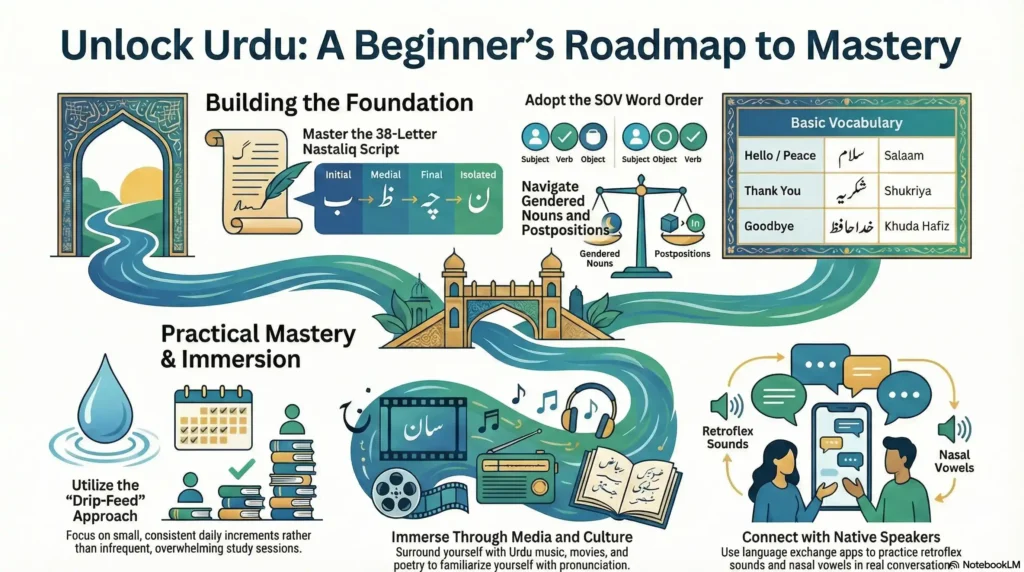
This comes up constantly, so let’s just address it upfront. Urdu has a reputation for being difficult and for English speakers, it does present a few genuine challenges. The script, for one. Urdu is written right-to-left in a calligraphic style called Nastaliq, which looks beautiful and reads nothing like anything most Western learners have encountered. Letters shift shape depending on their position in a word. Vowel markers are often dropped in everyday text, which means you have to infer pronunciation from context.
That said and this is something people don’t say enough spoken Urdu is actually quite learnable.
The grammar is logical and fairly regular. Sentence structure follows a subject-object-verb pattern, which takes some adjustment but stays consistent throughout. And if you happen to already have passive exposure to South Asian films or music, you may be closer to a foundation than you think.
For adults with no South Asian language background at all, the Foreign Service Institute (FSI) classifies Urdu as a Category III language, requiring roughly 1,100 class hours to reach professional working proficiency. That sounds intimidating. But that estimate is for diplomatic-level fluency. Conversational intermediate? You can get there in considerably less time especially with a focused, consistent self-study plan.
Step 1: Start With the Urdu Script (Nastaliq) | Don’t Skip It
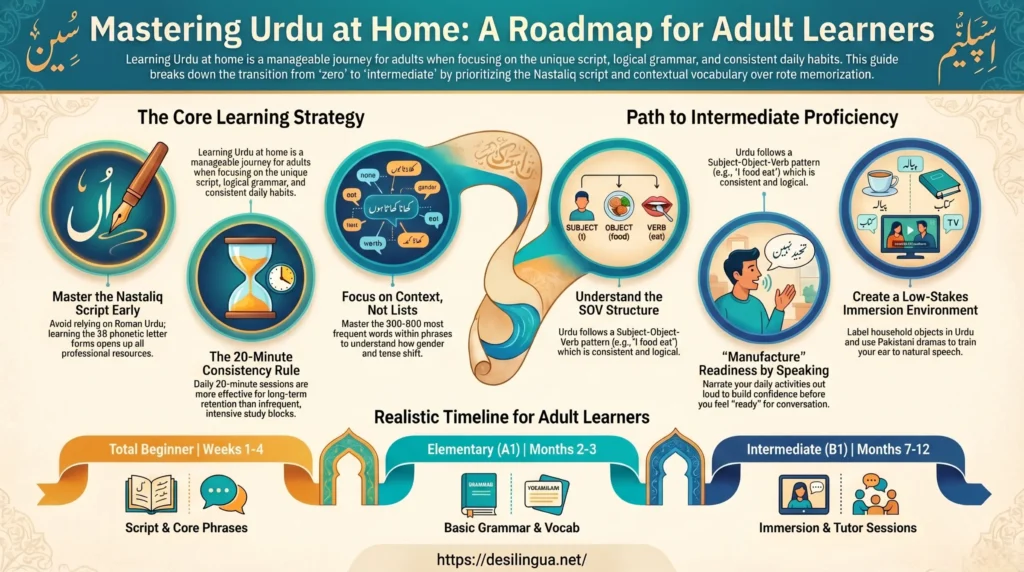
You can use Roman Urdu for a while. Romanised Urdu is widely used in casual texting and online communication, and plenty of beginner resources lean on it heavily. There’s nothing wrong with using it as a temporary crutch in the early weeks. But if you rely on it long-term, you’ll hit a ceiling. Real resources books, newspapers, subtitles, literature are all written in Nastaliq. Once you learn the script, a whole world of material opens up to you.
The good news is that the Urdu alphabet, while unfamiliar, is phonetic. Each letter has a consistent sound. Once you know the sounds, you can read anything you just might not understand it yet. That’s a reasonable starting point.
Spend two to four weeks just on the alphabet before moving on. Here’s what works well at the beginner stage:
- Structured script workbooks, A thin, focused workbook that walks you through letter forms with tracing exercises is worth far more than passive watching. Look for ones that group letters by shape similarity, not just alphabetical order.
- DesiLingua resources At DesiLingua, we’ve organised script learning around shape families, which dramatically reduces the overwhelm of encountering 38+ letter forms at once.
- YouTube video lessons Helpful for seeing how letters connect in real handwriting. Watch a few, then practice writing yourself.
Urdu Alphabet — Basic Letters with Romanised & Meaning
| Urdu (Nastaliq) | Romanised | Name in English | Sound (approximate) |
| ا | Alif | Alif | Like “a” in “art” |
| ب | Be | Ba | Like “b” in “ball” |
| پ | Pe | Pa | Like “p” in “pen” |
| ت | Te | Ta | Like “t” in “top” |
| ج | Jeem | Ja | Like “j” in “jam” |
| د | Daal | Da | Like “d” in “door” |
| ر | Re | Ra | Rolled “r” sound |
| س | Seen | Sa | Like “s” in “sun” |
| ک | Kaaf | Ka | Like “k” in “king” |
| م | Meem | Ma | Like “m” in “moon” |
Essential Beginner Urdu Phrases — Urdu | Romanised | English
| اردو (Urdu) | Romanised | English Meaning |
| السلام علیکم | As-salamu alaykum | Peace be upon you (Hello) |
| آپ کا نام کیا ہے؟ | Aap ka naam kya hai? | What is your name? |
| میرا نام ___ ہے۔ | Mera naam ___ hai. | My name is ___. |
| آپ کیسے ہیں؟ | Aap kaise hain? | How are you? (formal) |
| میں ٹھیک ہوں، شکریہ۔ | Main theek hoon, shukriya. | I am fine, thank you. |
| کیا آپ اردو بولتے ہیں؟ | Kya aap Urdu bolte hain? | Do you speak Urdu? |
| مجھے سمجھ نہیں آئی۔ | Mujhe samajh nahi aayi. | I didn’t understand. |
| براہ کرم آہستہ بولیں۔ | Baraah karam aahista bolain. | Please speak slowly. |
| خدا حافظ | Khuda Hafiz | Goodbye |
| پانی کہاں ہے؟ | Paani kahan hai? | Where is the water? |
Step 2: Build Vocabulary the Right Way | Not Just Word Lists
Words learned in isolation are fragile. Words learned in context inside a sentence, attached to a situation, paired with a sound those stick. This is especially true for Urdu, where word endings shift depending on gender, tense, and formality level. A word learned alone gives you half the picture at best.
So instead of raw word lists, think in phrases and sentences from the start.
Start with the 300-500 most common Urdu words. Not 3,000. Not even 1,000. Just the most frequent ones the words that show up in almost every conversation. Things like pronouns, common verbs, question words, numbers, and basic nouns. Master those first and you’ll be surprised how much you can already follow in slow, natural speech.
From there, expand by topic clusters family vocabulary, food, directions, daily routines, emotions. Learning words in themed groups means they reinforce each other.
Common Urdu Vocabulary by Topic — Urdu | Romanised | English
| Topic | اردو | Romanised | English |
| Family | ماں | Maa | Mother |
| Family | باپ / والد | Baap / Waalid | Father |
| Family | بھائی | Bhai | Brother |
| Family | بہن | Behan | Sister |
| Food | کھانا | Khaana | Food / To eat |
| Food | پانی | Paani | Water |
| Food | چائے | Chaay | Tea |
| Daily Life | گھر | Ghar | Home / House |
| Daily Life | کام | Kaam | Work |
| Daily Life | وقت | Waqt | Time |
| Emotions | خوشی | Khushi | Happiness |
| Emotions | غم | Gham | Sadness / Grief |
| Directions | دائیں | Daayen | Right |
| Directions | بائیں | Baayen | Left |
| Numbers | ایک، دو، تین | Aik, Do, Teen | One, Two, Three |
Step 3: Build a Daily Study Routine That Actually Fits Adult Life
Adults don’t have the luxury of immersive classroom hours. You have jobs, families, responsibilities and realistically, Urdu is somewhere on the list after all of those. That’s not a problem. It’s just the reality of adult learning, and it’s completely workable.
The key insight is this: consistency beats intensity every single time.
Twenty minutes a day, six days a week, will take you further than a three-hour session once a week. The brain consolidates language during rest. Short, frequent exposure creates the kind of repeated retrieval that actually builds long-term retention.
Recommended Daily Study Routine for Adult Urdu Learners
| Time of Day | Activity | Duration | Goal |
| Morning | Review flashcards (vocabulary) | 10 min | Reinforce previous words |
| Morning | Script practice / writing letters | 10 min | Build Nastaliq recognition |
| Afternoon | Listen to Urdu podcast or audio lesson | 15 min | Train your ear to natural speech |
| Evening | Watch Urdu drama (with subtitles) | 20-30 min | Passive immersion + cultural context |
| Evening | Write 2-3 sentences in Urdu (journal) | 10 min | Apply grammar + vocabulary actively |
| Weekly | Speaking session with a tutor or partner | 30-60 min | Real conversational practice |
You won’t hit this perfectly every day. That’s fine. Life happens. The goal isn’t perfection it’s keeping the habit alive in some form. Even five minutes of flashcard review on a chaotic day is better than nothing, because it keeps the habit intact.
Step 4: Choose the Right Resources | And Don’t Overwhelm Yourself
One of the most common mistakes adult learners make is collecting resources. Ten apps downloaded. Four textbooks bookmarked. A YouTube playlist with 200 videos. And then, somehow, none of it gets used consistently because there’s too much choice and not enough direction.
Pick one primary resource for each skill area. That’s it. One for script, one for vocabulary, one for listening, one for speaking. Rotate when you’ve genuinely exhausted what a resource has to offer not just when you get bored.
Urdu Learning Methods Compared — What Works Best for Adults
| Learning Method | Best For | Cost | Skill Focus | Beginner Friendly? |
| Language Apps | Daily habit, vocabulary, listening | Free – $$ | Vocab + Listening | Yes |
| Structured Textbooks | Grammar depth, reading comprehension | $ – $$ | Grammar + Reading | Yes |
| Online Tutors | Speaking confidence, feedback | $$ – $$$ | Speaking + Writing | Yes |
| Urdu Dramas / TV | Listening immersion, natural speech | Free | Listening + Culture | Intermediate+ |
| Podcasts / Audio | On-the-go learning, ear training | Free – $ | Listening + Pronunciation | Yes |
| Flashcard Systems | Vocabulary retention, spaced repetition | Free | Vocabulary | Yes |
| Urdu Poetry / Literature | Advanced reading, cultural depth | Free | Reading + Vocabulary | Advanced only |
| DesiLingua Courses | Structured adult learning, all levels | $$ | All 4 Skills | Yes |
Step 5: Urdu Grammar Basics | What You Actually Need to Know First
Grammar has a way of intimidating people before they’ve even started. You don’t need to master everything. You need to understand the core patterns that show up constantly, and let the rest fill in naturally over time.
The four things that matter most at beginner level:
- Sentence structure (SOV) — Urdu follows Subject-Object-Verb order. Where English says “I eat food,” Urdu says the equivalent of “I food eat.”
- Grammatical gender — Every noun in Urdu is either masculine or feminine. This affects verb endings and adjective agreement.
- The verb system — Urdu verbs change based on tense, gender, and formality. Focus on present, past, and future tenses first.
- Formal vs. informal register — Urdu has distinct levels of formality. Start with Aap (آپ) it’s always safe.
Urdu Pronouns — Urdu | Romanised | English
| Type | اردو | Romanised | English | Usage Note |
| 1st Person | میں | Main | I | Always the same |
| 1st Person | ہم | Hum | We | Also used as royal “we” |
| 2nd Person | تو | Tu | You (very intimate) | Used with very close friends or children |
| 2nd Person | تم | Tum | You (informal) | Friends, peers, younger people |
| 2nd Person | آپ | Aap | You (formal) | Always safe – use by default |
| 3rd Person | وہ | Woh | He / She / It / They | Gender-neutral in pronoun form |
| 3rd Person | یہ | Yeh | This / He / She (near) | Refers to someone/something nearby |
Basic Urdu Verb Conjugation — Present Tense (To Do / کرنا)
| اردو فعل | Romanised | English |
| میں کرتا / کرتی ہوں | Main karta / karti hoon | I do (m/f) |
| تم کرتے / کرتی ہو | Tum karte / karti ho | You do (informal, m/f) |
| آپ کرتے / کرتی ہیں | Aap karte / karti hain | You do (formal, m/f) |
| وہ کرتا / کرتی ہے | Woh karta / karti hai | He/She does (m/f) |
| ہم کرتے / کرتی ہیں | Hum karte / karti hain | We do (m/f) |
Step 6: Start Speaking Earlier Than You Think You Should
Most adult learners wait too long to speak. There’s a very understandable reason for this nobody wants to sound foolish, especially as an adult who’s used to being competent. But here’s the honest truth: that feeling of readiness almost never arrives on its own. You have to manufacture it by speaking before you’re comfortable.
Practical ways to practice speaking Urdu at home:
- Talk to yourself. Narrate what you’re doing in Urdu as you move through your day. Making chai? Say it out loud: “Main chaay bana raha/rahi hoon.”
- Record yourself. Read a sentence aloud, record it, play it back. Compare it to a native speaker’s version.
- Find a language exchange partner. Connect with native Urdu speakers who want to practice English. Low-stakes, genuinely useful.
- Book sessions with a DesiLingua tutor. Even once a week makes a significant difference. Our structured speaking sessions are built around real conversational scenarios not just drills.
Step 7: Immerse Yourself at Home | It’s More Possible Than You Think
Full immersion isn’t on the table for most adult learners. But partial immersion at home is genuinely achievable, and it compounds over time in ways that pure study sessions don’t.
- Label your environment. Stick small paper labels on objects around your home with their Urdu names in both Nastaliq and Romanised script.
- Switch your phone to Urdu. Even changing one or two apps forces passive engagement with the script throughout your day.
- Watch Urdu dramas strategically. Pakistani dramas on YouTube are a goldmine at intermediate level. Start with subtitles, then try without.
- Listen to Urdu music. Artists like Atif Aslam, Hadiqa Kiani, and Ali Zafar use clear, standard Urdu pronunciation. Learning through music you enjoy rarely feels like homework.
- Follow Urdu social media accounts. Even passive scrolling builds visual familiarity with the script and common vocabulary.
From Beginner to Intermediate: Your Realistic Urdu Learning Roadmap
| Stage | Approximate Timeline | What You Can Do | Focus Area |
| Total Beginner | Weeks 1-4 | Read basic script, say greetings, count to 100 | Script + Core Phrases |
| Elementary (A1) | Months 2-3 | Introduce yourself, ask simple questions, follow slow speech | Vocabulary + Basic Grammar |
| Pre-Intermediate (A2) | Months 4-6 | Hold short conversations, read simple texts, write basic sentences | Grammar Depth + Speaking |
| Intermediate (B1) | Months 7-12 | Discuss familiar topics, follow dramas with effort, write paragraphs | Immersion + Tutor Sessions |
| Upper Intermediate (B2) | Year 2+ | Express opinions, read news, follow native speech comfortably | Literature + Advanced Input |
Frequently Asked Questions About Learning Urdu at Home
How is Urdu different from Hindi, and does knowing one help with the other?
The spoken forms overlap significantly. Everyday conversational Urdu and Hindi are largely mutually intelligible. The differences become pronounced in the writing systems Urdu uses Nastaliq, Hindi uses Devanagari and in formal vocabulary, where Urdu draws heavily from Persian and Arabic while Hindi leans toward Sanskrit.
How many words do I need to know to hold a basic conversation in Urdu?
Research on language acquisition generally suggests that knowing around 300-500 high-frequency words is enough to handle basic conversational exchanges. Around 1,000-1,500 words gets you to a comfortable intermediate level. The key is that these words need to be active words you can use, not just recognise.
Is Urdu script really necessary or can I just use Romanised Urdu?
You can get by with Roman Urdu in casual digital communication. But for any serious engagement with the language reading books, newspapers, subtitles, or signs Nastaliq is essential. Learning the actual script removes ambiguity entirely and opens up far more resources in the long run.
How long does it take to learn Urdu to a conversational level?
For most adults studying consistently around 20 to 30 minutes daily basic conversational ability is achievable within three to six months. A solid intermediate level typically takes between one and two years, depending on prior language background, study intensity, and immersion built into daily life.
Final Thoughts | The Language Rewards the Patient
Learning Urdu as an adult at home is genuinely doable. It requires patience, a bit of structure, and the willingness to feel confused for longer than is comfortable. But the language has a way of opening up gradually and when it does, the rewards are real. Being able to read Urdu poetry in its original form, follow a conversation, or connect more deeply with a culture and its people those aren’t small things.
At DesiLingua, we believe the best way to learn Urdu is the one you’ll actually stick with. Start simple. Build the habit. Trust the process. The script that looks impossibly complex today will feel familiar sooner than you think.