Starting a conversation in Urdu… sounds simple at first. But when you actually try it, especially with a native speaker, there’s this brief hesitation. You’re not sure if you should go formal, casual, or somewhere in between. And that’s where most learners get stuck not because Urdu is difficult, but because conversation is… human.
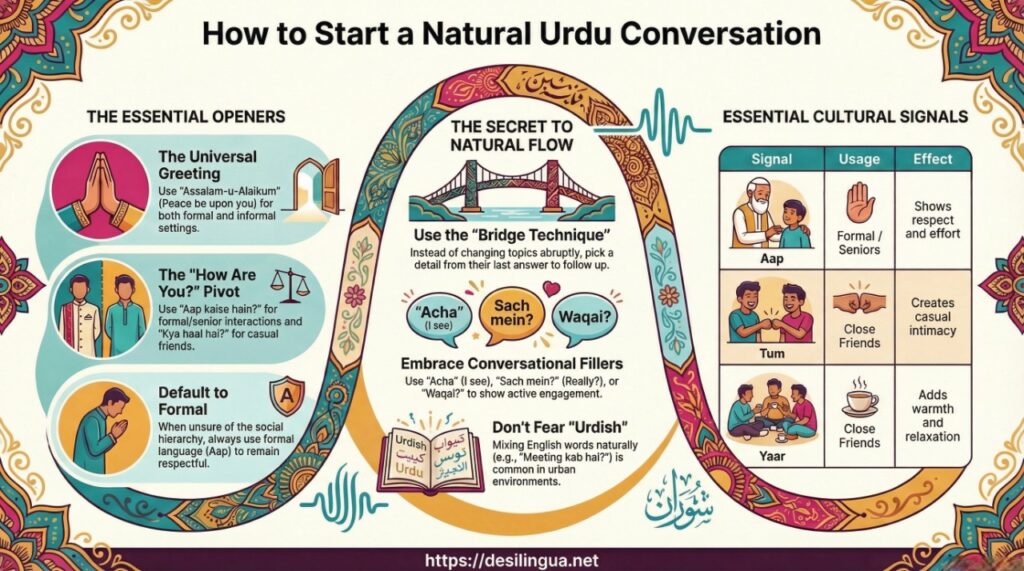
Naturally, the most common and culturally accepted way to begin is with “Assalam-u-Alaikum” (السلام علیکم) a greeting that carries respect, warmth, and social familiarity all at once. It works almost everywhere. Formal settings, casual meetups, even quick interactions with strangers.
But starting a conversation in Urdu naturally isn’t just about memorizing phrases. It’s about understanding tone, context, and social cues things that aren’t always written in textbooks.
In this guide, we’ll walk through:
- Natural Urdu conversation starters (not robotic ones)
- Context-based phrases (social, work, casual)
- Cultural nuances that actually matter
- And subtle mistakes learners often make (without realizing it)
Why “Natural” Urdu Conversation Matters More Than Vocabulary
There’s a common assumption learn more words, speak better. That’s… partially true.
But in Urdu, especially in Pakistani and South Asian contexts, how you say something often matters more than what you say.
For example:
You could say a grammatically correct sentence, but if your tone is too direct, it may come across as rude. On the other hand, even a broken sentence if polite will be received warmly.
That’s why phrases like:
- “Aap kaise hain?”
- “Kya haal hai?”
…aren’t just questions. They’re social bridges.
And maybe this sounds subtle, but once you notice it, you can’t unsee it.
Essential Urdu Greetings (Your First Conversation Entry Point)
Let’s start with what actually works in real life not just textbook examples.
Most Common Urdu Greetings
| Urdu Phrase | English Meaning | Usage Context |
|---|---|---|
| Assalam-u-Alaikum (السلام علیکم) | Peace be upon you | Universal (formal + informal) |
| Wa Alaikum Assalam | And peace be upon you | Response |
| Salaam (سلام) | Hi / Hello | Casual |
| Aadaab (آداب) | Respectful greeting | Traditional/formal |
| Subha Bakhair (صبح بخیر) | Good morning | Formal |
Now, here’s something people don’t always tell you:
Even though “Salaam” is shorter and easier, many people still prefer “Assalam-u-Alaikum” because it feels more complete, more respectful. It signals effort.
And in Urdu-speaking culture, effort is noticed.
The Natural Follow-Up: Asking “How Are You?”
This is where conversations either continue… or quietly end.
After greeting someone, it’s almost expected that you ask about their well-being.
Common Follow-Up Questions
| Phrase | Translation | Tone |
|---|---|---|
| Kya haal hai? (کیا حال ہے؟) | How are you? | Casual |
| Aap kaise hain? (آپ کیسے ہیں؟) | How are you? | Formal (male) |
| Aap kaisi hain? (آپ کیسی ہیں؟) | How are you? | Formal (female) |
| Sab theek hai? (سب ٹھیک ہے؟) | Is everything okay? | Neutral |
But here’s the nuance:
- Saying “Kya haal hai?” to a senior might feel slightly off
- Saying “Aap kaise hain?” to a close friend might feel… distant
So you’re constantly adjusting. And yes it can feel a bit mentally exhausting at first.
Context-Based Urdu Conversation Starters (This Is Where It Gets Real)
This is the part most blogs oversimplify. They give you generic phrases, but real conversations depend heavily on where you are and who you’re talking to.
Let’s break it down properly.
A. Social Situations (Events, Gatherings, Casual Meetups)
When you’re meeting someone new, you don’t jump straight into deep topics. Urdu conversations often start soft almost exploratory.
Useful Starters:
- “Aap aik doosray ko kaisay jaantay hain?”
→ How do you know each other? - “Kya aap bhi naye hain yahan?”
→ Are you also new here? - “Aap kahan se hain?”
→ Where are you from?
There’s a pattern here:
Questions are open-ended but not intrusive.
And maybe this is just observation, but Urdu conversations tend to avoid being overly direct at the start. There’s a kind of… easing into familiarity.
B. Work & Professional Settings
Professional Urdu leans more toward politeness + structure.
Conversation Starters:
- “Aap yahan kitni der se kaam kar rahay hain?”
→ How long have you been working here? - “Mera aaj pehla din hai.”
→ It’s my first day today - “Aap ka experience kaisa raha?”
→ How has your experience been?
Notice something:
There’s often a slight formality even when the environment is relaxed.
And honestly, if you’re unsure, default to formal. It’s safer.
C. Compliments (Fastest Way to Build Rapport)
This one works surprisingly well.
A small, genuine compliment can instantly shift the tone from neutral to warm.
Examples:
- “Yeh rang aap par jachta hai”
→ This color suits you - “Aap ki watch bohat achi hai”
→ Your watch is very nice
But and this matters tone matters more than words here.
If it feels forced, it doesn’t land the same way.
Cultural Layer: What Makes Urdu Conversations Feel “Natural”
You can memorize every phrase above and still sound… slightly off.
Why? Because Urdu isn’t just a language it’s tied closely to respect hierarchy and social behavior.
Key Cultural Signals
- Use “Aap” vs “Tum” carefully
- Aap = respectful
- Tum = casual
(Choosing wrong can subtly offend)
- Add warmth with “Yaar” (یار)
- Only with friends
- Makes tone relaxed
- Non-verbal cues matter
- Slight nod
- Hand on chest
- Soft smile
These aren’t optional they’re part of communication.
Mixing Urdu with English (What Actually Happens in Real Life)
Here’s something many learners find confusing:
People don’t always speak “pure” Urdu.
Especially in urban Pakistan, conversations often blend English naturally.
Examples:
- “Excuse me, cafeteria kahan hai?”
- “Match khelo gay?”
At first, this feels inconsistent. But it’s actually normal.
So if you mix languages slightly you’re not doing it wrong. You’re adapting.
How to Continue a Conversation in Urdu (Without Sounding Awkward)
There’s a moment in every conversation… a small pause.
If you don’t handle it well, things get quiet. A bit uncomfortable, even.
And in Urdu conversations, silence isn’t always neutral it can feel like disengagement.
So the goal isn’t just to speak. It’s to maintain conversational flow.
The “Bridge Technique” (How Native Speakers Keep Talking)
If you listen carefully to native Urdu speakers, they rarely jump randomly between topics. There’s usually a soft connection a “bridge.”
Example:
Person A: Aap kahan se hain?
Person B: Main Lahore se hoon
Person A: Lahore ka mausam kaisa hai aaj kal?
See what happened?
Instead of changing topics abruptly, the conversation flows from the previous answer.
How to Apply This Naturally
After someone answers, you can:
- Pick a detail from their response
- Ask a related follow-up
- Add a small personal reaction
Examples:
- “Oh acha, Lahore… wahan ka food bohat famous hai na?”
- “Acha, aap wahan kab se reh rahe hain?”
It’s simple, but surprisingly effective.
Conversation Fillers (The Small Things That Matter)
This might seem minor, but it’s actually critical.
Without fillers, your Urdu can sound… mechanical.
Common Urdu Fillers
| Phrase | Meaning | Use Case |
|---|---|---|
| Acha… (اچھا) | Oh / I see | Processing info |
| Hmmm… | Hmm | Thinking |
| Sach mein? (سچ میں؟) | Really? | Showing interest |
| Waqai? (واقعی؟) | Is that so? | Slight surprise |
| Phir? (پھر؟) | Then what? | Encouraging continuation |
Now, here’s something subtle:
Using too many fillers can sound unnatural…
But using none makes you sound robotic.
So there’s a balance and honestly, it comes with practice.
How to Transition Topics Smoothly in Urdu
At some point, you’ll need to shift topics. Abruptly doing it can feel awkward.
Native speakers often use soft transitions.
Natural Transition Phrases
- “Waisay…” (ویسے) → By the way
- “Acha, ek baat poochni thi…” → I wanted to ask something
- “Aur bataiye…” → So, tell me more
Example:
“Waisay, aap kya kaam kartay hain?”
(By the way, what do you do?)
It doesn’t feel forced. It feels… conversational.
Real-Life Urdu Conversation Example (Beginner to Natural)
Let’s compare something important.
❌ Beginner Style (Technically Correct, But Stiff)
- Assalam-u-Alaikum
- Aap kaise hain?
- Main theek hoon
- Aap kya karte hain?
Everything is correct… but it feels like an interview.
✅ Natural Style (How It Actually Happens)
- Assalam-u-Alaikum
- Walaikum Assalam, kya haal hai?
- Theek hoon… bas busy tha thora. Aap sunayein?
- Same yaar, kaam zyada chal raha hai aaj kal
Notice the difference?
- Slight pauses
- Casual additions (“bas…”, “thora…”)
- Shared feeling
It feels alive. Not scripted.
Situational Urdu Conversations (Practical Use Cases)
This is where things get practical. Because real conversations depend heavily on context.
A. Asking for Help / Directions
Politeness is key here. You don’t jump straight into the question.
Start like this:
- “Gustakhi maaf…” (گستاخی معاف) → Excuse me
- “Zara madad chahiye thi…” → I needed some help
Then ask:
- “Bus stop kidhar hai?”
- “Yeh jagah kahan par hai?”
B. Shopping Conversations
Shopping in Urdu-speaking regions is… interactive.
Common Starters:
- “Yeh kitnay ka hai?” → How much is this?
- “Thora kam ho sakta hai?” → Can you reduce the price?
And yes negotiation is expected in many places.
C. Casual Friend Conversations
This is where Urdu becomes more relaxed.
- “Kya scene hai?” → What’s the plan?
- “Kahan gayab thay?” → Where were you?
- “Chalo kahin chalte hain” → Let’s go somewhere
Tone becomes everything here.
Common Mistakes That Make You Sound Unnatural
Let’s be direct most learners make these.
1. Being Too Formal All the Time
Using “Aap” everywhere even with close friends creates distance.
2. Translating Directly from English
Urdu structure isn’t always the same.
Example:
- ❌ “Main jata hoon market”
- ✅ “Main market ja raha hoon”
3. Ignoring Tone
Same sentence, different tone → completely different meaning.
4. Overthinking Grammar
Ironically, this slows you down more than it helps.
Advanced Tip: Emotional Layer in Urdu Conversations
This is where fluency actually begins.
Urdu is expressive. People don’t just exchange information they share feelings.
Examples:
- “Yaar, thak gaya hoon aaj” → I’m tired today
- “Mazaa aa gaya” → That was enjoyable
These small emotional inserts make conversations feel human.
Without them, everything feels… flat.
| Aspect | Beginner Urdu | Natural Urdu |
|---|---|---|
| Flow | Question → Answer | Connected responses |
| Tone | Neutral | Expressive |
| Fillers | None | Used naturally |
| Structure | Rigid | Flexible |
Frequently Asked Questions
What is the best way to start a conversation in Urdu?
The most natural and widely accepted way is to begin with “Assalam-u-Alaikum” (السلام علیکم), followed by a polite inquiry like “Aap kaise hain?” (How are you?). This combination works in both formal and informal situations and reflects cultural respect.
How do you sound natural when speaking Urdu?
To sound natural in Urdu:
- Use conversational fillers like “acha,” “hmmm,” “waqai?”
- Adjust tone based on the relationship (formal vs casual)
- Avoid overly structured sentences
- Add small emotional expressions like “yaar,” “bas,” “acha…”
Natural Urdu is less about perfect grammar and more about flow and tone.
What are common Urdu conversation starters?
Some commonly used Urdu conversation starters include:
- “Kya haal hai?” (How are you?)
- “Aap kahan se hain?” (Where are you from?)
- “Aap kya karte hain?” (What do you do?)
- “Waisay…” (By the way…)
These help initiate conversations smoothly in different contexts.
Is Urdu formal or informal in daily conversation?
Urdu naturally shifts between formal and informal tones.
- Formal Urdu uses “Aap” and polite phrasing
- Informal Urdu uses “Tum” and relaxed expressions
Most real-life conversations mix both depending on the situation.
Can you mix English with Urdu in conversation?
Yes and it’s very common. In urban environments, people frequently use Urdu-English hybrid speech (often called “Hinglish” or “Urdish”), such as:
- “Excuse me, yeh kahan hai?”
- “Meeting kab hai?”
This is considered natural, not incorrect.