If you’ve been trying to learn Urdu online and let’s be honest, it’s not the easiest language to pick up you’ve probably faced that familiar question at some point: do I download another app or just book a real tutor? It’s a fair thing to wonder. The market is flooded with language apps making bold claims, and yet a lot of learners still feel stuck after months of swiping through lessons.
This article is specifically for people considering online Urdu tuition versus self-study apps. Not generic language learning advice actual, specific guidance for Urdu, which is unique for several reasons we’ll get into. And just to be upfront: DesiLingua doesn’t offer an app. We provide online Urdu tutoring sessions. So yes, we have a perspective here, but we’ll try to be fair about where apps genuinely help.
Why Urdu Is Not Just Another Language
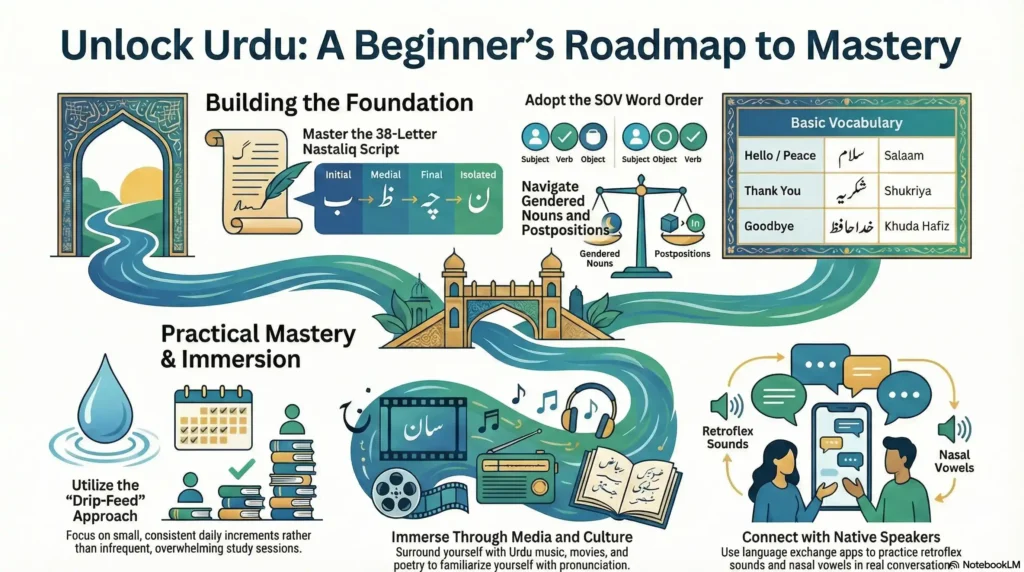
Most language apps were built with European languages in mind. Even the better ones. Urdu is different in ways that matter quite a lot when you’re learning it:
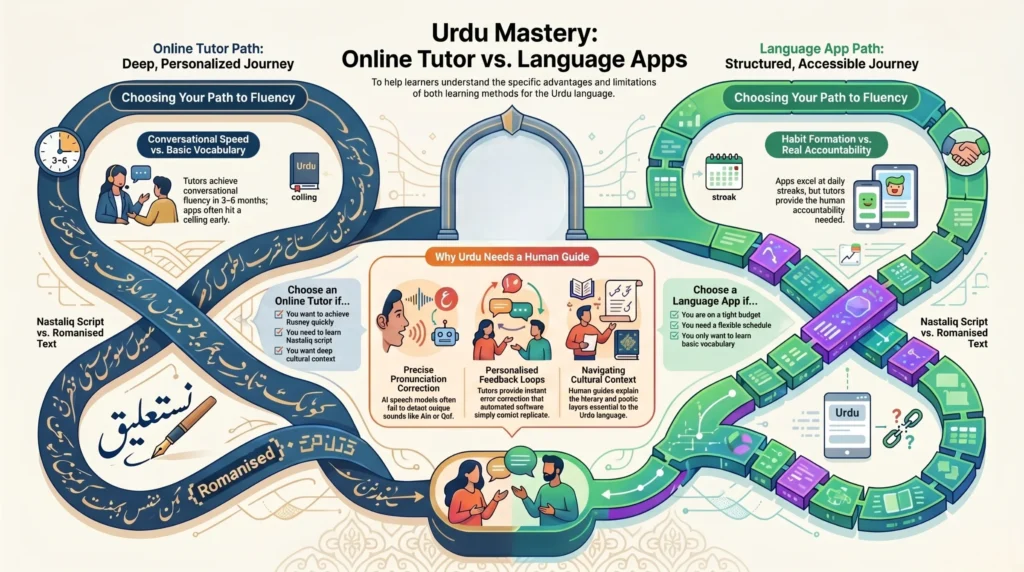
• نستعلیق رسم الخط (Nastaliq Rasam ul Khatt) Nastaliq script: Urdu is written right-to-left in a flowing calligraphic style. Apps often skip this entirely or offer a watered-down version.
• اعراب اور تلفظ (Aeraab aur Talaffuz) Diacritical marks and pronunciation: Sounds like ع (ain), غ (ghain), and ق (qaf) don’t exist in English. An automated speech recognizer often can’t reliably detect whether you’re saying them correctly.
• ثقافتی سیاق (Saqaafati Siyaaq) Cultural context: Urdu carries layers of literary, poetic, and cultural meaning. Without a human guide, a lot of that gets lost.
• رسمی اور غیر رسمی فرق (Rasmi aur Ghair Rasmi Farq) Formal vs informal registers: The gap between formal Urdu and everyday spoken Urdu is significant. Apps typically flatten this distinction.
Common Urdu Phrases You’ll Learn Urdu | Romanised | English
| Urdu | Romanised | English |
| آپ کا نام کیا ہے؟ | Aap ka naam kya hai? | What is your name? |
| مجھے اُردو سیکھنی ہے | Mujhe Urdu seekhni hai | I have to learn Urdu |
| آپ کیسے ہیں؟ | Aap kaise hain? | How are you? |
| شکریہ | Shukriya | Thank you |
| مجھے سمجھ نہیں آئی | Mujhe samajh nahi aayi | I didn’t understand |
| کیا آپ دوبارہ کہہ سکتے ہیں؟ | Kya aap dobara keh sakte hain? | Can you say that again? |
What Language Apps Actually Do Well
Look, apps aren’t useless. That would be an unfair thing to say, and honestly a bit dishonest. There’s a reason Duolingo has hundreds of millions of users. For some people, for specific goals, apps are genuinely useful.
Where apps tend to shine:
• الفاظ کی یادداشت (Alfaaz ki Yaaddasht) Vocabulary memorization: Spaced repetition in apps like Memrise works well for building word recognition over time.
• یومیہ مشق (Yaomiya Mashq) Daily habit formation: Duolingo’s streak system, whatever you think of it, does keep people coming back.
• کم خرچ (Kam Kharch) Low cost or free access: If budget is a real constraint, apps give you something rather than nothing.
• سفر سے پہلے بنیادی باتیں (Safar se pehle bunyadi baatein) Pre-travel basics: For picking up a few hundred words and simple phrases before a trip, apps are genuinely sufficient.
The issue isn’t that apps are bad. It’s that apps have a ceiling, and for Urdu specifically, that ceiling comes earlier than people expect.
Where Apps Fall Short for Urdu Learners
Apps struggle with Urdu in some very specific ways that don’t apply to, say, Spanish or French learners.
The Nastaliq script problem is significant. Duolingo’s Urdu course exists, but it’s among the less developed offerings on the platform the script teaching is minimal, and learners frequently report feeling confident with romanised Urdu but completely unable to read an actual Urdu newspaper or WhatsApp message from a Pakistani relative. That’s a pretty critical gap.
Then there’s the pronunciation issue. Apps use AI-based speech recognition, which works reasonably well for sounds that exist in English. But Urdu has several sounds ح (ha), خ (kha), ذ (zal) that English speech models aren’t trained to detect reliably. You could be mispronouncing something for weeks and the app will still give you a green tick.
And honestly… there’s no one to ask. When something confuses you in an app, you either Google it or you move on. With a tutor, you ask. You get an answer. The learning loop closes properly.
So… Which Actually Works Faster?
This is the real question, isn’t it. The one in the title. And I think the honest answer is: it depends what you mean by faster.
If faster means getting to conversational fluency being able to hold a real conversation about everyday topics, understand spoken Urdu at natural speed, read basic text then an online tutor is almost certainly faster. Most dedicated learners working with a qualified Urdu tutor achieve conversational ability within 3 to 6 months of consistent sessions. App-only learners often report that after a year or more of daily practice, they still can’t have a natural conversation.
If faster means getting started right now without any friction, opening an app in the next two minutes and learning five words then yes, apps win that one. Undeniably.
There’s also the question of what kind of learner you are. Some people are genuinely self-directed enough to make apps work over the long haul. Most people, if they’re being honest, need the accountability that comes with a real session and a real person expecting them to show up.
Why DesiLingua Focuses on Online Urdu Learning
We built DesiLingua around a simple observation: most people who want to seriously learn Urdu aren’t best served by an app. They need real conversation, real feedback, and someone who understands both the language and the learner.
We don’t have an app. That’s a deliberate choice. We provide one-on-one online Urdu sessions with qualified tutors people who can actually hear whether your ق sounds right, who can explain why a particular Urdu phrase carries a certain weight, who will notice if you’re consistently making the same grammatical error and address it directly.
• نستعلیق رسم الخط کی مکمل تعلیم (Nastaliq Rasam ul Khatt ki mukammal taleem) Full Nastaliq script instruction from day one
• ذاتی نصاب (Zaati Nisaab) Personalized curriculum based on your actual goals
• لچکدار اوقات (Lachakdar Awqaat) Flexible scheduling across time zones
• فوری اصلاح (Fauri Islah) Instant error correction in real time
Think of it this way: an app can show you what Urdu looks like. A tutor can teach you how Urdu actually works.

Can You Use Both? The Hybrid Approach
Yes and in fact, many of our students at DesiLingua do exactly this. They take weekly online tuition sessions for the core learning, and use a vocabulary app like Drops or Memrise between sessions just to keep new words fresh. That’s actually a pretty sensible approach.
The key is understanding the role each plays. The tutor is the learning. The app is the revision tool. Not the other way around.
Where people go wrong is treating the app as the primary learning method and expecting tutor-level results. It almost never works out that way, especially for a language as rich and structurally distinct as Urdu.
Frequently Asked Questions
How much does an online Urdu tutor cost?
Rates vary considerably. On platforms like italki, Urdu tutors typically charge between $5 and $40 per hour. Specialist tutors with strong qualifications may charge more. At DesiLingua, sessions are competitively priced with a focus on quality of instruction get in touch for current rates.
How long does it take to learn Nastaliq script?
With consistent practice and good tuition, most learners can read basic Nastaliq text within 4 to 8 weeks. Writing it fluently takes considerably longer. This is one area where a tutor genuinely makes a significant difference over self-study methods.
Is it possible to learn Urdu online?
Absolutely, and many people do it successfully. Online Urdu tuition has become highly effective with video calling tools that allow real-time interaction, screen sharing for script work, and flexible scheduling. DesiLingua is built entirely around online Urdu learning.
Final Thoughts
If your goal is to genuinely learn Urdu to speak it, read it, understand it then working with a qualified online Urdu tutor will almost certainly get you there faster than any app on the market. That’s not a controversial claim; it’s backed by how language acquisition actually works. Humans learn languages by using them with other humans.
Apps have their place. They’re convenient, cheap, and useful for keeping vocabulary fresh. But they’re not a substitute for real instruction, particularly for a language like Urdu with its distinct script, sound system, and cultural depth.
At DesiLingua, we’re focused entirely on online Urdu tuition no app, no gamified shortcuts, just real learning with real tutors. If that sounds like what you need, we’d love to hear from you.