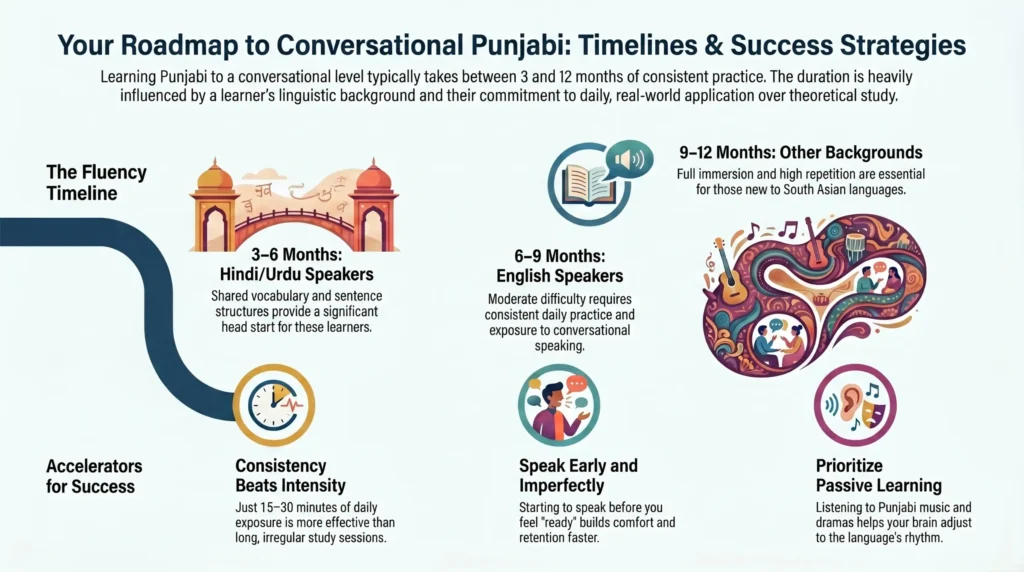
Learning Punjabi to a conversational level usually takes 3 to 12 months of consistent practice though, honestly, that range can stretch or shrink depending on how you learn. Some people pick it up faster than expected, others take a bit longer… and that’s fine.
If you already speak Hindi or Urdu, you’ll probably notice familiar phrases early on. For example:
- “کی حال اے؟ (ki haal ae?) — How are you?”
- “میں ٹھیک آں (main theek aan) — I’m fine”
Because of this overlap, many learners from similar language backgrounds reach conversational comfort in about 3–6 months.
For English-only speakers or those completely new to South Asian languages, it may take closer to 6–12 months to comfortably say things like:
- “میرا نام علی اے (mera naam Ali ae) — My name is Ali”
That said, time alone isn’t the deciding factor. You could study for hours one day and then skip a week… and somehow end up learning slower than someone doing just 20 minutes daily. It’s a bit frustrating, but consistency really does matter more.
What Does “Conversational Punjabi” Actually Mean?
It sounds straightforward, but when you think about it… it’s slightly unclear.
For most learners, conversational Punjabi means:
- Greeting someone naturally:
- “ست سری اکال (Sat Sri Akal) | Hello”
- “السلام علیکم (Assalam o Alaikum)”
- Asking simple questions:
- “تسی کتھوں او؟ (tusi kithon o?) | Where are you from?”
- Understanding everyday replies without translating everything in your head
- Holding short conversations, even if they’re not perfect
You’re not aiming for perfection here. Not really. Even a simple sentence like:
- “میں پنجابی سکھ ریا آں (main Punjabi sikh reha aan) — I am learning Punjabi”
is already a strong step forward.
Sometimes learners hesitate because they want to speak “correctly” first. But in reality, speaking imperfectly is what gets you there.
Punjabi Learning Timeline Based on Your Background
Here’s a clearer breakdown:
| Learner Type | Estimated Time to Conversational Level | Difficulty Level | What Helps Most |
| Hindi/Urdu Speakers | 3–6 months | Easy–Moderate | Shared vocabulary & sentence structure |
| English Speakers | 6–9 months | Moderate | Daily practice + speaking exposure |
| Other Language Speakers | 9–12 months | Moderate–Hard | Immersion and repetition |
At first glance, this table feels quite fixed. But in reality, people move between these ranges. Motivation, environment, and even mood can affect progress more than expected.
Key Factors That Affect How Fast You Learn Punjabi
1. Language Similarity (A Quiet Advantage)
If you already understand Urdu or Hindi, Punjabi doesn’t feel entirely new. Words like:
- “کوئی گل نئیں (koi gal nahi) — No problem”
- “چلو ٹھیک اے (chalo theek ae) — Alright then”
might already make sense to you.
But here’s something interesting understanding doesn’t always mean you can speak easily. Many learners recognize phrases but pause when trying to respond. It’s a small gap, but noticeable.
2. How You Learn (This Changes Everything)
Some learners start with grammar. Others just start speaking.
A balanced approach works best, but leaning slightly toward conversation helps you improve faster. You might feel unsure saying:
- “تسی کی کر رہے او؟ (tusi ki kar rahe o?) | What are you doing?”
at first. But after repeating it a few times, it becomes almost automatic.
Helpful methods include:
- Watching Punjabi dramas or movies
- Listening to Punjabi songs (even in the background)
- Practicing daily phrases
- Speaking with native speakers whenever possible
And maybe this is just observation but learners who speak early, even imperfectly, seem to progress quicker.
3. Consistency vs. Intensity
It’s tempting to think long study sessions are better.
But daily exposure even 15–30 minutes helps more in the long run. Words like:
- “پانی (paani) — water”
- “روٹی (roti) — bread”
start to stick naturally.
Skip a few days, though, and things feel slightly harder. Not impossible… just slower.
4. Real-Life Practice (Where It Starts Feeling Real)
At some point, learning shifts from studying to actually using the language.
Simple exchanges like:
- “تسی ٹھیک او؟ (tusi theek o?) — Are you okay?”
- “ہاں جی، میں ٹھیک آں (haan ji, main theek aan) — Yes, I’m fine”
begin to feel natural.
Without this step, learning can feel a bit theoretical like you know the words, but they don’t come out when needed.
Practical Strategies to Learn Punjabi Faster (Without Burning Out)
At some point, most learners stop asking “how long will it take?” and start wondering “what should I actually do every day?”
That shift matters. A lot.
Because knowing the timeline is helpful but knowing how to spend your 20–30 minutes daily is what really moves things forward.
1. Start Speaking Early (Even If It Feels Messy)
There’s a natural hesitation here. You might think, “I’ll speak once I know more words.”
But strangely, it works better the other way around.
Start with simple sentences like:
- “میں نواں سیکھ ریا آں (main navaan sikh reha aan) / I am learning new things”
- “مینوں پنجابی تھوڑی آندی اے (menu Punjabi thori aundi ae) / I know a little Punjabi”
You’ll probably pause mid-sentence. Maybe forget a word. That’s normal.
And honestly… those imperfect attempts tend to stick more than perfectly memorized phrases.
2. Build Vocabulary Around Your Daily Life
Instead of learning random word lists, focus on things you actually use.
For example:
- “گھر (ghar) — home”
- “کھانا (khana) — food”
- “دوست (dost) — friend”
Then form small sentences:
- “میں گھر جا ریا آں (main ghar ja reha aan) — I am going home”
It’s simple, maybe even repetitive but that repetition builds comfort. Slowly, almost quietly.
3. Use Passive Learning (It Helps More Than You Think)
Not every learning moment has to be active.
Listening to Punjabi songs or watching dramas even without full understanding helps your brain adjust to the rhythm of the language.
At first, it might sound like noise. Then, gradually, you start catching words:
- “پیار (pyaar) — love”
- “دل (dil) — heart”
It’s a subtle shift. Easy to overlook, but important.
4. Focus on Common Conversations First
You don’t need advanced grammar right away.
Focus on everyday interactions:
- “تسی کی کر رہے او؟ (tusi ki kar rahe o?) / What are you doing?”
- “میں کم کر ریا آں (main kaam kar reha aan) / I am working”
These patterns repeat often. Once they feel natural, expanding becomes easier.
Learning Punjabi with Desilingua
At Desilingua, we focus on making Punjabi learning feel natural not overwhelming or overly academic.
Instead of memorizing rules endlessly, we encourage learning through:
- Real-life conversations
- Romanised Transliteration
- Practical vocabulary
- Gradual immersion
For example, rather than starting with complex grammar, we might begin with something simple like:
- “تسی کدھر جا رہے او؟ (tusi kidhar ja rahe o?) — Where are you going?”
It’s useful immediately. And that immediate usefulness… keeps you motivated.
We also understand that learners move at different speeds. Some prefer structure, others prefer flexibility. So, the approach stays adaptable.
Common Mistakes That Slow Down Your Progress
Even with good intentions, learners sometimes get stuck.
A few common ones:
1. Waiting Too Long to Speak
You might feel unprepared but waiting doesn’t fix that. Speaking does.
2. Over-Focusing on Grammar
Grammar is important, yes. But focusing only on rules can slow down real communication.
3. Inconsistent Practice
Skipping days happens. But long gaps make it harder to retain words like:
- “کتاب (kitaab) — book”
- “بازار (bazaar) — market”
4. Fear of Making Mistakes
This one’s probably the biggest.
Saying something slightly wrong like mispronouncing “ٹھیک (theek)” is part of learning. Most native speakers understand anyway.
Final Thoughts: So, How Long Will You Take?
By now, the “3 to 12 months” answer probably feels… a bit incomplete. Not wrong, just not the full picture.
Because the real answer is: it depends on how you show up daily.
If you practice consistently—even casually—you’ll start noticing small wins:
- Understanding a sentence without translating
- Responding faster than before
- Recognizing phrases like:
- “میں سمجھ گیا آں (main samajh gaya aan) — I understood”
- “دوبارہ دسو (dobara daso) — say it again”
These moments don’t feel dramatic. But they add up.
And then, one day, you’re having a short conversation and realize… you didn’t think about every word. It just happened.