If you’re an Arabic speaker living in Oman and you’ve been putting off learning conversational English, you’re probably not alone. Maybe you studied English in school for years: grammar rules, textbook exercises, fill-in-the-blank, and yet somehow, when a colleague or tourist asks you something in English, the words just don’t come. That feeling is incredibly common. And honestly? It’s not your fault.
The problem isn’t that Arabic speakers can’t learn English. It’s that most traditional methods focus too heavily on written grammar and not enough on real, spoken conversation. This guide is different. We’re going to walk through a practical, step-by-step approach specifically built for Arabic speakers in Oman that helps you move from knowing English in theory to actually using it with confidence.
Whether you’re learning English for work, travel, or daily life in Muscat, Sohar, or Salalah, this roadmap will help you get there faster than you might think.
Why Conversational English is Different from “School English”
Here’s something most textbooks won’t tell you: the English people actually speak every day is very different from what’s written in grammar books. Native speakers contract words, drop syllables, use informal phrases, and talk fast. When you’ve only trained your ear on formal written English, real conversations can feel almost like a different language entirely.
For Arabic speakers, this gap is especially significant. Arabic itself has a clear distinction between Modern Standard Arabic (الفصحى / Al-Fusha) , the formal written form and the everyday dialects people actually speak. You already live in a world where there are two registers of your own language. Think of conversational English the same way: it’s the “dialect” you need to learn separately, alongside the standard form.
Common English Challenges for Arabic Speakers
| Challenge | Why It Happens | How to Fix It |
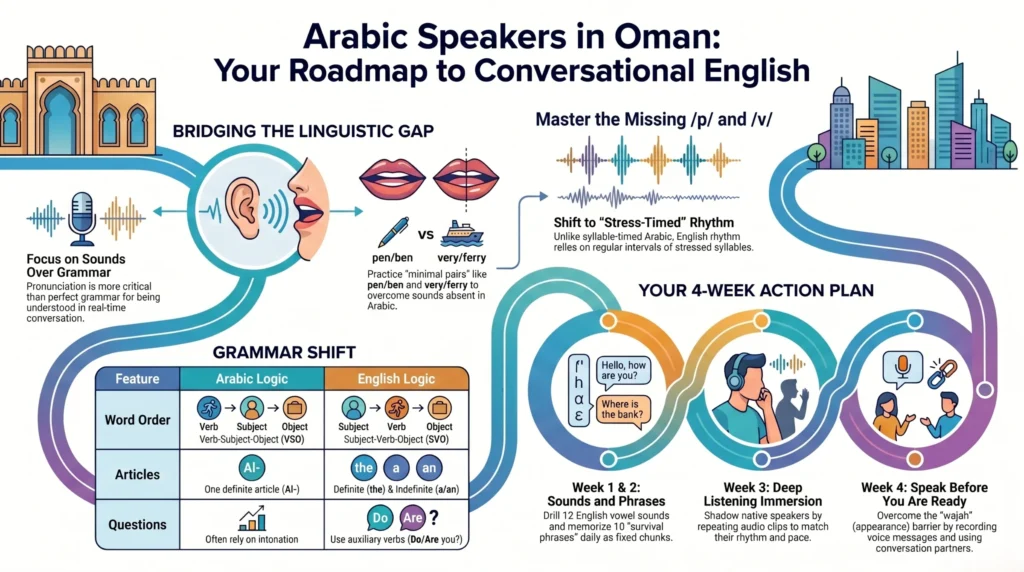
| No /p/ sound in Arabic | Arabic lacks the /p/ phoneme entirely | Practice minimal pairs: “pen/ben”, “pay/bay” daily |
| Vowel sounds confusion | Arabic has only 3 core vowels vs English’s ~12 | Use tongue position diagrams; listen & repeat |
| Definite article misuse | Arabic uses ال (al-) differently than ‘the’/’a’ | Memorize article rules through phrases, not rules |
| Verb placement order | Arabic is Verb-Subject-Object; English is SVO | Practice simple SVO sentences daily |
| Silent letters | No concept of silent letters in Arabic | Learn common silent-letter word lists |
| Consonant clusters | Arabic rarely clusters consonants | Practice words like “strength,” “splash” slowly |
Step 1: Set a Clear, Realistic Goal
Before you download any app or open any textbook, ask yourself one question: Why do I need English? This sounds obvious, but it genuinely shapes everything else.
Someone who needs English for customer service calls at an Omani hotel has very different needs from someone preparing for a job interview with a multinational company in Muscat. The vocabulary, the tone, the phrases they’re quite different. Setting a specific goal means you’re not wasting time learning things you’ll never actually use.
Some realistic starter goals:
• Hold a basic conversation in English without freezing
• Understand English-speaking colleagues or customers
• Watch English TV shows without subtitles
• Pass an English proficiency requirement for work or study
Pick one. Start there. You can always expand later.
Step 2: Build Your English Sound System First
This is the step most learners skip and it’s often the reason they plateau. Pronunciation matters more than grammar for conversation. A sentence with a grammatical error is still usually understood. A sentence mispronounced in key places? That’s where real communication breaks down.
Arabic and English share some consonant sounds but diverge significantly in vowels. English has roughly 12 distinct vowel sounds, while Arabic has essentially three (short and long). Training your ear and mouth to hear and produce these new sounds takes focused, daily practice even just 10 minutes.
Key Sounds Arabic Speakers Need to Master
| English Sound | Arabic Equivalent / Note | Example Words |
| /p/ as in “park” | No direct Arabic equivalent often confused with /b/ | park, play, speak, happy |
| /v/ as in “very” | Close to ف (fa) but softer often replaced with /f/ | very, voice, video, love |
| Short /æ/ as in “cat” | Doesn’t exist in Arabic often replaced with /e/ | cat, hat, bad, hand |
| Long /ɔː/ as in “thought” | No Arabic equivalent often confused with /o/ | thought, caught, law |
| /ə/ “schwa” in “about” | The most common English vowel entirely absent in Arabic | about, again, lesson |
| /th/ voiced “the” | Close to ذ (dhal) but lighter | this, that, brother, mother |
| /th/ unvoiced “think” | Close to ث (tha) in MSA | think, three, thank, bath |
Try spending just one week on each sound. Record yourself, compare it to a native speaker recording, adjust. It’s not glamorous work, but honestly it’s the kind of thing that makes the biggest difference.
Step 3: Learn Phrases, Not Just Words
Here’s a mindset shift that changes everything: stop trying to build sentences word-by-word from scratch. Native speakers don’t do that. They think in chunks of set phrases and expressions they’ve used hundreds of times. The goal is to build your own mental library of ready-made phrases.
Below are some of the most useful conversational English phrases, written in Arabic, romanised Arabic, and English so you can connect what you already know to what you’re learning.
Essential Conversational Phrases: Arabic → English
| Arabic (عربي) | Romanised Arabic | English Phrase |
| كيف حالك؟ | Kef halak? | How are you? |
| أنا بخير، شكراً | Ana bkhair, shukran | I’m fine, thank you |
| آسف على الإزعاج | Asif alal iz’aj | Sorry to bother you |
| هل يمكنك مساعدتي؟ | Hal yumkinak musa’adati? | Can you help me? |
| لم أفهم جيداً | Lam afham jayidan | I didn’t quite understand |
| هل يمكنك التكرار من فضلك؟ | Hal yumkinak al-tikrar min fadlak? | Could you repeat that, please? |
| ما معنى هذه الكلمة؟ | Ma ma’na hadhihi al-kalima? | What does this word mean? |
| أنا أتعلم الإنجليزية | Ana ata’allam al-Ingliziyya | I’m learning English |
| هل تتحدث ببطء من فضلك؟ | Hal tatahaddath bibut’ min fadlak? | Could you speak more slowly? |
| شكراً جزيلاً | Shukran jazilan | Thank you very much |
These phrases are your conversational survival kit. The moment you can say “Could you repeat that, please?” without thinking about it, you’ve unlocked a major conversation tool. You can ask for help, and that changes everything.
Step 4: Immerse Yourself in English Every Day (Even Without Leaving Oman)
You don’t need to move to England or America to surround yourself with English. What you do need is consistency. Daily exposure, even 20 to 30 minutes, builds fluency faster than one long weekly study session ever could.
Some practical ways to immerse yourself while living in Oman:
• Switch your phone language to English. It’s uncomfortable at first, but that discomfort is exactly what builds real retention.
• Watch English TV shows with Arabic subtitles first, then switch to English subtitles, then no subtitles at all. “Friends,” “The Crown,” and nature documentaries work well.
• Listen to English podcasts during your commute. Start with slow, clear speech (like BBC Learning English or VOA Learning English).
• Shadow native speakers: play a short audio clip and repeat it simultaneously, matching their rhythm, stress, and pace. It feels strange. Do it anyway.
• Find an online English conversation partner. Platforms like iTalki, Preply, or DesiLingua’s own online sessions connect you with native or fluent speakers.
Step 5: Speak Before You Feel Ready
This is probably the hardest step. Most Arabic speakers learning English wait until they feel “ready” to speak. But here’s the uncomfortable truth: that feeling of readiness almost never comes on its own. Speaking is how you get ready to speak.
There’s a real psychological barrier here. Arabic speakers often feel a strong sense of “wajah” (وجه) concern for how they appear to others. Making errors in a second language can feel deeply embarrassing. But native English speakers? They’re usually impressed that you’re trying at all. Most are patient. Most will wait.
A few tactics that help:
• Talk to yourself in English while driving or cooking. Out loud. Even if it feels ridiculous.
• Use voice messages in WhatsApp in English with willing friends.
• Join an online English speaking club. There are free ones on Discord and Meetup.
• Give yourself permission to make mistakes. Errors are evidence of learning, not failure.
Step 6: Focus on Listening, Seriously
People underestimate listening. They think speaking is the main skill and listening is just… what happens in between. But fluency is actually built on listening. The more accurate your internal model of English sounds and rhythms, the more naturally your speaking improves.
Arabic and English have very different rhythms. Arabic is largely syllable-timed (each syllable gets roughly equal time), while English is stress-timed meaning stressed syllables occur at regular intervals and unstressed ones are compressed. This is why fast English can sound like a blur to Arabic speakers. You’re trying to parse equally-weighted syllables, but they’re not equal at all.
Training for this: listen to the same short audio clip (1–2 minutes) repeatedly, over several days. The first time, you’ll catch maybe 40%. By day five, it’ll be 90%. That’s your ear recalibrating. It works.
A Sample 4-Week Conversational English Study Plan for Omani Learners
| Week | Focus Area | Daily Activity (20–30 min) | Key Outcome |
| Week 1 | Sounds & Pronunciation | Minimal pair drills; record & compare /p/, /v/, vowels | Train ear to hear new English sounds |
| Week 2 | Core Phrases & Vocabulary | Memorize 10 phrases/day; use them in self-talk | Build a 70-phrase conversational survival kit |
| Week 3 | Listening Immersion | Repeat same 2-min clip daily; shadow native speakers | Internalize English rhythm and stress patterns |
| Week 4 | Real Speaking Practice | 30-min tutor session 3x/week + daily voice messages | Hold a basic real-time conversation in English |
Step 7: Learn English Grammar But Don’t Obsess Over It
Grammar matters. I’m not going to pretend it doesn’t. But the kind of grammar that matters for conversation is much simpler than what most courses teach. You need functional grammar enough to be understood and to understand, not enough to pass a linguistics exam.
The most important grammar areas for Arabic speakers learning conversational English:
• Articles (a, an, the): Arabic doesn’t have “a/an,” and uses ال (al-) differently. This trips up almost every Arabic learner. Learn through exposure and practice, not rules.
• Verb tenses: Focus on present simple, present continuous, and past simple first. These three cover the vast majority of everyday conversations.
• Subject-Verb-Object order: Arabic is often VSO (verb first). English is almost always SVO. Training this word order matters.
• Question formation: Arabic questions often rely on intonation alone; English uses auxiliary verbs (“Do you…?” “Are you…?”). Practice these as fixed chunks.
Arabic vs. English Grammar: Key Differences at a Glance
| Grammar Feature | Arabic (عربي) | English |
| Word order | VSO (verb-subject-object) or SVO | Strictly SVO |
| Definite article | ال (al-) one form for all nouns | “the” (definite), “a/an” (indefinite) |
| Indefinite article | None marked by context/nunation (tanwin) | “a” before consonants, “an” before vowels |
| Verb conjugation | Highly complex; encodes gender, number, mood | Simpler; mainly 3rd person -s in present simple |
| Plural forms | Many irregular patterns (broken plurals) | Mostly regular (-s/-es); some irregular |
| Dual form | Distinct grammatical form for exactly two | No dual form; use “two” + plural noun |
| Gender in nouns | All nouns are masculine or feminine | No grammatical gender in nouns |
| Question formation | Often intonation alone, or hal/a particle | Auxiliary verb inversion: “Do you…?” |
Where Can Omani Learners Practice English Online?
One thing I’ve noticed is that Omani learners often struggle to find the right platform not because options don’t exist, but because so many platforms aren’t built with Arabic speakers in mind. You might find a great speaking app, but the tutor has no idea why /p/ is hard for you, or why you default to VSO word order. Context matters.
DesiLingua’s online English learning platform is specifically designed for South Asian and Middle Eastern learners, with tutors who understand your linguistic background. Sessions are conversation-focused, flexible in scheduling, and structured around your actual goals, not a generic curriculum.
Frequently Asked Questions (FAQ)
How long does it take an Arabic speaker in Oman to become conversational in English?
It depends significantly on your current level and how consistently you practice. Most learners who study 30 minutes a day with a focus on speaking and listening, not just grammar, reach basic conversational fluency in 3 to 6 months. Comfortable, natural conversation typically takes 12–18 months of consistent effort.
Is English widely spoken in Oman?
Yes, more than many people expect. English is used widely in business, tourism, healthcare, and education across Oman. In Muscat especially, English is essentially a working language in many professional environments. Learning it isn’t just an academic exercise it has direct, practical value.
Should I learn British English or American English?
For Omani learners, British English is slightly more common. Oman’s educational and historical connections to the UK make British spelling and pronunciation more familiar. But honestly, for conversational English, it matters very little. Focus on whichever accent you find most natural to hear, and consistency will follow.
What’s the biggest mistake Arabic speakers make when learning English?
Waiting too long to speak. Grammar study has its place, but the single biggest mistake is spending months reading and studying without having real conversations. Speaking early even badly accelerates everything else.
Final Thoughts
Learning conversational English as an Arabic speaker in Oman is genuinely achievable. It takes consistency, the right approach, and perhaps most importantly the willingness to sound imperfect while you practice. That vulnerability is where language learning actually happens.
Start with your sounds. Build your phrase library. Immerse yourself daily. Speak before you feel ready. And find a learning platform that understands where you’re coming from. The path is there. You just have to start walking it.If you’re ready to take the next step, DesiLingua’s online English courses are a great place to begin, designed for learners like you, with tutors who understand the journey from Arabic to English.