If you’ve ever started a sentence in English and halfway through lost track of the verb, or said “brice” instead of “price,” trust me you’re not alone. Arabic and English are, structurally speaking, about as different as two languages can get. Different alphabets, different reading directions, different grammar rules, even different sounds. That’s a lot to navigate.
The good news? Most mistakes Arabic speakers make in English are predictable which means they’re also fixable. Once you understand why you’re making an error, correcting it becomes much more straightforward. This guide walks you through the most common mistakes, gives you real-world examples (with Arabic pronunciation guides), and offers practical strategies to help you speak English confidently.
Whether you’re learning for work, travel, academic study, or simply everyday life, the patterns here will feel familiar. And perhaps more importantly you’ll see that fluency isn’t about being perfect. It’s about being understood.
Mistake #1: Dropping or Overusing Articles (a, an, the)
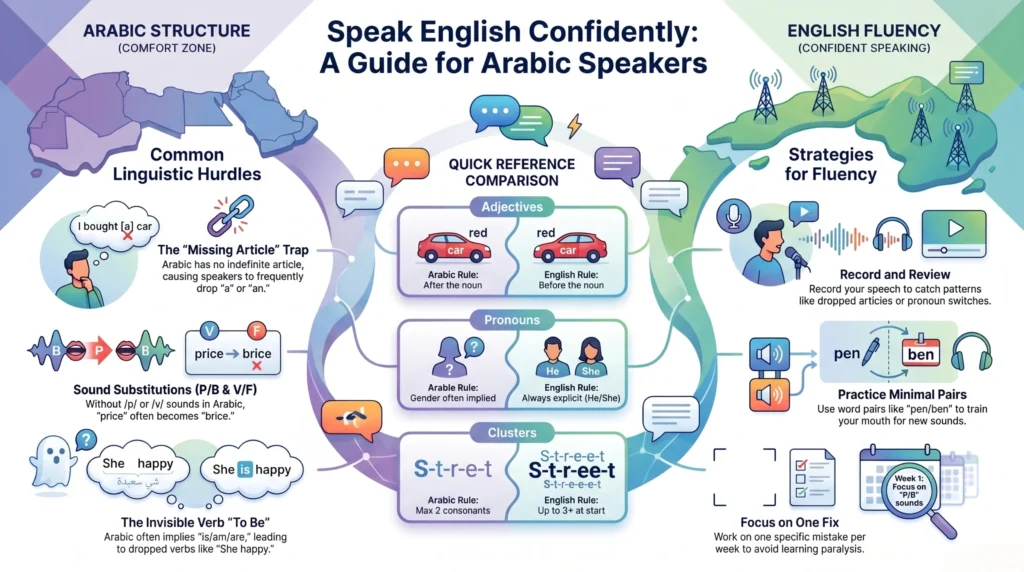
This might be the single most common issue and it’s completely understandable why. Arabic has the definite article “al-“ (ال), but has no indefinite article. Nothing equivalent to “a” or “an.” So when an Arabic speaker first learns English, the brain simply doesn’t register that these tiny words need to be there.
You end up with sentences like: “I need doctor.” Or the opposite problem: “She works in the engineering.” where “the” gets added where it doesn’t belong.
Article Mistakes: Common Errors vs. Correct English
| ❌ Common Mistake | ✅ Correct Form | Rule / Tip |
| I need doctor | I need a doctor | Use ‘a/an’ before singular countable nouns |
| She works in the engineering | She works in engineering | No ‘the’ before fields/subjects |
| The life is beautiful | Life is beautiful | No article for general uncountable nouns |
| I bought car | I bought a car | Always use ‘a’ before singular countable nouns |
| He is the engineer | He is an engineer (job, not specific) | Use ‘an’ for jobs unless referring to a specific person |
Quick tip: Before finishing a sentence, pause for just a second and ask yourself “Does this noun need an article?” With time, this becomes automatic.
Practice Phrases Articles in Context
| English | Pronunciation (Arabic) | Arabic Meaning |
| I want to learn driving | آي وانت تو ليرن درايفنج | أريد تعلم القيادة |
| This is my first lesson | ذِس إز ماي فرست لِسن | هذه أول حصة لي |
| Please explain again | بليز إكسبلين أجين | من فضلك اشرح مرة أخرى |
| I need a pen | آي نييد أ بِن | أحتاج إلى قلم |
| Can I have the menu? | كان آي هاف ذا مِنيو؟ | هل يمكنني الحصول على القائمة؟ |
Mistake #2: Mixing Up P/B and V/F Sounds
This one can lead to some genuinely awkward moments. Arabic doesn’t have the /p/ or /v/ sounds at all. The closest equivalents are /b/ and /f/ so that’s what the brain reaches for automatically.
The result? “Paper” becomes “baber.” “Price” becomes “brice.” “Very” becomes “fery.” And “van” sounds like “fan.” These substitutions happen fast and often unconsciously even among speakers with strong written English.
Pronunciation Substitution Mistakes
| ❌ Common Mistake | ✅ Correct Form | �� Rule / Tip |
| I need to brint the document | I need to print the document | /p/ is voiceless no throat vibration |
| The brice is too high | The price is too high | Feel the puff of air for /p/ |
| It’s fery important | It’s very important | /v/ is voiced lips and teeth together |
| Please give me a ben | Please give me a pen | Practise: ‘pen, pin, pan, pot’ |
| I want to go by fan | I want to go by van | /v/ vibrates, /f/ does not |
A simple exercise: place your hand on your throat. Say “bee” you feel vibration. Now say “pee” with no vibration. That’s the difference. Voiceless vs. voiced. Same for V and F.
Pronunciation Practice P, B, V, F Sounds
| English | Pronunciation (Arabic) | Arabic Meaning |
| Please pass the paper | بليز باس ذا بيبر | من فضلك مرّر الورقة |
| The price is very fair | ذا برايس إز فيري فير | السعر عادل جداً |
| I love vegetables | آي لاف فيجيتابلز | أنا أحب الخضروات |
| Put it in the van | بوت إت إن ذا فان | ضعه في الشاحنة |
| Pay for the visa | بيي فور ذا فيزا | ادفع ثمن التأشيرة |
Mistake #3: Omitting the Verb ‘To Be’
In Arabic, the verb “to be” (is, am, are) is often implied in the present tense. You don’t always need to say it. So Arabic speakers frequently carry that habit into English and drop it entirely.
“I going home now.” “She happy today.” “He very tall.” These sound natural internally, because in Arabic they essentially are correct. But in English, that missing verb stands out immediately.
Verb ‘To Be’ Missing vs. Correct
| ❌ Common Mistake | ✅ Correct Form | �� Rule / Tip |
| I going to school | I am going to school | Always include ‘am/is/are’ in present continuous |
| She very happy | She is very happy | ‘Is’ cannot be omitted in English |
| He tall man | He is a tall man | Need both ‘to be’ AND an article here |
| They ready | They are ready | ‘Are’ is required before adjectives |
| It difficult to learn | It is difficult to learn | Never drop ‘it is’ at sentence start |
Practice Phrases Verb ‘To Be’
| English | Pronunciation (Arabic) | Arabic Meaning |
| She is my English teacher | شي إز ماي إنجليش تيشر | هي معلمة الإنجليزية عندي |
| I am ready to speak | آي أم ريدي تو سبيك | أنا مستعد للتحدث |
| They are learning fast | ذيي آر ليرنينج فاست | هم يتعلمون بسرعة |
| It is not easy | إت إز نوت إيزي | إنه ليس سهلاً |
| We are from Egypt | وي آر فروم إيجيبت | نحن من مصر |
Mistake #4: Confusing He/She and His/Her
Arabic gendering works differently. The language marks gender extensively in verbs, adjectives, and nouns but the third-person pronoun isn’t always as distinctly separated as he/she in English. Many Arabic speakers mix these up when speaking quickly.
So you get: “My friend, she came yesterday… he is very kind.” Both pronouns in the same sentence referring to the same person. It doesn’t seem like a big deal until the listener gets confused about who you’re talking about.
Pronoun Gender Confusion
| ❌ Common Mistake | ✅ Correct Form | �� Rule / Tip |
| My brother, she called me | My brother called me | He = male, She = female always |
| She left his bag | She left her bag | Possessive must match the subject’s gender |
| He is my sister | She is my sister | Sister is always female → ‘she’ |
| My mother, he is a doctor | My mother, she is a doctor | Mentally lock pronoun before starting sentence |
| I spoke to him. She was nice. | I spoke to her. She was nice. | Keep pronoun consistent throughout |
Practice Phrases Pronouns
| English | Pronunciation (Arabic) | Arabic Meaning |
| He is my brother | هي إز ماي براذر | هو أخي |
| She left her keys at home | شي ليفت هر كيز آت هوم | تركت مفاتيحها في المنزل |
| His name is Ahmed | هيز نيم إز أحمد | اسمه أحمد |
| Her lesson starts at 9 | هر لِسن ستارتس آت ناين | درسها يبدأ في التاسعة |
| They finished their homework | ذيي فينيشت ذير هومورك | أنهوا واجبهم المنزلي |
Mistake #5: Tense Confusion Simple Past vs. Present Perfect
The present perfect tense (“I have seen,” “she has done”) is one of the trickier areas. Arabic doesn’t have a directly equivalent structure, so learners either avoid it completely or use the simple past in every situation.
This causes sentences like: “I already ate” when you mean “I’ve already eaten.” Or “Did you ever go to London?” instead of “Have you ever been to London?” The meaning comes through but the tense tells a different story about when something happened.
Tense Mistakes Simple Past vs. Present Perfect
| ❌ Common Mistake | ✅ Correct Form | �� Rule / Tip |
| I already ate | I have already eaten | Present perfect for actions with ‘already’ |
| Did you ever try sushi? | Have you ever tried sushi? | Use ‘have you ever’ for life experience |
| I lived here for 3 years | I have lived here for 3 years (if still living) | Present perfect for ongoing situations |
| She finished just now | She has just finished | ‘Just’ pairs with present perfect |
| We never went to Paris | We have never been to Paris | ‘Never’ for life experience → present perfect |
Practice Phrases Tenses
| English | Pronunciation (Arabic) | Arabic Meaning |
| I have studied English for two years | آي هاف ستادييد إنجليش فور تو ييرز | لقد درست الإنجليزية لمدة سنتين |
| Have you ever visited London? | هاف يو إفر فيزيتد لاندن؟ | هل سبق لك أن زرت لندن؟ |
| She has just arrived | شي هاز جاست أرايفد | وصلت للتو |
| We went to Dubai last year | وي ونت تو دبي لاست ييير | ذهبنا إلى دبي العام الماضي |
| I finished the book yesterday | آي فينيشت ذا بوك يستيرديي | أنهيت الكتاب أمس |
Mistake #6: Word Order Adjectives Before Nouns
In Arabic, the adjective follows the noun. You’d say “car red” (سيارة حمراء). In English, it’s the opposite adjectives come before nouns. “Red car.”
This sounds like a simple rule, but under pressure — when you’re speaking fast, nervous, or reaching for vocabulary — the Arabic instinct kicks in. You’ll say “the book interesting” instead of “the interesting book.”
Word Order — Adjective Placement
| ❌ Common Mistake | ✅ Correct Form | Rule / Tip |
| I have pen red | I have a red pen | Adjective BEFORE noun in English |
| She is teacher good | She is a good teacher | Good teacher, not teacher good |
| Give me water cold | Give me cold water | Cold water, not water cold |
| I saw movie interesting | I saw an interesting movie | Interesting + noun, always |
| He is man tall | He is a tall man | Tall man — adjective first |
Mistake #7: Inserting Extra Vowels in Consonant Clusters
English loves consonant clusters groups of consonants right next to each other with no vowel between them. Words like “stress,” “split,” “street,” “spring” have three consonants in a row at the start.
Arabic doesn’t work like that. Clusters in Arabic are generally limited to two consonants, and rarely at the very beginning of a word. So Arabic speakers instinctively add a small vowel sound to break up the cluster. “Sipring” for “spring.” “Istreet” for “street.” It’s a natural phonological response but one that can make speech harder to follow.
Practice Phrases Difficult Consonant Clusters
| English | Pronunciation (Arabic) | Arabic Meaning |
| The street is straight | ذا ستريت إز ستريت | الشارع مستقيم |
| Spring is my favourite season | سبرينج إز ماي فيفريت سيزن | الربيع موسمي المفضل |
| Please speak slowly | بليز سبيك سلولي | من فضلك تكلم ببطء |
| The screen is broken | ذا سكرين إز بروكن | الشاشة مكسورة |
| She can drive straight | شي كان درايف ستريت | هي تستطيع القيادة مباشرة |
Quick Comparison: Arabic vs. English Grammar Rules
Understanding the structural differences between Arabic and English is the first step toward fixing recurring errors.
| Feature | Arabic Rule | English Rule |
| Indefinite Article | None doesn’t exist | a / an before singular countable nouns |
| Definite Article | al- (ال) attached to noun | the separate word, many rules |
| Adjective Position | After the noun (car red) | Before the noun (red car) |
| Verb ‘To Be’ (present) | Often omitted in present tense | Required: I am, she is, they are |
| P / V Sounds | Don’t exist replaced by B / F | Distinct sounds must be learned |
| Consonant Clusters | Max 2 consonants, rarely at start | Up to 3+ at start of word |
| He / She Pronoun | Gender complex, sometimes implied | Always explicit: he (male), she (female) |
| Present Perfect | No direct equivalent | Have/has + past participle |
| Plural Nouns after numbers | Singular used after 3–10 | Always plural: 5 books, 3 cars |
How to Build Confidence When Speaking English
Grammar rules are important. But honestly, confidence matters just as much as correctness. Here’s what actually works:
1. Speak before you’re ready. The biggest trap Arabic learners fall into is waiting until their English is “good enough” before speaking. It never feels good enough. Speak in low-stakes environments with a tutor, a language partner, or even to yourself.
2. Record yourself. This is uncomfortable, I know. But hearing your own speech is the fastest way to catch patterns you don’t notice at the moment. Play it back. Listen for dropped articles, pronoun switches, missing verb forms.
3. Focus on one mistake at a time. Trying to fix everything simultaneously leads to paralysis. Pick the mistake that slows you down the most, perhaps the P/B confusion, perhaps missing “is” — and work on just that one for a week.
4. Use minimal pairs. These are word pairs that differ by only one sound like “pen / ben,” “price / brice,” “van / fan.” Practicing minimal pairs trains both your ear and your mouth to distinguish sounds you haven’t needed before.
5. Immerse without pressure. Watch English content with subtitles. Listen to podcasts. You don’t need to understand every word your brain is absorbing patterns even passively. Over time, sentences start to feel right or wrong before you consciously analyze them.
Daily Practice Phrases for Arabic Speakers
Everyday Conversations
| English | Pronunciation (Arabic) | Arabic Meaning |
| Good morning, how are you? | جود مورنينج، هاو آر يو؟ | صباح الخير، كيف حالك؟ |
| I would like a coffee please | آي وود لايك أ كوفي بليز | أريد قهوة من فضلك |
| Can you speak more slowly? | كان يو سبيك مور سلولي؟ | هل تستطيع التكلم بصوت أبطأ؟ |
| I don’t understand | آي دونت أندرستاند | أنا لا أفهم |
| Please repeat that | بليز ريبييت ذات | من فضلك كرر ذلك |
| What does this word mean? | وات دَز ذِس وورد مين؟ | ماذا تعني هذه الكلمة؟ |
| I am studying English | آي أم ستادييينج إنجليش | أنا أدرس اللغة الإنجليزية |
| My English is improving | ماي إنجليش إز إمبروفينج | لغتي الإنجليزية تتحسن |
At Work or School
| English | Pronunciation (Arabic) | Arabic Meaning |
| I have a question | آي هاف أ كويستشن | لدي سؤال |
| Could you explain that again? | كود يو إكسبلين ذات أجين؟ | هل يمكنك شرح ذلك مرة أخرى؟ |
| I finished the task | آي فينيشت ذا تاسك | أنهيت المهمة |
| The meeting is at 3 pm | ذا ميتينج إز آت ثري بي إم | الاجتماع الساعة 3 مساءً |
| I need more time | آي نييد مور تايم | أحتاج مزيداً من الوقت |
Final Thoughts: Mistakes Are Part of the Process
Every Arabic speaker who speaks English fluently today made every single one of these mistakes probably hundreds of times. Fluency isn’t the absence of errors. It’s the confidence to keep going despite them, and the awareness to gradually correct them.
The differences between Arabic and English are real and significant. But they’re also well-understood, which means the path to correction is clear. Work on articles. Practise P and V sounds. Don’t drop the verb “to be.” Lock in your pronouns before you start a sentence.
And perhaps most importantly: find a tutor or learning environment where you feel safe enough to make mistakes. That’s where real progress happens. At DesiLingua, our tutors understand the specific challenges Arabic speakers face and design lessons around exactly those gaps. If you’re ready to start speaking with confidence, we’re here.