So you married into a Desi family. Or maybe you’re about to. Either way, you’ve probably already noticed that language is the invisible wall in the room especially at family gatherings where conversations happen in Urdu or Punjabi, and you’re left smiling and nodding, hoping nobody asks you a direct question.
I think a lot of people underestimate how much this matters. It’s not just about communication, really. It’s about being seen. About showing the people your spouse loves that you made an effort that you care enough to learn even a few words of their language.
You don’t need to become fluent. That’s probably not realistic, and honestly, nobody expects that. But learning conversational Urdu the kind of Urdu that actually gets used at the dinner table, during Eid celebrations, or when the in-laws visit that’s both achievable and genuinely impactful.
This guide is built around that goal. Practical phrases. Real family contexts. No jargon, no grammar lectures. Just the stuff that actually helps you connect with your spouse’s family in a way that feels natural, not forced.
What Is Conversational Urdu And Why It’s Different From ‘Textbook’ Urdu
Here’s something that surprises a lot of beginners. The Urdu you’ll hear at a Pakistani or Indian household is not exactly what you’d find in a language textbook. Formal, written Urdu is almost a different dialect in some ways more Persianate, more literary.
Conversational Urdu is softer, more mixed with English and Punjabi depending on where the family is from, and it follows rhythms that feel very different on paper. Words get shortened. Sentences get half-finished. People use rishtedar (relatives) terms constantly, and if you don’t know those terms, you’ll quickly get lost.
This is why so many Urdu courses end up being somewhat useless for this specific situation. They teach you how to order food in a restaurant or ask for directions, but they don’t prepare you for the moment your mother-in-law asks if you’d like more roti, or your father-in-law makes a comment about the weather and everyone laughs.
DesiLingua is built specifically for this gap. The focus is on family-centric, conversational Urdu which is a rather different approach, and one that makes a lot of sense when you think about it.
Essential Urdu Greetings to Use With Your In-Laws
Let’s start with greetings the first thing you’ll need, and probably the thing that makes the biggest first impression. Getting the greeting right shows respect immediately.
| اردو (Urdu Script) | Romanised Urdu | English Meaning |
| السلام علیکم | Assalam-o-Alaikum | Peace be upon you (Hello) |
| وعلیکم السلام | Wa Alaikum Assalam | And upon you be peace (Reply) |
| آپ کیسے ہیں؟ | Aap kaise hain? | How are you? |
| میں ٹھیک ہوں | Main theek hoon | I am fine |
| شکریہ | Shukriya | Thank you |
| اللہ حافظ | Allah Hafiz | Goodbye (common modern usage) |
A quick note: Assalam-o-Alaikum is almost universal in Muslim Desi households. Using it correctly, with a slight nod or hand-to-heart gesture, tends to go over very well. It signals cultural awareness more than fluency does and that matters.
Urdu Family Terms You Need to Know
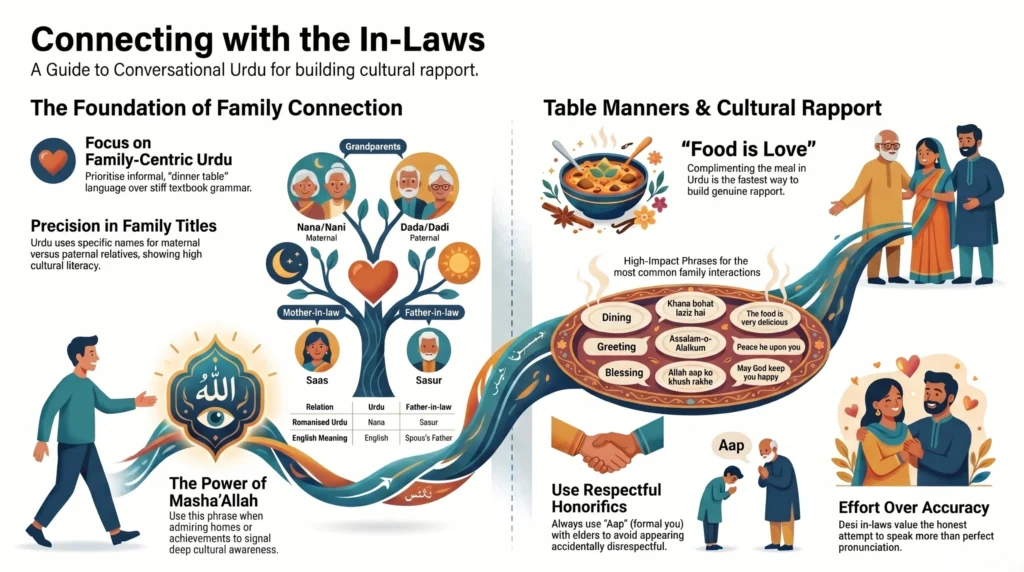
This is probably the most practically important section for anyone marrying into a Desi family. Urdu has a remarkably specific set of words for family relationships far more specific than English. Each relative has their own title, and using the wrong one (or using none at all) can feel awkward or even disrespectful, though most families are forgiving if they know you’re trying.
| اردو | Romanised Urdu | English |
| ساس | Saas | Mother-in-law |
| سسر | Sasur | Father-in-law |
| بھابھی | Bhabhi | Sister-in-law (brother’s wife) |
| دیور | Dewar | Brother-in-law (husband’s younger brother) |
| جیٹھ | Jeth | Brother-in-law (husband’s older brother) |
| نند | Nand | Sister-in-law (husband’s sister) |
| بیٹا | Beta | Son |
| بیٹی | Beti | Daughter |
| بھائی | Bhai | Brother |
| بہن | Behan | Sister |
| نانا / دادا | Nana / Dada | Maternal / Paternal Grandfather |
| نانی / دادی | Nani / Dadi | Maternal / Paternal Grandmother |
One thing I found interesting when I first started learning this: the distinction between Nana/Nani and Dada/Dadi is something that English speakers frequently miss. In English, we just say ‘grandma’ and ‘grandpa.’ In Urdu, the maternal and paternal grandparents have entirely separate titles. Knowing the difference shows a level of cultural literacy that most in-laws genuinely appreciate.
Urdu Phrases for the Dinner Table (Where Most Family Time Happens)
Food is central to Desi culture. Perhaps more than in any other cultural context I can think of, sharing a meal in a Pakistani or Indian household is a deeply relational act. You will be offered food constantly, urged to have more, and the quality of the cooking will be communicated through your reaction.
These phrases will serve you well maybe better than any others.
| اردو | Romanised Urdu | English |
| کھانا بہت لذیذ ہے | Khana bohat laziz hai | The food is very delicious |
| مجھے بھوک لگی ہے | Mujhe bhook lagi hai | I am hungry |
| پانی چاہیے | Paani chahiye | I need water |
| کھانا بہت مزے کا ہے | Khana bohat maze ka hai | The food is very tasty |
| چائے لیں گے؟ | Chai lein ge? | Will you have tea? |
Saying Bohat mazedaar khana hai (the food is very tasty) after a meal will quite possibly make your mother-in-law your biggest fan. I am not exaggerating. Food is love in this culture, and acknowledging it in Urdu hits differently than saying it in English.
Polite Expressions and Compliments That Build Real Rapport
Beyond greetings and food, there’s a whole layer of social Urdu that centers on politeness, compliments, and blessings. Desi culture is deeply relational, and these kinds of phrases are the glue that holds interactions together.
| اردو | Romanised Urdu | English |
| بہت خوبصورت گھر ہے | Bohat khoobsoorat ghar hai | What a beautiful home |
| ماشاءاللہ | Masha’Allah | God has willed it (used for praise) |
| اللہ آپ کو خوش رکھے | Allah aap ko khush rakhe | May God keep you happy |
| آپ سے مل کر خوشی ہوئی | Aap se mil kar khushi hui | It was a pleasure meeting you |
One phrase worth highlighting: Masha’Allah. It’s used when admiring something a child, a home, someone’s achievement and carries the meaning of acknowledging God’s role in what’s good. Using it appropriately signals cultural and religious awareness. And in most households, it’s deeply appreciated.
Urdu Phrases for Eid, Weddings, and Special Occasions
If you only memorize phrases for one context beyond daily greetings, make it special occasions. These are the moments that create lasting memories and saying the right thing in Urdu, even imperfectly, tends to move people.
| Occasion | Romanised Urdu Phrase | English Meaning |
| عید مبارک | Eid Mubarak | Blessed Eid (Eid greeting) |
| رمضان مبارک | Ramadan Mubarak | Blessed Ramadan |
| شادی مبارک ہو | Shadi Mubarak ho | Congratulations on the wedding |
| اللہ سلامت رکھے | Allah salamat rakhe | May God keep you safe |
| خوش رہو | Khush raho | Stay happy (informal blessing) |
Eid Mubarak and Ramadan Mubarak are perhaps the most universally useful. Even non-Muslims who have Desi friends or in-laws benefit from knowing these. They show awareness of what’s important to the family.
Practical Tips for Learning Urdu When You’re Married Into a Desi Family
A few things that actually help, beyond just memorizing phrases:
• Start with what you’ll use most. Greetings, food phrases, and family terms first. Don’t try to learn everything at once, that’s a guaranteed way to get overwhelmed.
• Practice out loud. Urdu pronunciation is quite specific, and reading silently won’t help you. Say the words, even if you feel silly doing it.
• Ask your spouse to help. They know what their family actually says, and what will land well versus what might sound oddly formal.
• Don’t be afraid to try and get it wrong. In-laws particularly Desi in-laws are generally delighted when a non-native speaker makes an honest attempt. The effort matters more than the accuracy.
• Use labels. Stick Urdu labels on things around the house, or save phrases on your phone to review while commuting. Repetition is the real key.
• Watch Pakistani dramas. Sounds like unusual advice, but it genuinely helps with comprehension, tone, and everyday vocabulary and they’re actually quite good.
Common Mistakes Non-Native Speakers Make (And How to Avoid Them)
Using overly formal language. Textbook Urdu can come across as stiff or even slightly comical in casual family settings. Match the energy of the room.
Mispronouncing names and terms. Urdu has sounds like the retroflex ‘t’ and ‘d’, and the guttural ‘kh’ that don’t exist in English. These take practice. They’re worth it.
Skipping honorifics. Urdu has formal and informal registers, and using ‘tum’ (informal you) with elders can feel disrespectful. When in doubt, use ‘aap’ (formal you).
Translating idioms directly. Some things just don’t translate. It’s better to say a simple Urdu phrase correctly than to attempt a direct translation that ends up making no sense.
Learning Urdu as a Non-Native Speaker: What to Realistically Expect
I want to be honest here: becoming conversationally comfortable in Urdu takes time. For most adult learners, especially those whose first language is English, reaching a point where conversations feel natural probably takes months of consistent effort, not weeks.
But here’s the thing: you don’t need to be conversationally fluent to make a real difference. Even a handful of phrases, deployed at the right moments, creates a connection that wasn’t there before. It signals effort. It signals respect. And in family relationships, those signals go a very long way.
The goal, at least at first, isn’t fluency. It’s a connection. And connection can start with something as simple as greeting your mother-in-law in Urdu and asking how she’s doing and actually understanding her reply.
Final Thoughts: Small Effort, Big Impact
Language learning, in any context, is ultimately an act of empathy. You’re stepping outside your comfort zone to meet someone else in theirs. When it comes to your spouse’s family, that act carries a weight that’s hard to overstate.
You don’t need to be perfect. You don’t need to nail the pronunciation on the first try, or memorize every family term before the next gathering. What matters is that you tried and that you’re still trying. With DesiLingua, even small efforts in conversational Urdu can create meaningful family connections that last a lifetime.