If you’ve ever been in a room where some people are speaking Punjabi and others are replying in Urdu and somehow everyone seems to follow along you’ve probably wondered what exactly is going on. Is it mutual intelligibility? Cultural familiarity? Or just years of living side by side? The answer, honestly, is a bit of all three.
Urdu and Punjabi share a long and tangled history. They’re both spoken widely across Pakistan and India, both rooted in the same geographic and cultural soil, and both have absorbed influences from Persian, Arabic, and Sanskrit over centuries. But they are not the same language. Not even close. And yet, many Urdu speakers find themselves picking up chunks of Punjabi conversation without ever having formally studied it. That’s the puzzle worth exploring here.
This article looks at what Urdu and Punjabi actually have in common, where they diverge in ways that genuinely matter, and what realistic comprehension looks like for someone who only knows Urdu. No fluff, just practical linguistic context and a few comparisons that might surprise you.
The Linguistic Relationship Between Urdu and Punjabi
Both languages belong to the Indo-Aryan branch of the Indo-European language family. That’s the starting point for understanding why there’s any overlap at all. Punjabi is actually older it developed from Sauraseni Prakrit and has been spoken in the Punjab region for over a thousand years. Urdu, on the other hand, emerged much later, roughly in the 13th to 17th century, as a contact language between Persian-speaking elites and the local population in the Indian subcontinent.
The vocabulary overlap is real, but it’s also somewhat misleading. Everyday conversational Urdu especially the informal variety spoken in Lahore, Rawalpindi, or Karachi borrows heavily from Punjabi. Many Urdu speakers, particularly those from Punjab, grew up hearing Punjabi at home or in the street even if they never formally used it. That passive exposure matters more than people realize.
Still, the two languages have distinct grammar systems, tonal features (Punjabi is tonal; Urdu is not), and vocabularies that diverge significantly when you move beyond basic conversation. A linguist would classify them as related but separate languages not dialects of each other.
Urdu vs. Punjabi: A Quick Structural Comparison
Before diving into comprehension, it helps to see the differences laid out clearly. Here’s a side-by-side look at some key structural features:
| Feature | Urdu | Punjabi |
| Language Family | Indo-Aryan | Indo-Aryan |
| Script | Nastaliq (Urdu script) | Shahmukhi (Pakistan) / Gurmukhi (India) |
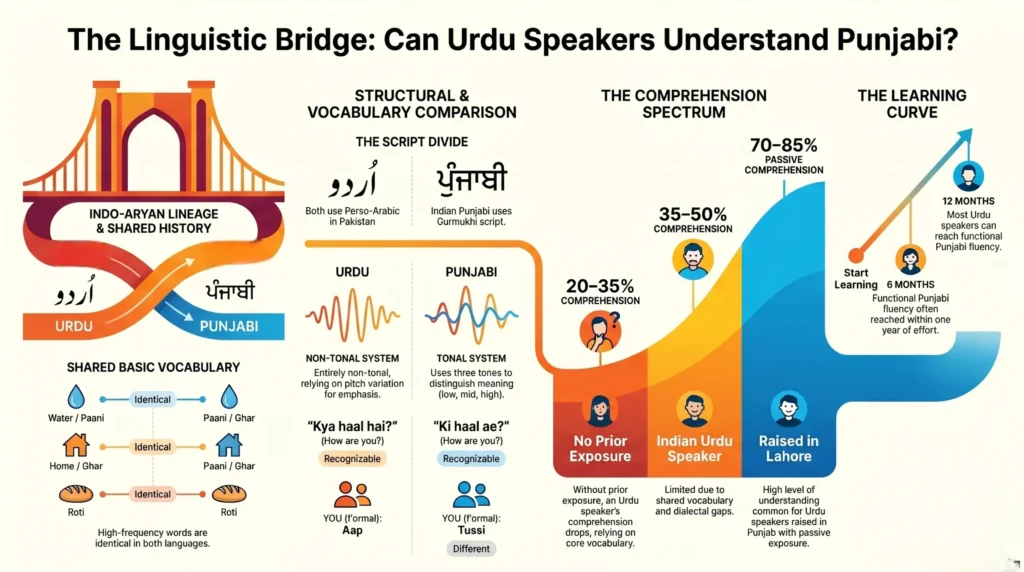
| Tonal System | Non-tonal | Tonal (3 tones: high, low, mid) |
| Verb Structure | SOV (Subject-Object-Verb) | SOV (Subject-Object-Verb) |
| Formality Register | High formal/literary tradition | More colloquial in everyday use |
| Persian/Arabic Influence | Very high | Moderate |
| Sanskrit Influence | Low | Moderate to High |
| Number of Speakers | ~70–80 million native | ~130 million native globally |
| Status in Pakistan | Official national language | Regional — no official status |
| Mutual Intelligibility | Partial (passive better than active) | Partial (passive better than active) |
The tonal system is probably the biggest practical barrier. Punjabi uses tones to distinguish meaning the same word spoken with a different pitch can mean something entirely different. Urdu speakers who haven’t grown up around Punjabi often miss these tonal cues entirely, which can lead to genuine confusion or misunderstanding.
Common Words and Phrases: Urdu vs. Punjabi
One of the best ways to gauge mutual intelligibility is to look at common vocabulary. Some words are almost identical; others are completely different. Here’s a practical comparison:
| Punjabi (Script) | Punjabi (Romanised) | English Meaning | Urdu Equivalent | Similar? |
| ਪਾਣੀ / پانی | Paani | Water | Paani (پانی) | ✅ Identical |
| ਰੋਟੀ / روٹی | Roti | Bread / Food | Roti (روٹی) | ✅ Identical |
| ਘਰ / گھر | Ghar | Home / House | Ghar (گھر) | ✅ Identical |
| ਕਿੱਥੇ / کتھے | Kitthe | Where | Kahaan (کہاں) | ⚠️ Partial |
| ਕੀ ਹਾਲ ਹੈ / کی حال اے | Ki haal ae | How are you? | Kya haal hai (کیا حال ہے) | ⚠️ Recognisable |
| ਆਜਾ / آجا | Aaja | Come here | Aao / Chalo (آؤ) | ⚠️ Partial |
| ਹੁਣ / ہن | Hun | Now | Ab (اب) | ❌ Different |
| ਮੈਂ / میں | Main | I / Me | Main (میں) | ✅ Identical |
| ਤੁਸੀਂ / تُسیں | Tussi | You (plural/formal) | Aap (آپ) | ❌ Different |
| ਨਹੀਂ / نہیں | Nahi | No / Not | Nahi (نہیں) | ✅ Identical |
| ਚੰਗਾ / چنگا | Changa | Good | Acha (اچھا) | ❌ Different |
| ਬਹੁਤ / بہت | Bahut | Very / A lot | Bahut (بہت) | ✅ Identical |
You can see the pattern. High-frequency, everyday words especially those tied to basic needs and feelings tend to overlap a lot. The divergence shows up more in grammatical particles, pronouns, and vocabulary borrowed from different source languages. Punjabi leans toward its own native roots in many areas where Urdu would default to a Persian or Arabic borrowing.
How Much Can Urdu Speakers Actually Understand?
This is the question most people actually want answered. And the honest reply is: it depends. Passive comprehension meaning just listening and understanding is generally quite decent for Urdu speakers who’ve had regular exposure to Punjabi, even informally. Someone who grew up in Lahore, or who has Punjabi-speaking family members, will likely understand 60–75% of casual Punjabi conversation. Maybe more.
But for an Urdu speaker from, say, Karachi, with no real Punjabi exposure? Comprehension drops considerably. Perhaps 30–40% for simple phrases, less for anything that involves tonal nuance, dialectal vocabulary, or fast-paced colloquial speech.
Active use actually speaking Punjabi is a different story altogether. Most monolingual Urdu speakers cannot speak Punjabi fluently, even if they can follow a conversation. The tones, the specific grammatical forms, the vocabulary gaps these create real production barriers that passive understanding doesn’t prepare you for.
Comprehension Levels: A Rough Guide by Background
| Urdu Speaker Background | Estimated Comprehension (Casual Punjabi) | Notes |
| Lahore / Central Punjab raised | 70–85% | High passive exposure, often code-switches naturally |
| Other Pakistani cities (moderate exposure) | 45–60% | Recognises common phrases, struggles with tones |
| Indian Urdu speaker (Delhi/UP) | 35–50% | Shared vocabulary helps, but dialectal gaps are real |
| No prior Punjabi exposure | 20–35% | Core vocabulary overlap only |
| Formally studied Punjabi | 80–95% | Tonal training makes a significant difference |
These are rough estimates, not scientific measurements. Individual variation is enormous. Someone who watched a lot of Punjabi films or music growing up might score significantly higher than their geographic background would suggest.
The Role of Dialects: It’s Not One Punjabi
Another thing worth mentioning Punjabi is not monolithic. There are several major dialects, and they vary quite a bit from each other. The main ones include Majhi (spoken around Lahore and Amritsar, considered the standard), Doabi, Malwi, Pothohari, and Hindko (which some classify separately). The Punjabi spoken in Rawalpindi sounds noticeably different from what you’d hear in Faisalabad or across the border in Amritsar.
For an Urdu speaker, Majhi Punjabi , specifically the Lahori variety, is probably the most accessible. It’s the dialect most commonly heard in Pakistani media and popular culture, and it has the heaviest crossover with everyday Urdu as spoken in Punjab. Pothohari, on the other hand, can sound almost like a different language to someone unfamiliar with it.
Punjabi Dialects and Their Relative Accessibility for Urdu Speakers
| Dialect | Region | Accessibility for Urdu Speakers | Notable Feature |
| ਮਾਝੀ / ماجھی (Majhi) | Lahore, Amritsar | High | Standard Punjabi, most media representation |
| ਦੁਆਬੀ / دوآبی (Doabi) | Jalandhar, Hoshiarpur | Moderate | Heavy in diaspora communities |
| ਮਾਲਵੀ / مالوی (Malwi) | Ludhiana, Patiala | Moderate | Distinct vocabulary from Majhi |
| ਪੋਠੋਹਾਰੀ / پوٹھوہاری (Pothohari) | Rawalpindi, Azad Kashmir | Low–Moderate | Very distinct, some treat as separate |
| ਹਿੰਦਕੋ / ہندکو (Hindko) | Peshawar, Hazara | Low | Often classified as a separate language |
Script Differences: Shahmukhi vs. Nastaliq
One area where Urdu speakers have a clear advantage in Pakistan at least in theory is script. Punjabi in Pakistan is typically written in Shahmukhi, which uses a modified version of the Perso-Arabic script, the same general family as Urdu’s Nastaliq. An Urdu reader can usually decode Shahmukhi text phonetically, even if the words themselves are unfamiliar.
In India, Punjabi is written in Gurmukhi a completely different script with no overlap with Urdu’s writing system. An Urdu speaker encountering written Gurmukhi would need to learn an entirely new alphabet before making any sense of it.
This is worth noting because written Punjabi and spoken Punjabi accessibility are two different things for Urdu speakers, depending on which side of the border you’re on.
Useful Punjabi Phrases for Urdu Speakers
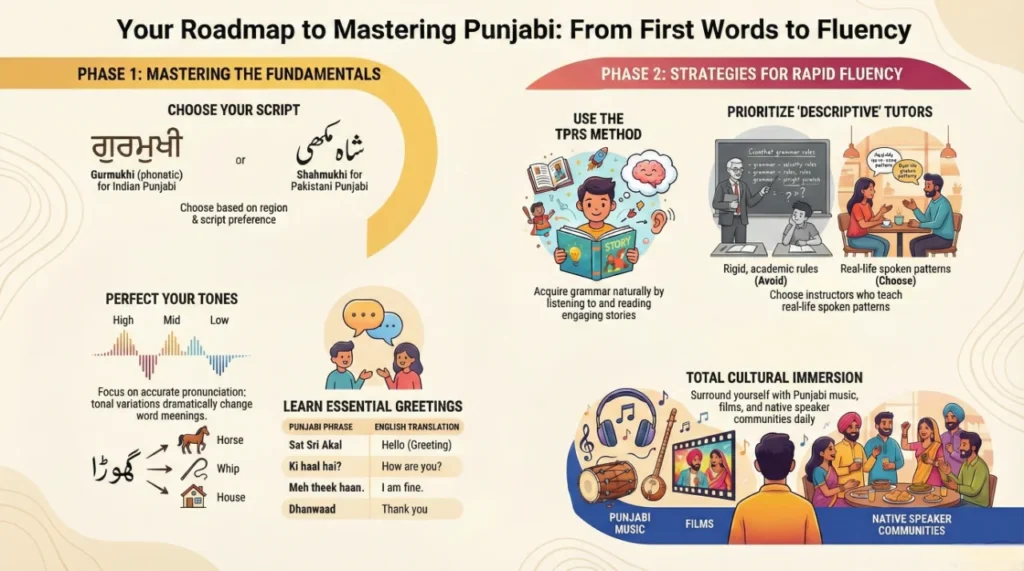
If you’re an Urdu speaker trying to pick up some Punjabi whether for travel, family connection, or just curiosity here are some foundational phrases to start with. The similarity to Urdu will be immediately obvious in some; in others, not so much.
| Punjabi (Script) | Romanised Punjabi | English Meaning | Urdu Parallel |
| ਸਤਿ ਸ੍ਰੀ ਅਕਾਲ / ست سری اکال | Sat Sri Akal | Hello (Sikh greeting) | Assalam u Alaikum / Hello |
| ਕੀ ਹਾਲ ਹੈ? / کی حال اے؟ | Ki haal ae? | How are you? | Kya haal hai? |
| ਮੈਂ ਠੀਕ ਆਂ / میں ٹھیک آں | Main theek haan | I am fine | Main theek hoon |
| ਤੁਹਾਡਾ ਨਾਂ ਕੀ ਹੈ? / تہاڈا ناں کی اے؟ | Tuhada naam ki ae? | What is your name? | Aapka naam kya hai? |
| ਮੈਂ ਨਹੀਂ ਜਾਣਦਾ / میں نہیں جاندا | Main nahi jaanda | I don’t know | Mujhe nahi pata |
| ਬਹੁਤ ਵਧੀਆ / بہت ودھیا | Bahut vadhia | Very good / Excellent | Bahut acha |
| ਪਾਣੀ ਦਿਓ / پانی دیو | Paani deo | Give me water | Paani dein |
| ਕਿੱਥੇ ਜਾਣਾ ਹੈ? / کتھے جانا اے؟ | Kitthe jaana ae? | Where are you going? | Kahaan jaana hai? |
| ਚੰਗਾ ਲੱਗਿਆ / چنگا لگیا | Changa lagya | I liked it / Felt good | Acha laga |
| ਤੁਸੀਂ ਕਿੱਥੋਂ ਹੋ? / تُسیں کتھوں ہو؟ | Tussi kittho ho? | Where are you from? | Aap kahaan se hain? |
Can Urdu Speakers Learn Punjabi Easily?
Relatively speaking yes. Compared to learning a completely unrelated language, an Urdu speaker has a meaningful head start. The shared vocabulary, similar sentence structure (SOV word order), and in Pakistan at least overlapping script all reduce the learning curve substantially.
The main things an Urdu speaker needs to deliberately learn:
• The tonal system this takes conscious effort and ear training
• Punjabi-specific vocabulary, particularly verbs and pronouns
• Colloquial expressions that have no Urdu equivalent
• The Gurmukhi script (if engaging with Indian Punjabi content)
• Dialectal variation knowing which variety you’re targeting
With regular listening practice Punjabi music, films, conversations most Urdu speakers can reach a functional conversational level in Punjabi within 6–12 months of genuine effort. That’s a fairly encouraging timeline.
The Cultural and Emotional Dimension
Languages aren’t just communication systems. For many Punjabi speakers particularly in the diaspora Punjabi carries enormous emotional and identity weight. It’s the language of dhamal, of qisse, of the land. There’s a whole poetic and folk tradition in Punjabi, from Waris Shah’s Heer to Bulleh Shah’s kafis, that simply doesn’t translate fully into Urdu.
Urdu, on the other hand, has its own rich literary tradition one that has historically enjoyed more institutional prestige in Pakistan. This has created an interesting dynamic where Punjabi is often the language of intimacy and warmth, while Urdu is associated with formality and education.
I think this emotional asymmetry is worth acknowledging. When an Urdu speaker makes the effort to speak or understand Punjabi even imperfectly it’s often received with genuine warmth. Language learning, in this context, is also a kind of cultural bridge.
Frequently Asked Questions
Can a Punjabi speaker understand Urdu?
Yes often more easily than the reverse. Punjabi speakers in Pakistan have typically had more institutional exposure to Urdu through education and media. Many Punjabi speakers are functionally bilingual in Urdu.
Is Punjabi dying out in Pakistan?
This is a concern raised by linguists and activists. Despite being the most widely spoken mother tongue in Pakistan, Punjabi has no official status and is not the primary medium of instruction in schools. Urban Punjabi families increasingly shift to Urdu as the primary home language a pattern that worries language preservation advocates.
What is the best dialect of Punjabi to learn first?
For most learners, Majhi particularly the Lahori variety is the most practical starting point. It has the most media representation, the most learning resources, and the broadest mutual intelligibility with other Punjabi dialects.
Final Thoughts
So can Urdu speakers understand Punjabi? Yes, partially. And often more than they give themselves credit for. The overlap in vocabulary, shared cultural context, and especially for those raised in Punjab years of passive exposure all contribute to a baseline of comprehension that’s genuinely useful.
But understanding snippets in a conversation is quite different from following a fast-paced Punjabi film, appreciating the poetry of Shah Hussain, or navigating a rural market in Gujranwala. The gap between partial comprehension and actual fluency is real, and it’s worth being honest about.
What’s clear, though, is that the linguistic distance between Urdu and Punjabi is small enough that serious learners can bridge it with time, exposure, and a willingness to embrace a language that, for millions of people, is something much more than just words.