
Learning conversational Urdu naturally, without getting bogged down in grammar rules, is about immersing yourself in the language and culture. It’s about picking up the language the way children do: through listening, repeating, and understanding context. This approach prioritizes communication and fluency over grammatical perfection, letting you speak Urdu and understand native Urdu speakers faster.
Why learn Urdu? Because it unlocks a world of rich culture, including Bollywood films, Pakistani dramas, and beautiful Urdu poetry. Knowing Urdu also allows you to connect with millions of Urdu speaking communities around the world.
This guide will show you strategic components for mastering Urdu, including mastering the script and sound system, developing foundational vocabulary through stories (TPRS), prioritizing conversation practice early, leveraging expert guidance, refining pronunciation, and embracing cultural context. We’ll also discuss the essential role of consistent practice and provide advanced Urdu language learning tips and tricks.
You’ll discover resources for learning Urdu, such as online courses on desilingua, tutoring options, and immersive videos and podcasts. We’ll address common challenges like sentence structure and pronunciation, and offer solutions to overcome them. Finally, we’ll cover how to make learning Urdu easy and convenient by setting SMART goals and finding the right resources. Learning conversational Urdu is a journey, and this guide is your roadmap to success.
Why Learn Urdu?
Urdu is more than just a language; it’s a gateway to a vibrant culture and history. Spoken by millions across Pakistan, India, and the global diaspora, Urdu opens doors to Bollywood, Sufi music, and classic literature. Learning Urdu also enhances cognitive skills like problem-solving and creativity. Plus, with its increasing global influence, knowing Urdu can be a valuable asset in fields like international business and cultural exchange. And because of the similarities between conversational Urdu and conversational Hindi, learning Urdu also gives you a head start in understanding Hindi.
Getting Started with the Urdu Language
Starting your Urdu language journey doesn’t have to be daunting. The key is to focus on practical communication and build a foundation gradually.
Urdu Alphabet and Script: The Building Blocks
While you can begin with Romanised Urdu (Urdu written with the English alphabet), learning the Urdu script opens up a world of authentic materials. The Urdu alphabet, derived from the Persian-Arabic script, is written from right to left and consists of 39 letters. Start by familiarizing yourself with the basic letter forms and their sounds. Resources like flashcards and online tutorials can help you master the alphabet. Practice connecting letters to form words, paying attention to how the shape of a letter changes depending on its position in a word.
Basic Grammar for Conversation: Constructing Spoken Urdu Sentences (SOV)
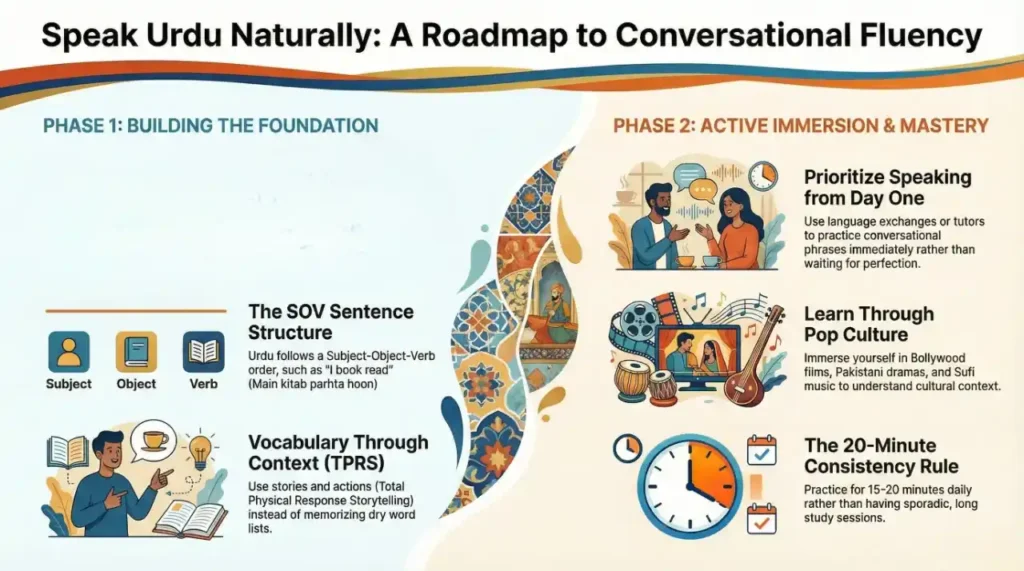
Instead of getting bogged down in complex grammar rules, focus on understanding the basic structure of Urdu sentences. Urdu typically follows a Subject-Object-Verb (SOV) word order. For example, “I book read” translates to “Main kitab parhta hoon.” Understanding this basic structure allows you to start constructing simple sentences quickly. Also, while Urdu does have gendered nouns, don’t let that intimidate you. Focus on learning common phrases and gradually understanding how gender affects verb conjugation and adjective agreement.
Common Phrases: Start Speaking Urdu
One of the most effective ways to start speaking Urdu is by learning common phrases. Here are a few essential phrases to get you started:
سلام (Salaam) – Hello
شکریہ (Shukriya) – Thank you
کیا حال ہے؟ (Kya haal hai?) – How are you?
میرا نام ____ ہے (Mera naam ____ hai) – My name is ____
معاف کیجیے (Maaf kijiye) – Excuse me
Practice these phrases regularly, and don’t be afraid to use them in real conversations. Focusing on pronunciation early on will also help you communicate more effectively.
Strategic Components for Mastering Urdu
Mastering Urdu requires a strategic approach that combines different learning methods. Here are key components to focus on:
Master the Urdu Script and Sound System
While conversational Urdu can be learned using Romanised Urdu, mastering the Urdu script unlocks a wealth of resources. Practice writing individual letters and connecting them to form words. Pay attention to the phonetic consistency of Urdu, where each letter generally corresponds to a specific sound.
Develop Foundational Vocabulary Through Context and Stories (TPRS)
Instead of memorizing lists of words, learn vocabulary in context. Total Physical Response Storytelling (TPRS) is a method that uses stories and actions to help you remember new words and phrases. Find Urdu stories online or create your own, acting out the scenes to reinforce your understanding. This method makes vocabulary acquisition more engaging and memorable.
Prioritize Conversational Practice Early
Don’t wait until you feel “ready” to start speaking. Begin practicing conversational Urdu from day one. Find a language exchange partner, join an online conversation group, or simply practice with a native Urdu speaker. Focus on using the phrases and vocabulary you’ve learned in real conversations.
Leverage Expert Guidance Through Tutoring or Language Exchange
A tutor can provide personalized feedback and guidance, helping you overcome specific challenges. Language exchange partners offer a more informal setting for practicing conversational Urdu and learning about Urdu culture. Platforms like italki and HelloTalk connect you with native Urdu speakers for tutoring and language exchange.
Refine Pronunciation Through Listening and Speaking Practice
Accurate pronunciation is crucial for effective communication. Listen to native Urdu speakers and try to mimic their pronunciation. Pay attention to the nuances of Urdu sounds, such as the retroflex consonants and nasal vowels. Record yourself speaking and compare it to native speakers to identify areas for improvement.
Embrace Cultural Context Through Authentic Materials
Immerse yourself in Urdu culture by watching Urdu movies and TV shows, listening to Urdu music, and reading Urdu literature. Bollywood films, Pakistani dramas, and Sufi music offer a rich source of language and cultural insights. Engaging with authentic materials helps you understand the cultural context of the language and makes learning more enjoyable.
Romanised Transliteration Urdu Learning: A Faster Path to Conversation
Romanised transliteration Urdu learning uses the English alphabet to represent Urdu sounds, allowing learners to focus on speaking and listening without being slowed down by script recognition. For beginners and conversational learners, this approach removes one of the biggest early barriers and helps build confidence faster.
Instead of immediately learning the Urdu script, learners see familiar letters while training their ears and mouths to produce natural Urdu sounds. This keeps attention on pronunciation, rhythm, and response the core skills needed for real conversation.
Romanised transliteration is especially effective in the early stages of learning because it supports natural language acquisition rather than academic memorization.
Why Romanised Transliteration Helps Conversational Urdu
- Reduces hesitation caused by unfamiliar script
- Allows learners to start speaking from day one
- Keeps focus on sound patterns and sentence flow
- Builds speaking reflexes instead of translation habits
- Makes conversation practice less intimidating
For example, seeing “Aap kaise hain?” instead of only Urdu script allows learners to immediately practice speaking while gradually training their listening skills.
When to Use Romanised Transliteration
Romanised transliteration works best when the goal is:
- Conversational fluency
- Speaking with family or friends
- Travel and daily communication
- Building confidence before learning the script
As learners progress, romanised transliteration can naturally transition into reading Urdu script. It acts as a bridge, not a replacement, helping learners speak comfortably first and add reading skills later without pressure.
The Essential Role of Consistent Practice
Consistent practice is key to mastering any language. Set aside time each day to study Urdu, even if it’s just for 15-20 minutes. Regular, focused practice is more effective than sporadic, long study sessions. Use a variety of methods, such as vocabulary review, grammar exercises, conversation practice, and listening comprehension, to keep your learning engaging.
Advanced Urdu Language Learning Tips and Tricks
Once you’ve mastered the basics, it’s time to delve deeper into the language. Explore more complex grammar rules, expand your vocabulary, and engage in more meaningful conversations. Read Urdu literature, watch Urdu films without subtitles, and try writing in Urdu. Consider taking an advanced Urdu course or working with a tutor to refine your skills.
Additional Strategies for Accelerated Learning
Engage With the Urdu-Speaking Community
Attend Urdu cultural events, join online Urdu language forums, and connect with Urdu speakers on social media. Engaging with the Urdu-speaking community provides opportunities to practice your language skills and learn about Urdu culture.
Utilize Parallel Texts Strategically
Parallel texts, which present Urdu alongside English translations, can be a valuable tool for intermediate learners. Use parallel texts to improve your reading comprehension and vocabulary. Gradually transition to reading Urdu-only materials as your skills improve.
Resources for Learning Urdu
There are many resources available to help you learn Urdu. Here are a few popular options:
Online Urdu Language Courses on desilingua
Desilingua offers structured online Urdu Conversational learning courses for all levels. These courses cover grammar, vocabulary, pronunciation, and conversation skills.
Tutoring: Personalized Guidance
Platforms like italki and Preply connect you with experienced Urdu tutors who can provide personalized guidance and feedback.
Videos and Podcasts: Immersive Learning
Spotify and YouTube
YouTube channels like Desilingua and Urdu Studio offer a wealth of free Urdu language lessons and cultural insights. Spotify also offers Urdu language learning podcasts.
Common Challenges and Solutions
Learning Urdu can present some challenges, but with the right strategies, you can overcome them.
Initial Challenges for Urdu Learners
Different Sentence Structure
The SOV word order can be challenging for English speakers. Practice constructing simple sentences using the SOV structure to get used to it.
Script Recognition Difficulties
The Urdu script can seem daunting at first. Focus on mastering individual letters and their sounds, and practice connecting letters to form words.
Pronunciation Resistance
Urdu has sounds that don’t exist in English. Listen to native speakers and practice mimicking their pronunciation. Use online resources to learn the correct mouth positions for these sounds.
Vocabulary Retention Issues
Use spaced repetition software like Memrise to help you remember new words. Learn vocabulary in context and use it in real conversations.
Motivation Fluctuations
Language learning can be challenging, and it’s normal to experience fluctuations in motivation. Set realistic goals, celebrate your progress, and find ways to make learning fun.
Finding the Right Resources
With so many resources available, it can be difficult to know where to start. Experiment with different methods and find what works best for you. Don’t be afraid to ask for recommendations from other Urdu learners.
How to Make Learning Urdu Easy and Convenient
Be SMART About Your Goals
Set Specific, Measurable, Achievable, Relevant, and Time-bound (SMART) goals to stay motivated and track your progress.
Urdu is Not That Unique
Recognize that Urdu shares similarities with other languages, including English. Many English words have been adopted into Urdu, and the SOV sentence structure is common in many languages.
The Right Resources Are Out There!
Explore different resources and find the ones that work best for your learning style. Don’t be afraid to experiment and try new things.
Take it One Step at a Time!
Focus on learning conversational Urdu first, and then gradually move on to more complex grammar and script.
Humor in a Language Learning Process
Incorporate humor into your learning process by watching Urdu comedy shows, reading Urdu jokes, and using humorous examples in your conversations.
Embracing the Journey
Learning Urdu is a journey, not a destination. Embrace the challenges and celebrate your successes. Don’t be afraid to make mistakes; they’re a natural part of the learning process.
Conclusion: How to Learn Urdu
Learning conversational Urdu naturally, without focusing on grammar rules, is about embracing immersion, prioritizing communication, and finding joy in the process. By mastering the Urdu script and sound system, developing foundational vocabulary through context, prioritizing conversation practice, and leveraging expert guidance, you can achieve fluency faster. Remember the importance of consistent practice, explore advanced learning tips, and utilize resources like desilingua’s online courses and language exchange partners. Overcome common challenges with practical solutions, set SMART goals, and most importantly, embrace the cultural richness that comes with learning Urdu. You’ll be speaking Urdu fluently and naturally in no time.