
If you search this question online, the short answer you’ll usually find is something like: Punjabi can be challenging, but it’s not impossible. Which is… true, I think. But also incomplete. Because it depends on what kind of Punjabi you want to learn.
If your goal is to read and write perfectly, learn scripts, memorize grammar tables, and sound textbook-correct, yes, Punjabi might feel heavy at first. But if what you actually want is to speak, to understand everyday conversations, to respond naturally when someone talks to you the picture changes. Quite a lot, actually.
This is where Conversational Punjabi, Romanised Punjabi, and methods like TPRS (Teaching Proficiency through Reading and Storytelling) quietly make everything easier.
And maybe more enjoyable too.
So… Is Conversational Punjabi Really “Hard”?
Honestly? Not in the way most English speakers fear.
Punjabi sentence structure is often more flexible than English, not more complex. You can say the same thing in a few slightly different ways and still sound natural. That flexibility helps beginners more than it hurts them.
Take a very basic spoken sentence:
Main theek haan.
I am fine.
That’s it. No verb conjugation maze. No tense gymnastics. Just meaning.
Or:
Tainu samajh aa rahi ae?
Do you understand?
At first glance, it might look unfamiliar. But when you hear it spoken a few times especially in a story or a real interaction it sticks faster than you’d expect. I’ve seen learners surprise themselves here. They hesitate at first, then suddenly… they answer back. Without translating in their head.
That moment matters.
Why Romanised Punjabi Changes Everything for Speakers
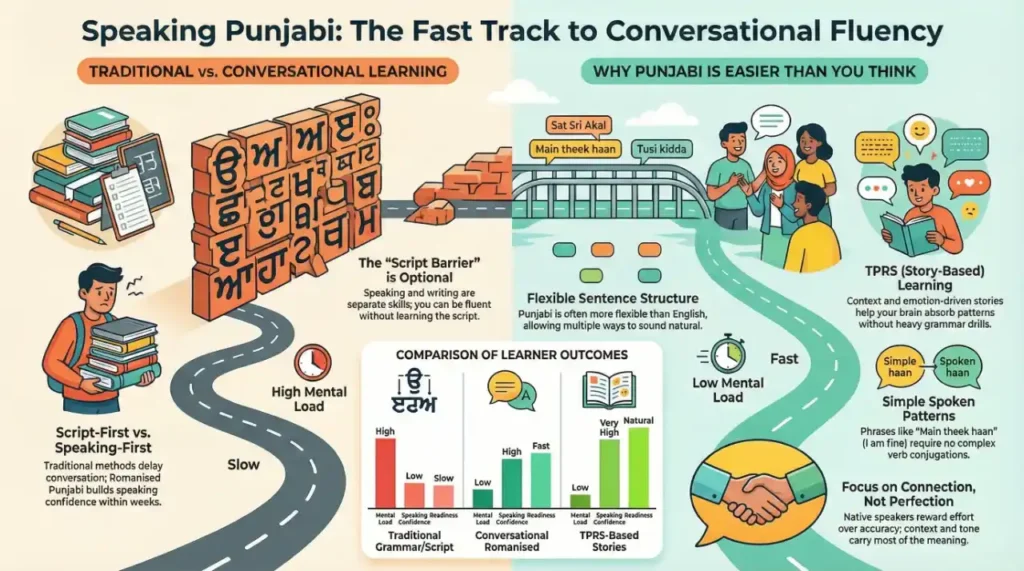
One of the biggest mental blocks English speakers have is the script. Gurmukhi looks unfamiliar, and people assume that means the language itself is hard. But speaking and writing are different skills. You don’t need one to build the other.
Using Romanised Punjabi removes that pressure completely.
You focus on:
- Sounds
- Rhyth
- Meaning
- Response speed
Not spelling rules. Not letters. Not writing drills.
For example:
Tusi ki kar rahe ho?
What are you doing?
You don’t need to know how this looks in Punjabi script to say it, understand it, or hear it in conversation. And when your goal is speaking, that’s enough. More than enough.
At DesiLingua, this speaking-first approach isn’t accidental. It’s intentional especially for learners who want to learn online Punjabi in a way that feels natural, conversational, and practical from day one..
Where TPRS Fits In
TPRS works because it mirrors how people actually learn languages through context, repetition, and emotion, not memorization.
Instead of isolated phrases, you hear sentences inside small stories:
Oh roz subah chai peenda ae.
He drinks tea every morning.
Then later:
Ajj oh chai nahi peenda.
Today he is not drinking tea.
Same structure. Slight change. Your brain notices without being told to notice. No grammar explanation needed. And oddly enough, you remember it better.
I think this is where many traditional methods go wrong. They explain too much, too early. Conversation doesn’t wait for perfect understanding. It moves forward. TPRS respects that.
Speaking Punjabi Isn’t About Perfection (And That’s a Relief)
Here’s something learners don’t hear often enough: Punjabi speakers don’t expect perfection.
If you say:
Main kal aaya si.
I came yesterday.
Even if your pronunciation isn’t flawless, the meaning lands. And communication is the real goal. Over time, accuracy improves naturally through exposure, correction, and confidence.
Sometimes learners hesitate because they want to “get it right” before speaking. But spoken Punjabi rewards trying more than waiting.
Why Conversational Punjabi Feels Easier Than You Expect
A few reasons, based on real learner experiences:
- Repetition is built into everyday speech
- Many expressions are reused constantly
- Emotions and tone carry meaning
- Romanised Punjabi keeps your focus on sound, not spelling
- TPRS turns language into something lived, not studied
Common Fears English Speakers Have (And Why They Usually Fade)
Most English speakers come to Punjabi with a quiet list of worries. They don’t always say them out loud, but they’re there.
“I’ll mispronounce everything.”
“I won’t understand native speakers.”
“I’ll freeze mid-sentence.”
And yes, all of that happens. Briefly. Then something interesting happens too people still understand you.
Punjabi, especially conversational Punjabi, is forgiving. Context does a lot of work. Tone does even more.
If you say:
Main thoda late haan.
I am a little late.
Even if the rhythm isn’t perfect, the message is clear. Nobody stops the conversation to correct you. Life keeps moving. That’s how spoken language actually works.
I think many learners expect Punjabi conversations to behave like exams. They don’t. They behave like… conversations.
Why Thinking in English First Is the Real Obstacle
One subtle difficulty English speakers face isn’t Punjabi itself it’s translation.
People try to map English sentences word-for-word onto Punjabi. That’s when things feel hard.
But when you learn through Romanised Punjabi + TPRS, something shifts. You stop asking, “How do I say this in Punjabi?” and start reacting with ready-made patterns.
For example, instead of translating:
“I don’t feel like going today.”
You already have:
Ajj jaan da mann nahi ae.
I don’t feel like going today.
That sentence becomes a single idea, not a puzzle. And once that happens, speaking gets lighter. Faster. More instinctive.
This is why conversational learning beats rule-based learning early on. You’re training a response, not an explanation.
Speaking vs Writing: Why We’re Ignoring Writing (On Purpose)
Some people find this approach strange at first.
“No writing?”
“No script?”
“No spelling rules?”
But think about it honestly how many languages have you spoken before you could write them?
Punjabi spoken on the street, at home, with friends, doesn’t ask you to visualize letters. It asks you to listen and respond. That’s it.
By focusing only on speaking and understanding, Romanised Punjabi keeps your attention where it matters most in the beginning. Writing can come later. Or not at all. Many fluent speakers never formally learn it and they’re still fluent.
That’s not laziness. It’s prioritization.
Conversational Punjabi Compared to Other Languages (Speaking-Only View)
Here’s a simple comparison, purely from a speaking and conversation perspective for English speakers:
| Language | Conversational Difficulty | Script Barrier | Speaking Flexibility | Beginner Confidence |
| Punjabi (Romanised) | Moderate | None | High | Builds quickly |
| Hindi (Romanised) | Moderate | None | Medium | Steady |
| Arabic (Spoken) | High | Medium | Low–Medium | Slow early progress |
| German | Medium–High | None | Low | Grammar slows speech |
| Japanese (Romaji) | High | Medium | Medium | Context-heavy |
Punjabi stands out because natural repetition, emotional expression, and flexible structure support spoken fluency early especially when you remove the script barrier.
How TPRS Makes Punjabi Feel “Learned” Before You Realize It
TPRS doesn’t rush explanations. It lets you live inside the language first.
You hear variations like:
Oh ajj kaam te gaya ae.
He went to work today.
Then later:
Kal oh kaam te nahi gaya si.
Yesterday he didn’t go to work.
Same verbs. Same rhythm. Different time. Your brain quietly organizes this without stress. And one day, you use it yourself a little imperfectly, maybe but confidently.
That’s the goal.
A Small but Important Truth About Speaking Punjabi
You don’t need to sound native to sound natural.
Pauses are okay. Hesitation is okay. Even mixing English occasionally is normal in real Punjabi conversations. Fluency grows from participation, not from waiting until you’re “ready.”
How to Build a Daily Punjabi Speaking Habit (Without Calling It “Study”)
Most people fail at language learning because they try to schedule motivation. It doesn’t work. What works better especially for conversational Punjabi is small, repeatable exposure that feels almost casual.
Five minutes of listening.
A few sentences spoken out loud.
One short story replayed twice.
That’s enough.
If you wait for an hour of focus, you’ll probably wait a long time. But five minutes? That happens naturally. And Punjabi, when learned conversationally, fits well into these small windows.
For example, you might replay a short exchange like this:
Tusi ajj kithe ja rahe ho?
Where are you going today?
Main bazaar ja reha haan.
I’m going to the market.
That’s not a lesson. That’s a moment. And moments add up faster than rules.

Why Listening Comes Before Speaking (Even If It Feels Passive)
This part surprises people.
They think speaking means speaking immediately. But confidence usually comes from recognition first, not output.
When you hear sentences repeatedly in context especially through TPRS-style stories your brain starts predicting what comes next. And prediction is the doorway to speaking.
You might hear:
Oh roz shaam nu walk te janda ae.
He goes for a walk every evening.
After enough exposure, when someone says:
Roz shaam nu…
Every evening…
Your mind already knows what kind of sentence might follow. That familiarity reduces hesitation. Speaking feels less risky.
Listening isn’t passive. It’s preparation.
Common Conversational Punjabi Patterns You’ll Hear Everywhere
Punjabi conversation relies heavily on patterns rather than endless vocabulary. Once you recognize a few, everything starts sounding familiar.
Here are some you’ll hear constantly:
Ki haal ae?
How are you?
Theek aa. Tu dass.
I’m fine. You tell me.
Koi gall nahi.
No problem.
Chal theek ae.
Alright then.
These aren’t fancy. They’re not poetic. But they carry conversations. And learning them through Romanised Punjabi lets you focus on rhythm and tone instead of spelling anxiety.
Sometimes learners feel disappointed by how simple these are. But simplicity is power in conversation.
Pronunciation Confidence: Why Romanised Punjabi Helps More Than You Think
Pronunciation fear is real. People worry they’ll sound awkward or unclear. Romanised Punjabi helps by anchoring sounds to letters English speakers already know even if it’s imperfect.
Is it a perfect system? No.
Is it practical? Very.
When you see:
Main samajh gaya.
I understand.
You can already approximate the sound. Then hearing it spoken refines it. That loop see, hear, repeat builds confidence faster than abstract phonetic charts ever could.
And yes, accents remain.That’s normal. Fluency doesn’t erase identity. It just adds connection.
What Progress Actually Looks Like.
Progress in spoken Punjabi isn’t linear.
Some days you’ll understand everything.
Other days, nothing.
Then suddenly, a full sentence comes out without planning.
That doesn’t mean you’re regressing. It means your brain is reorganizing.
Why This Conversational Approach Fits DesiLingua So Naturally
Some platforms try to do everything at once reading, writing, grammar theory, spelling accuracy. DesiLingua doesn’t. And honestly, that restraint matters.
When the goal is speaking Punjabi confidently, the smartest move is to remove friction. No scripts to decode. No writing pressure. No early grammar overload. Just listening, understanding, and responding the way conversations actually happen.
This is where Romanised Punjabi + TPRS quietly works in your favor.
Stories give context.
Context gives meaning.
Meaning makes memory stick.
You’re not memorizing sentences. You’re recognizing situations.
For example, hearing variations like:
Main ajj thak gaya haan.
I’m tired today.
Oh kal thak gaya si.
He was tired yesterday.
You’re not “studying tense.” You’re absorbing patterns. Later, when you need them, they show up. Slightly imperfect at first, maybe. But usable. And usable beats perfect every time in conversation.
Traditional Learning vs Conversational Romanised Punjabi
Here’s a simple comparison, focused only on speaking ability, not academic learning:
| Learning Approach | Focus | Early Speaking Confidence | Mental Load | Real Conversation Readiness |
| Traditional Punjabi Courses | Grammar, writing, rules | Low | High | Slow |
| Script-First Learning | Reading & writing accuracy | Very low | Very high | Delayed |
| Conversational Romanised Punjabi | Listening & speaking | High | Low | Fast |
| TPRS-Based Speaking | Stories & repetition | Very high | Low | Natural |
This doesn’t mean traditional learning is “wrong.” It just means it solves a different problem. If your problem is speaking and understanding people, conversational learning solves it faster.
Frequently Asked Questions (Speaking-Only Focus)
Is Punjabi hard for English speakers to speak?
Not particularly when learned conversationally. The difficulty usually comes from trying to learn everything at once. If you focus only on speaking and understanding through Romanised Punjabi, progress feels much smoother.
Can I really speak Punjabi without learning the script?
Yes. Many fluent speakers do exactly that. Script knowledge is useful, but it’s not required for conversation. Speaking and writing are separate skills.
Will Romanised Punjabi affect my pronunciation?
It helps more than it hurts. Seeing familiar letters reduces hesitation, and hearing native pronunciation refines accuracy over time. Perfection isn’t required to be understood.
How long does it take to hold basic conversations?
With consistent listening and light speaking practice, many learners begin responding naturally within weeks. Full confidence takes longer, but early wins come sooner than expected.
Is TPRS suitable for adults?
Absolutely. In fact, adults often benefit more because stories provide emotional hooks and context something rote memorization lacks.
A Small Reality Check (Because It’s Honest)
Punjabi won’t magically become effortless overnight. There will be moments when speech feels fast, accents blur, or confidence dips. That’s normal. It doesn’t mean you’re bad at languages. It means you’re learning one the way humans actually do through exposure, confusion, adjustment, and repetition.
And sometimes, strangely enough, confusion is a sign you’re close to a breakthrough.
Final Thoughts: Is Conversational Punjabi Hard?
I think the more accurate question is this:
Is Punjabi hard the way people usually try to learn it?
Sometimes, yes.
Is Punjabi hard when you focus on speaking first, use Romanised Punjabi, learn through stories, and allow yourself to be imperfect?
And that’s the version of Punjabi most people are actually looking for the one that lets you respond, connect, and feel part of a conversation, not trapped in a lesson.