Learning a new language rarely begins with grammar books. Most people start with small phrases simple expressions used in everyday conversations. Urdu is no different. In fact, if you want to speak Urdu naturally, memorizing daily use Urdu sentences can make a surprising difference.
Perhaps more than anything else, these phrases help you navigate ordinary interactions. Greeting someone. Asking a simple question. Ordering food. Even apologizing when you bump into someone in a crowded market. They are small sentences, yes, but they carry a lot of real-world value.
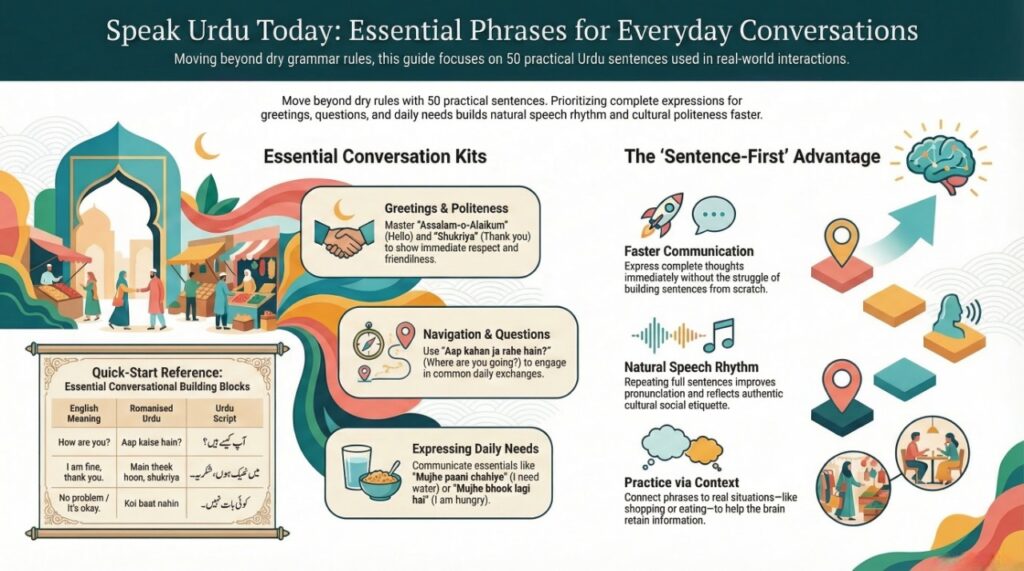
This guide collects 50 daily use Urdu sentences commonly used in everyday conversations. They are organized into practical categories such as greetings, questions, daily routines, and polite expressions. Each sentence includes the Urdu script, Romanised Urdu pronunciation, and English meaning, so learners at any level can follow along.
If you are just starting to learn Urdu or maybe brushing up on conversational phrases you’ll likely find these sentences useful. And honestly, some of them might feel familiar already.
Why Learning Daily Use Urdu Sentences Matters
When people try to learn a language, they often focus heavily on vocabulary lists or grammar rules. That approach works, technically. But it can also feel slow and a bit disconnected from real life.
Daily conversation phrases are different.
They teach you how language actually functions in everyday situations. Instead of isolated words like paani (water) or kitab (book), you learn full expressions such as:
- “Mujhe paani chahiye.” (I need water.)
- “Yeh kitab kahan hai?” (Where is this book?)
These types of sentences help learners develop practical fluency faster.
A few benefits stand out:
| Benefit | Explanation |
|---|---|
| Faster communication | You can express complete thoughts without building sentences from scratch |
| Real-life relevance | These phrases appear in daily conversations, markets, workplaces, and homes |
| Easier pronunciation practice | Repeating full sentences improves natural speech rhythm |
| Better cultural understanding | Many Urdu expressions reflect politeness and social etiquette |
In other words, learning common Urdu sentences for daily conversation is one of the fastest ways to start speaking the language with confidence.
Greetings and Basic Urdu Sentences
Greetings are often the first phrases language learners encounter. And in Urdu-speaking cultures, greetings carry social importance. They show respect, politeness, and friendliness.
The most common greeting, of course, is Assalam-o-Alaikum. You’ll hear it almost everywhere from homes and offices to shops and classrooms.
Below are some essential daily Urdu greeting sentences.
| Urdu Sentence | Romanised Urdu | English Meaning |
|---|---|---|
| السلام علیکم | Assalam-o-Alaikum | Peace be upon you / Hello |
| آپ کیسے ہیں؟ | Aap kaise hain? | How are you? |
| میں ٹھیک ہوں، شکریہ۔ | Main theek hoon, shukriya | I am fine, thank you |
| آپ کا نام کیا ہے؟ | Aap ka naam kya hai? | What is your name? |
| میرا نام علی ہے۔ | Mera naam Ali hai | My name is Ali |
| آپ سے مل کر خوشی ہوئی۔ | Aap se mil kar khushi hui | Pleased to meet you |
| شکریہ۔ | Shukriya | Thank you |
| بہت بہت شکریہ۔ | Bohat bohat shukriya | Thank you very much |
| خوش آمدید۔ | Khush aamdeed | Welcome |
| اللہ حافظ۔ | Allah Hafiz | Goodbye |
At first glance, these might look basic. They are. But that’s exactly the point.
In everyday life, conversations usually begin with simple exchanges like these. And once you know them well, starting a conversation in Urdu feels significantly less intimidating.
Common Urdu Questions and Answers
After greetings, the next step in conversation usually involves questions. Asking where someone is going, what they do for work, or even what time it is these questions appear constantly in daily interactions.
Interestingly, Urdu questions often follow patterns that are fairly easy to learn. Once you understand a few sentence structures, you can create many variations.
Here are some common Urdu sentences used in everyday questions and answers.
| Urdu Sentence | Romanised Urdu | English Meaning |
|---|---|---|
| آپ کہاں جا رہے ہیں؟ | Aap kahan ja rahe hain? | Where are you going? |
| میں بازار جا رہا ہوں۔ | Main bazaar ja raha hoon | I am going to the market |
| وقت کیا ہوا ہے؟ | Waqt kya hua hai? | What time is it? |
| تین بجے ہیں۔ | Teen bajay hain | It is three o’clock |
| آپ کیا کرتے ہیں؟ | Aap kya karte hain? | What do you do? |
| میں ایک طالب علم ہوں۔ | Main ek talib-e-ilm hoon | I am a student |
| کیا آپ میری مدد کر سکتے ہیں؟ | Kya aap meri madad kar sakte hain? | Can you help me? |
| جی ہاں، ضرور۔ | Ji haan, zaroor | Yes, of course |
| نہیں، میں نہیں کر سکتا۔ | Nahin, main nahin kar sakta | No, I can’t |
| آپ کہاں سے ہیں؟ | Aap kahan se hain? | Where are you from? |
You might notice something interesting here. Urdu often uses polite forms like “aap” instead of informal pronouns. This reflects the language’s emphasis on respect and social hierarchy.
Of course, there are informal versions too. But beginners usually start with the polite form, just to be safe.
Everyday Urdu Sentences for Daily Needs
Daily life involves a surprising number of routine expressions. Saying you’re hungry, asking for water, talking about the weather these are small things, yet they appear repeatedly in conversation.
Learning these phrases makes interactions feel smoother. More natural.
And honestly, sometimes it’s these ordinary sentences that people use the most.
Below are some common Urdu daily routine sentences.
| Urdu Sentence | Romanised Urdu | English Meaning |
|---|---|---|
| مجھے بھوک لگی ہے۔ | Mujhe bhook lagi hai | I am hungry |
| چلیں، کچھ کھاتے ہیں۔ | Chalein, kuch khate hain | Let’s eat something |
| میں تھک گیا ہوں۔ | Main thak gaya hoon | I am tired |
| مجھے آرام کی ضرورت ہے۔ | Mujhe araam ki zaroorat hai | I need rest |
| جلدی کرو! | Jaldi karo | Hurry up |
| باہر بارش ہو رہی ہے۔ | Bahar baarish ho rahi hai | It is raining outside |
| مجھے تھوڑا پانی چاہیے۔ | Mujhe thora paani chahiye | I need some water |
| آج موسم بہت اچھا ہے۔ | Aaj mausam bohat acha hai | The weather is very nice today |
| میں مصروف ہوں۔ | Main masroof hoon | I am busy |
| مجھے جانا ہے۔ | Mujhe jana hai | I have to go |
These types of sentences form the backbone of everyday speech. Even advanced Urdu speakers still rely on them constantly.
Language, after all, is mostly repetition.
Quick Comparison: Beginner Urdu Learning Approaches
Below is a quick comparison showing why learning sentences first often works better than memorizing individual vocabulary words.
| Learning Method | Advantages | Limitations |
|---|---|---|
| Memorizing Vocabulary | Builds word knowledge quickly | Hard to form natural sentences |
| Studying Grammar Rules | Improves sentence accuracy | Slow for beginners |
| Learning Daily Sentences | Immediate conversational ability | Requires practice to understand grammar later |
| Immersion and Conversation | Fastest fluency improvement | Can be difficult without basic phrases |
Social Courtesies and Polite Urdu Expressions
If there’s one thing that stands out in Urdu conversations, it’s politeness. The language has a natural rhythm of respect built into everyday speech. Even simple phrases often sound softer, more considerate.
And honestly, once you start noticing it, you realize how frequently people use these expressions. Not only in formal settings but in ordinary daily life as well.
These social courtesy sentences in Urdu help smooth conversations, resolve small misunderstandings, and maintain friendly interactions.
Below are some widely used expressions.
| Urdu Sentence | Romanised Urdu | English Meaning |
|---|---|---|
| فکر نہ کریں۔ | Fikar na karein | Don’t worry |
| کوئی بات نہیں۔ | Koi baat nahin | No problem / It’s okay |
| معاف کیجیے گا۔ | Maaf kijiyega | Excuse me / I’m sorry |
| پھر ملیں گے۔ | Phir milenge | See you later |
| اپنا خیال رکھنا۔ | Apna khayal rakhna | Take care |
| شب بخیر۔ | Shab bakhair | Good night |
| صبح بخیر۔ | Subah bakhair | Good morning |
| میں سمجھا نہیں۔ | Main samjha nahin | I don’t understand |
| براہِ مہربانی دوبارہ کہیں۔ | Bara-e-meherbani dobara kahein | Please repeat that |
| خاموش رہو۔ | Khamosh raho | Be quiet |
Some of these phrases appear incredibly often. For instance, “Koi baat nahin” (no problem) is probably one of the most casually used Urdu responses.
Someone apologizes for being late?
Koi baat nahin.
They accidentally step on your foot in a crowded bus?
Koi baat nahin.
It’s a small phrase, but it keeps conversations friendly.
Useful Urdu Sentences for Shopping and Daily Situations
Language learning becomes much easier when phrases connect to real-world situations. Markets, restaurants, transportation these places naturally force people to communicate.
Interestingly, shopping-related phrases are often among the first sentences travelers learn in a new language.
The following expressions are commonly heard in shops, markets, or casual daily interactions.
| Urdu Sentence | Romanised Urdu | English Meaning |
|---|---|---|
| یہ کیا ہے؟ | Yeh kya hai? | What is this? |
| اس کی قیمت کیا ہے؟ | Is ki qeemat kya hai? | How much does this cost? |
| یہ بہت مہنگا ہے۔ | Yeh bohat mehnga hai | This is very expensive |
| چلو چلتے ہیں۔ | Chalo chalte hain | Let’s go |
| مجھے یہ پسند ہے۔ | Mujhe yeh pasand hai | I like this |
| مجھے امید ہے آپ سمجھ گئے ہوں گے۔ | Mujhe umeed hai aap samajh gaye honge | I hope you understand |
| مذاق بند کرو۔ | Mazaaq band karo | Stop joking |
| آرام سے۔ | Aaram se | Take it easy |
| یہ آپ پر منحصر ہے۔ | Yeh aap par munhasir hai | It depends on you |
| مبارک ہو! | Mubarak ho | Congratulations |
Some phrases might feel slightly context-specific. But in daily conversations, these sentences appear surprisingly often.
For example:
- congratulating someone
- negotiating prices
- discussing preferences
- expressing opinions
Even a phrase like “Yeh bohat mehnga hai” becomes useful very quickly if you visit local markets.
Complete List of 50 Daily Use Urdu Sentences
Now that we’ve gone through each category individually, it helps to see the entire collection together. Sometimes learners prefer scanning a single list and practicing phrases in sequence.
Below is the full list of 50 daily Urdu sentences used in everyday conversations.
| # | Urdu Sentence | Romanised Urdu | English Meaning |
|---|---|---|---|
| 1 | السلام علیکم | Assalam-o-Alaikum | Hello |
| 2 | آپ کیسے ہیں؟ | Aap kaise hain? | How are you? |
| 3 | میں ٹھیک ہوں، شکریہ۔ | Main theek hoon | I am fine |
| 4 | آپ کا نام کیا ہے؟ | Aap ka naam kya hai? | What is your name? |
| 5 | میرا نام علی ہے۔ | Mera naam Ali hai | My name is Ali |
| 6 | آپ سے مل کر خوشی ہوئی۔ | Aap se mil kar khushi hui | Pleased to meet you |
| 7 | شکریہ۔ | Shukriya | Thank you |
| 8 | بہت بہت شکریہ۔ | Bohat bohat shukriya | Thank you very much |
| 9 | خوش آمدید۔ | Khush aamdeed | Welcome |
| 10 | اللہ حافظ۔ | Allah Hafiz | Goodbye |
| 11 | آپ کہاں جا رہے ہیں؟ | Aap kahan ja rahe hain? | Where are you going? |
| 12 | میں بازار جا رہا ہوں۔ | Main bazaar ja raha hoon | I am going to the market |
| 13 | وقت کیا ہوا ہے؟ | Waqt kya hua hai? | What time is it? |
| 14 | تین بجے ہیں۔ | Teen bajay hain | It is 3 o’clock |
| 15 | آپ کیا کرتے ہیں؟ | Aap kya karte hain? | What do you do? |
| 16 | میں ایک طالب علم ہوں۔ | Main ek talib-e-ilm hoon | I am a student |
| 17 | کیا آپ میری مدد کر سکتے ہیں؟ | Kya aap meri madad kar sakte hain? | Can you help me? |
| 18 | جی ہاں، ضرور۔ | Ji haan zaroor | Yes of course |
| 19 | نہیں، میں نہیں کر سکتا۔ | Nahin main nahin kar sakta | No I can’t |
| 20 | آپ کہاں سے ہیں؟ | Aap kahan se hain? | Where are you from? |
| 21 | مجھے بھوک لگی ہے۔ | Mujhe bhook lagi hai | I am hungry |
| 22 | چلیں کچھ کھاتے ہیں۔ | Chalein kuch khate hain | Let’s eat something |
| 23 | میں تھک گیا ہوں۔ | Main thak gaya hoon | I am tired |
| 24 | مجھے آرام کی ضرورت ہے۔ | Mujhe araam ki zaroorat hai | I need rest |
| 25 | جلدی کرو۔ | Jaldi karo | Hurry up |
| 26 | باہر بارش ہو رہی ہے۔ | Bahar barish ho rahi hai | It is raining |
| 27 | مجھے پانی چاہیے۔ | Mujhe pani chahiye | I need water |
| 28 | آج موسم اچھا ہے۔ | Aaj mausam acha hai | The weather is nice |
| 29 | میں مصروف ہوں۔ | Main masroof hoon | I am busy |
| 30 | مجھے جانا ہے۔ | Mujhe jana hai | I have to go |
| 31 | فکر نہ کریں۔ | Fikar na karein | Don’t worry |
| 32 | کوئی بات نہیں۔ | Koi baat nahin | No problem |
| 33 | معاف کیجیے گا۔ | Maaf kijiyega | Excuse me |
| 34 | پھر ملیں گے۔ | Phir milenge | See you later |
| 35 | اپنا خیال رکھنا۔ | Apna khayal rakhna | Take care |
| 36 | شب بخیر۔ | Shab bakhair | Good night |
| 37 | صبح بخیر۔ | Subah bakhair | Good morning |
| 38 | میں سمجھا نہیں۔ | Main samjha nahin | I don’t understand |
| 39 | براہ مہربانی دوبارہ کہیں۔ | Bara-e-meherbani dobara kahein | Please repeat |
| 40 | خاموش رہو۔ | Khamosh raho | Be quiet |
| 41 | یہ کیا ہے؟ | Yeh kya hai | What is this? |
| 42 | اس کی قیمت کیا ہے؟ | Is ki qeemat kya hai | How much does it cost? |
| 43 | یہ مہنگا ہے۔ | Yeh mehnga hai | This is expensive |
| 44 | چلو چلتے ہیں۔ | Chalo chalte hain | Let’s go |
| 45 | مجھے یہ پسند ہے۔ | Mujhe yeh pasand hai | I like this |
| 46 | مجھے امید ہے آپ سمجھ گئے ہوں گے۔ | Mujhe umeed hai samajh gaye | I hope you understand |
| 47 | مذاق بند کرو۔ | Mazaaq band karo | Stop joking |
| 48 | آرام سے۔ | Aaram se | Take it easy |
| 49 | یہ آپ پر منحصر ہے۔ | Yeh aap par munhasir hai | It depends on you |
| 50 | مبارک ہو۔ | Mubarak ho | Congratulations |
Tips to Remember Urdu Sentences Faster
Memorizing sentences can feel overwhelming at first. Fifty phrases might not seem like much on paper, but remembering them in real conversations takes practice.
A few strategies help significantly:
1. Practice Speaking Out Loud
Reading silently rarely builds speaking ability. Try repeating each phrase several times.
Language learning is partly muscle memory.
2. Use Real Situations
Instead of memorizing randomly, connect phrases with situations:
- greeting someone
- asking for directions
- shopping in a market
The brain tends to remember context more easily than isolated information.
3. Practice with Native Speakers
Even short conversations improve retention dramatically. Sometimes one real conversation teaches more than hours of memorization.
How to Practice Daily Use Urdu Sentences Effectively
Learning sentences is one thing. Actually remembering them in conversations… that’s a different challenge.
Many language learners discover something slightly frustrating: memorizing phrases feels easy at home, but when a real conversation starts, the brain suddenly freezes.
It happens a lot.
The key is turning memorized sentences into active speaking habits. That usually requires repetition, context, and a bit of patience.
Here are a few practical ways to practice these daily Urdu conversation phrases more effectively.
1. Speak the Sentences Daily
Reading Urdu sentences silently helps with recognition, but speaking them out loud builds fluency.
Try this simple approach:
- Read each sentence three times
- Repeat it without looking
- Use it in a short imaginary conversation
For example:
Aap kaise hain?
How are you?
Main theek hoon.
I am fine.
These short exchanges train your brain to respond naturally rather than translate word-by-word.
2. Learn Urdu in Conversation Pairs
Single sentences can feel abstract. Pairing them together creates natural dialogue patterns.
Example:
| Speaker | Urdu Sentence | Meaning |
|---|---|---|
| Person A | آپ کہاں جا رہے ہیں؟ | Where are you going? |
| Person B | میں بازار جا رہا ہوں۔ | I am going to the market |
Practicing small exchanges like this makes Urdu feel more like a living language rather than a memorization exercise.
3. Watch Urdu Content
Exposure matters more than people realize.
Listening to Urdu in movies, interviews, or daily vlogs helps you recognize how these sentences appear naturally in speech.
You’ll notice things like:
- tone changes
- pronunciation differences
- informal variations
Sometimes a phrase you memorized suddenly appears in a video, and it clicks.
That moment tends to stick in memory.
4. Use Language Apps or Conversation Partners
Language learning becomes significantly easier when you speak with others.
Even short conversations improve:
- pronunciation
- confidence
- sentence recall
A five-minute conversation in Urdu often teaches more than reading dozens of sentences.
Need 1-on-1 Help?
Work directly with a native Urdu-speaking tutor
Common Mistakes When Learning Urdu Sentences
Interestingly, beginners often make similar mistakes while learning conversational Urdu.
Not because the language is particularly difficult but because of how it’s studied.
Here are a few patterns learners should watch for.
Memorizing Without Context
Learning random sentences can feel productive at first. But if those sentences never appear in real situations, they fade quickly.
Try linking each phrase to a specific scenario:
- greeting someone
- ordering food
- asking directions
Context makes memory stronger.
Ignoring Pronunciation
Urdu pronunciation is generally phonetic, but small differences still matter.
For instance:
- Khush aamdeed (Welcome)
- Khamosh raho (Be quiet)
The “kh” sound appears frequently in Urdu and may feel unfamiliar to some learners.
Practicing pronunciation early prevents bad habits later.
Translating Directly From English
Another common issue is word-for-word translation.
Languages rarely match perfectly. Urdu sentence structures sometimes differ from English patterns.
Example:
English:
“I need water.”
Urdu:
Mujhe paani chahiye.
Literally it means something closer to:
“Water is needed by me.”
It may sound unusual in English grammar, but in Urdu it’s perfectly natural.
Additional Daily Urdu Phrases Worth Learning
Once you’re comfortable with the basic 50 sentences, expanding your phrase collection becomes easier.
Here are a few extra conversational Urdu phrases learners often find helpful.
| Urdu Phrase | Romanised Urdu | Meaning |
|---|---|---|
| ذرا رکیں | Zara rukain | Please wait |
| کیا بات ہے؟ | Kya baat hai? | What happened? |
| کوئی مسئلہ نہیں | Koi masla nahi | No problem |
| دیر ہو گئی | Dair ho gayi | It became late |
| ٹھیک ہے | Theek hai | Okay |
These small phrases appear frequently in everyday interactions.
In fact, once you start recognizing them, you may realize they’re used constantly in casual conversations.
FAQ – Daily Use Urdu Sentences
What are the most common Urdu sentences used daily?
Some of the most common daily Urdu sentences include:
- Assalam-o-Alaikum – Hello
- Aap kaise hain? – How are you?
- Shukriya – Thank you
- Mujhe paani chahiye – I need water
- Allah Hafiz – Goodbye
These phrases appear frequently in everyday conversations.
How can beginners learn Urdu sentences quickly?
Beginners can learn Urdu sentences faster by:
- practicing short conversations
- repeating phrases daily
- listening to Urdu media
- speaking with native speakers
Learning complete sentences instead of isolated words helps build conversational ability more quickly.
Is Urdu difficult to learn for beginners?
Urdu is generally considered moderately easy for beginners, especially for learners already familiar with Hindi or other South Asian languages.
Many everyday sentences follow simple patterns, and pronunciation is relatively consistent.
Why should learners focus on daily conversation phrases?
Daily conversation phrases help learners communicate immediately in real-life situations.
Instead of studying complex grammar first, beginners can start speaking basic Urdu using common expressions.
Final Thoughts
Learning a language rarely happens all at once. More often, it develops through small steps phrases learned here and there, conversations that feel awkward at first, then gradually easier.
Daily Urdu sentences offer a practical starting point.
They help you greet people, ask questions, express needs, and participate in ordinary interactions. Over time, those small sentences begin to form larger conversations.
And that’s when language learning becomes genuinely rewarding.
Maybe not overnight. But steadily.