Learning a new language rarely begins with grammar rules. Most people start with something simpler, everyday conversations. Short exchanges. Small phrases that help you greet someone, ask a question, or navigate daily situations.
Urdu is no different.
If you’re trying to learn basic Urdu conversation, the fastest way is to practice common real-life dialogues. These include greetings, polite expressions, simple questions, and everyday interactions like asking for directions or ordering food.
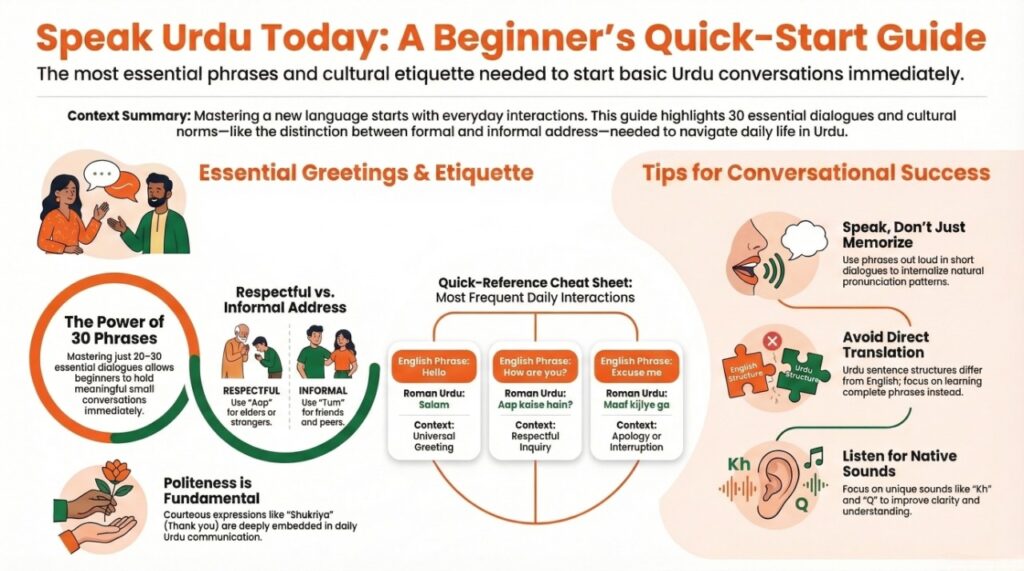
In fact, many language learners discover something interesting early on: you don’t need hundreds of words to start speaking. Sometimes, 20–30 essential phrases can already help you hold small conversations.
This guide focuses on 30 essential Urdu dialogues that beginners can start using immediately. Each phrase includes:
- Urdu script
- Romanised Urdu pronunciation
- English meaning
- Context where it’s commonly used
These dialogues are widely used across Pakistan and the Urdu-speaking communities worldwide, and mastering them will help you communicate in everyday situations.
Perhaps more importantly, they also help you understand how Urdu conversations naturally flow. And that… well, that’s often the hardest part for beginners.
Why Learning Basic Urdu Conversations First Works Better
Many language courses start with grammar lessons. Verb structures. Sentence patterns. Formal rules.
But conversational learning tends to work faster for beginners.
When you practice real-life Urdu dialogues, you immediately learn:
- Natural pronunciation patterns
- Common sentence structures
- Cultural politeness norms
- Frequently used vocabulary
For example, greetings like Salam or polite phrases like Shukriya appear constantly in everyday conversations. Learning them early helps you build confidence quickly.
Another important detail: Urdu conversations change slightly depending on formality.
Urdu uses two common pronouns:
| Pronoun | Usage | Example |
|---|---|---|
| Aap (آپ) | Formal / respectful | Talking to elders or strangers |
| Tum (تم) | Informal | Friends or younger people |
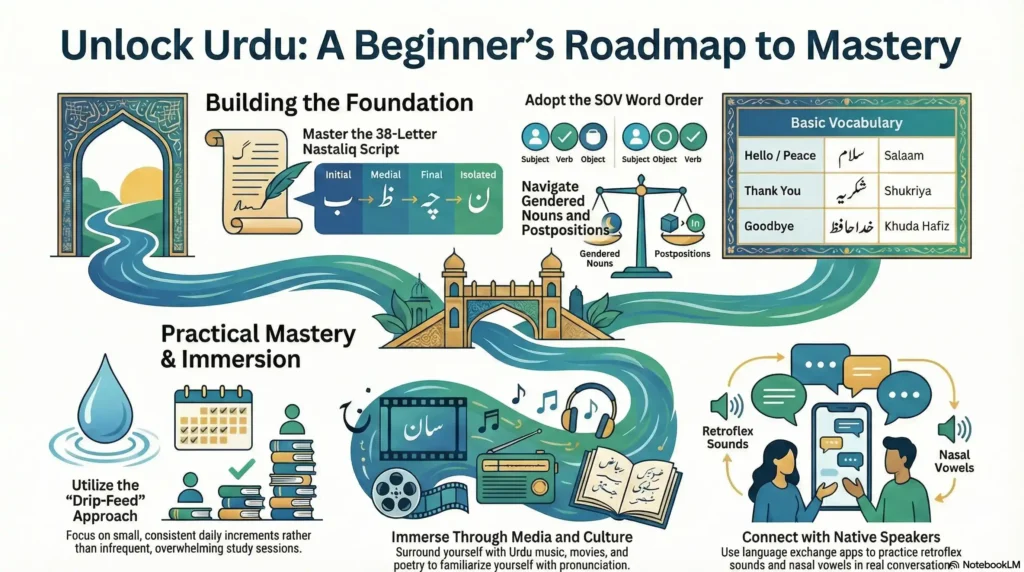
Beginners sometimes mix these up. It happens. But with practice, the difference becomes natural.
1. Basic Urdu Greetings and Introductions
Greetings are usually the first phrases anyone learns in a new language. They’re simple, but they carry a lot of cultural meaning.
In Urdu-speaking cultures, greetings are often warm and polite. Even small conversations typically start with a greeting.
Below are some of the most common Urdu greeting dialogues beginners should know.
Essential Greeting Phrases
| English | Urdu Script | Romanised Urdu | Typical Situation |
|---|---|---|---|
| Hello | سلام | Salam | Universal greeting |
| How are you? (Formal) | آپ کیسے ہیں؟ | Aap kaise hain? | Respectful greeting |
| How are you? (Informal) | تم کیسے ہو؟ | Tum kaise ho? | Friends or peers |
| I am fine | میں ٹھیک ہوں | Main theek hoon | Response to greeting |
| What is your name? | آپ کا نام کیا ہے؟ | Aap ka naam kya hai? | Meeting someone |
| My name is… | میرا نام … ہے | Mera naam … hai | Introducing yourself |
| Nice to meet you | تم سے مل کر اچھا لگا | Tum se mil kar acha laga | After introduction |
| Goodbye | خدا حافظ | Khuda Hafiz | Ending conversation |
Example Dialogue
A small conversation might look like this:
Person A:
Salam
Person B:
Salam, aap kaise hain?
Person A:
Main theek hoon. Aap ka naam kya hai?
Person B:
Mera naam Ali hai. Aap se mil kar acha laga.
It’s simple. Maybe even a little repetitive. But that repetition actually helps beginners internalize patterns.
2. Courtesy and Polite Urdu Phrases
Politeness is deeply embedded in Urdu communication. People frequently use courteous expressions during even the smallest interactions.
If you’re learning basic Urdu conversation for beginners, these polite phrases are essential. They appear in shops, restaurants, daily conversations, and formal interactions.
Sometimes beginners skip them. That’s usually a mistake.
Even a small phrase like Shukriya (thank you) can change how friendly a conversation feels.
Essential Polite Urdu Expressions
| English | Urdu Script | Romanised Urdu | Usage |
|---|---|---|---|
| Thank you | شکریہ | Shukriya | Showing gratitude |
| You’re welcome | خوش آمدید | Khush aamdeed | Response to thanks |
| Please | براہ کرم | Barah-e-karam | Polite request |
| Excuse me / Sorry | معاف کیجئے گا | Maaf kijiye ga | Apology or interruption |
| No problem | کوئی بات نہیں | Koi baat nahi | Reassurance |
| Yes | جی ہاں | Ji haan | Polite agreement |
| No | جی نہیں | Ji nahin | Polite refusal |
Small Polite Conversation Example
Imagine asking for help in a store:
Customer:
Maaf kijiye ga, yeh kya hai?
Shopkeeper:
Yeh kitaab hai.
Customer:
Shukriya.
Shopkeeper:
Koi baat nahi.
Short exchanges like this appear everywhere. Learning them early helps beginners feel more comfortable interacting with Urdu speakers.
3. Basic Urdu Phrases for Daily Life Conversations
Daily conversations often involve small questions. Asking about time. Understanding something. Clarifying information.
These phrases might seem basic. Yet they form the backbone of real communication.
Interestingly, many beginners learn vocabulary but struggle to form questions. Practicing simple question phrases solves that problem fairly quickly.
Below are several everyday Urdu dialogue phrases beginners should learn.
Daily Urdu Conversation Phrases
| English Phrase | Urdu Script | Romanised Urdu | Situation |
|---|---|---|---|
| What time is it? | کیا وقت ہوا ہے؟ | Kya waqt hua hai? | Asking time |
| Where is the bathroom? | بیت الخلا کہاں ہے؟ | Bait ul khala kahan hai? | Public places |
| I don’t know | مجھے نہیں پتہ | Mujhe nahi pata | Uncertainty |
| Do you speak English? | کیا آپ انگلش بولتے ہیں؟ | Kya aap English bolte hain? | Language clarification |
| I don’t understand | سمجھ نہیں آیا | Samajh nahi aaya | Communication issue |
| Please speak slowly | آہستہ بولیں | Aahista bolen | Listening difficulty |
| How much is this? | اس کی قیمت کتنی ہے؟ | Is ki qeemat kitni hai? | Shopping |
| What is this? | یہ کیا ہے؟ | Yeh kya hai? | General question |
Example Real-Life Scenario
A tourist in Pakistan might say:
Tourist:
Maaf kijiye ga, bait ul khala kahan hai?
Local:
Seedha jao, phir daayein mur jao.
Tourist:
Shukriya.
Local:
Koi baat nahi.
Conversations like this happen dozens of times each day.
Beginner Tip: Don’t Memorize… Use
Many language learners try to memorize entire phrase lists.
That approach rarely works long-term.
Instead, try something simpler:
- Speak phrases out loud
- Use them in short dialogues
- Repeat them during daily routines
You might feel awkward at first. Everyone does. But over time, these small phrases start feeling natural.
And that’s when real conversation begins.
4. Urdu Conversations for Directions and Transportation
If you spend even a short time in Pakistan or around Urdu speakers, you’ll quickly notice how often people ask for directions. Streets are busy, neighborhoods can be confusing, and sometimes even locals ask each other for guidance.
For beginners learning basic Urdu conversation, direction-related phrases are surprisingly useful. They’re simple, practical, and used almost daily.
Maybe you’re asking a taxi driver where to stop. Or trying to find a shop, a mosque, or a bus station. These small questions open real conversations.
Below are essential Urdu dialogue phrases for directions and transportation.
| English Phrase | Urdu Script | Romanised Urdu | Typical Situation |
|---|---|---|---|
| Where is…? | … کہاں ہے؟ | … kahan hai? | Asking for locations |
| Go straight | سیدھا جائیں | Seedha jaien | Giving directions |
| Turn left | بائیں مڑیں | Bayain murein | Navigation |
| Turn right | دائیں مڑیں | Daayain murein | Navigation |
| Stop here | یہاں روکو | Yahan roko | Taxi or ride |
| Is it far? | کیا یہ دور ہے؟ | Kya yeh door hai? | Distance question |
| How do I get there? | میں وہاں کیسے جاؤں؟ | Main wahan kaise jaon? | Navigation help |
Example Conversation: Asking for Directions
Traveler:
Maaf kijiye ga, masjid kahan hai?
Local:
Seedha jao, phir bayain murein.
Traveler:
Shukriya.
Local:
Koi baat nahi.
It’s simple, but interactions like this happen constantly in real life. Practicing them helps beginners build conversational confidence very quickly.
5. Urdu Conversations for Food and Restaurants
Food is central to social life in Urdu-speaking cultures. Whether it’s a street food stall or a family dinner invitation, conversations about food come up naturally.
And beginners usually enjoy learning these phrases, probably because they’re practical and immediately usable.
Below are basic Urdu conversation phrases related to food and eating.
| English | Urdu Script | Romanised Urdu | Usage |
|---|---|---|---|
| I am hungry | بھوک لگی ہے | Bhook lagi hai | Express hunger |
| I am thirsty | پیاس لگی ہے | Pyas lagi hai | Express thirst |
| I want water | مجھے پانی چاہیے | Mujhe pani chahiye | Requesting water |
| This is delicious | یہ بہت مزیدار ہے | Yeh bohat mazedaar hai | Complimenting food |
| I want food | مجھے کھانا چاہیے | Mujhe khana chahiye | Requesting meal |
| Do you have tea? | کیا آپ کے پاس چائے ہے؟ | Kya aap ke paas chai hai? | Restaurant or home |
Restaurant Dialogue Example
Customer:
Salam, mujhe pani chahiye.
Waiter:
Ji zaroor.
Customer:
Yeh bohat mazedaar hai.
Waiter:
Shukriya.
Even basic phrases like these help beginners navigate restaurants, family meals, and casual conversations about food.
6. Urdu Shopping Conversations for Beginners
Shopping conversations are another area where basic Urdu phrases become extremely useful. Markets, small stores, and bazaars are full of quick exchanges.
Interestingly, many Urdu-speaking markets involve friendly bargaining, so conversations can become surprisingly lively.
But beginners usually start with the basics: asking about price and understanding items.
Below are common shopping phrases.
| English Phrase | Urdu Script | Romanised Urdu | Situation |
|---|---|---|---|
| How much is this? | اس کی قیمت کتنی ہے؟ | Is ki qeemat kitni hai? | Shopping |
| This is expensive | یہ مہنگا ہے | Yeh mehnga hai | Reacting to price |
| Do you have another one? | کیا آپ کے پاس دوسرا ہے؟ | Kya aap ke paas doosra hai? | Looking for options |
| I will take this | میں یہ لوں گا | Main yeh loon ga | Buying something |
| Do you accept cash? | کیا آپ نقد لیتے ہیں؟ | Kya aap naqd lete hain? | Payment |
Example Bazaar Conversation
Customer:
Yeh kya hai?
Shopkeeper:
Yeh kitaab hai.
Customer:
Is ki qeemat kitni hai?
Shopkeeper:
500 rupees.
Customer:
Yeh mehnga hai.
Conversations like these often expand naturally, especially in local markets.
7. Essential Urdu Vocabulary for Beginners
While dialogues help you start speaking, vocabulary builds the foundation of conversation. Some words appear constantly in everyday Urdu speech or while visitng doctor.
Learning them early makes conversations easier to understand.
Below is a core vocabulary list used frequently in beginner Urdu conversations.
| English | Urdu | Romanised Urdu |
|---|---|---|
| Wait a moment | کچھ دیر انتظار کریں | Kuch dair intezar karein |
| Listen | سنو | Suno |
| Come inside | اندر آئیں | Andar aaien |
| Go outside | باہر جائیں | Bahar jaien |
| What’s the problem? | کیا مسئلہ ہے؟ | Kya masla hai? |
| Friend | دوست | Dost |
| House | گھر | Ghar |
8. Common Beginner Mistakes in Urdu Conversations
When people start learning Urdu conversations, a few common mistakes appear repeatedly.
They’re normal. Every learner goes through them.
1. Mixing Formal and Informal Pronouns
Using tum instead of aap with elders can sound slightly disrespectful.
Beginners sometimes do this accidentally.
A safer approach is simple:
Use aap unless you’re talking to a close friend.
2. Ignoring Pronunciation
Urdu pronunciation contains sounds that don’t exist in English.
For example:
- Kh in Khuda Hafiz
- Q in Qeemat
Listening to native speakers helps improve pronunciation.
3. Translating Directly from English
Urdu sentence structure differs slightly from English.
Instead of:
“I water want”
Urdu says:
Mujhe pani chahiye
“I need water.”
It takes time for the brain to adjust.
Practice Tip: Speak Even If It’s Imperfect
Language learners sometimes hesitate to speak because they worry about mistakes.
But conversation improves only with practice.
Even short exchanges like:
Salam
Aap kaise hain?
Main theek hoon
…can slowly build confidence.
And eventually those small dialogues become natural conversations.
9. Complete List of 30 Basic Urdu Conversations for Beginners
By this point, you’ve seen many phrases scattered across different situations, greetings, directions, shopping, and food. But beginners often prefer having one consolidated list they can review quickly.
So here is a complete reference table of 30 essential Urdu dialogues that beginners can practice daily.
These phrases cover the majority of simple interactions you’re likely to encounter in everyday Urdu communication.
| # | English Phrase | Urdu Script | Romanised Urdu | Common Situation |
|---|---|---|---|---|
| 1 | Hello | سلام | Salam | Greeting someone |
| 2 | How are you? (formal) | آپ کیسے ہیں؟ | Aap kaise hain? | Respectful greeting |
| 3 | How are you? (informal) | تم کیسے ہو؟ | Tum kaise ho? | Friends |
| 4 | I am fine | میں ٹھیک ہوں | Main theek hoon | Reply to greeting |
| 5 | What is your name? | آپ کا نام کیا ہے؟ | Aap ka naam kya hai? | Meeting someone |
| 6 | My name is… | میرا نام … ہے | Mera naam … hai | Introducing yourself |
| 7 | Nice to meet you | آپ سے مل کر اچھا لگا | Aap se mil kar acha laga | First meeting |
| 8 | Goodbye | خدا حافظ | Khuda Hafiz | Ending conversation |
| 9 | Thank you | شکریہ | Shukriya | Showing gratitude |
| 10 | You’re welcome | خوش آمدید | Khush aamdeed | Response to thanks |
| 11 | Please | براہ کرم | Barah-e-karam | Polite request |
| 12 | Excuse me / Sorry | معاف کیجئے گا | Maaf kijiye ga | Apology |
| 13 | No problem | کوئی بات نہیں | Koi baat nahi | Reassurance |
| 14 | Yes | جی ہاں | Ji haan | Agreement |
| 15 | No | جی نہیں | Ji nahin | Disagreement |
| 16 | What time is it? | کیا وقت ہوا ہے؟ | Kya waqt hua hai? | Asking time |
| 17 | Where is the bathroom? | بیت الخلا کہاں ہے؟ | Bait ul khala kahan hai? | Public places |
| 18 | I don’t know | مجھے نہیں پتہ | Mujhe nahi pata | Uncertainty |
| 19 | Do you speak English? | کیا آپ انگلش بولتے ہیں؟ | Kya aap English bolte hain? | Language clarification |
| 20 | I don’t understand | سمجھ نہیں آیا | Samajh nahi aaya | Communication difficulty |
| 21 | Please speak slowly | آہستہ بولیں | Aahista bolen | Listening help |
| 22 | How much is this? | اس کی قیمت کتنی ہے؟ | Is ki qeemat kitni hai? | Shopping |
| 23 | What is this? | یہ کیا ہے؟ | Yeh kya hai? | Clarification |
| 24 | Where is…? | … کہاں ہے؟ | … kahan hai? | Asking location |
| 25 | Go straight | سیدھا جاؤ | Seedha jao | Directions |
| 26 | Turn left | بائیں مڑیں | Bayain murein | Directions |
| 27 | Turn right | دائیں مڑیں | Daayain murein | Directions |
| 28 | I am hungry | بھوک لگی ہے | Bhook lagi hai | Food conversation |
| 29 | I want water | مجھے پانی چاہیے | Mujhe pani chahiye | Requesting water |
| 30 | This is delicious | یہ بہت مزیدار ہے | Yeh bohat mazedaar hai | Complimenting food |
Frequently Asked Questions About Basic Urdu Conversation
Is Urdu difficult for beginners?
Urdu can seem challenging initially because of its script and pronunciation. However, basic Urdu conversation phrases are quite simple, and beginners can start speaking within a few days of practice.
How many Urdu phrases should beginners learn first?
Most language experts recommend starting with 20–30 core phrases, especially greetings, polite expressions, and daily questions.
These allow beginners to handle common situations quickly.
Should beginners learn Urdu script immediately?
Not necessarily. Many learners begin with Romanised Urdu (Urdu written using English letters). Later, they gradually learn the Urdu script for reading and writing.
How long does it take to learn basic Urdu conversation?
With consistent practice, beginners can learn simple conversations within two to four weeks.
Fluency, of course, takes longer and requires regular exposure.
Final Thoughts
Learning basic Urdu conversation for beginners doesn’t require mastering the entire language immediately.
Sometimes it begins with just a few words:
Salam.
Shukriya.
Aap kaise hain?
Those small phrases open doors to real conversations.
Over time, as vocabulary grows and pronunciation improves, those short dialogues become natural communication.
And eventually… Urdu stops feeling like a foreign language.
It becomes something you can use every day.
Practice the Urdu Phrases You Just Learned
Now that you’ve explored these basic Urdu conversation phrases, try using them yourself. Write one or two Urdu phrases in the comments that you learned from this guide. Even simple phrases like:
Salam
Aap kaise hain?
Shukriya
Practicing small phrases helps you remember them faster and builds confidence when speaking Urdu. We’d love to see what you learned. Share your favorite Urdu phrase in the comments below.