You want to learn Urdu. Maybe it’s for family, maybe it’s for work, maybe someone you care about speaks it and you’re tired of nodding along. But here’s the problem your calendar is already a disaster. Meetings back to back, deadlines stacking up, and somehow you’re supposed to add a new language on top of all that? It sounds impossible. But it isn’t.
The truth is, most language learning advice is designed for students with hours to spare. This post is not that. This is for the professional who can carve out 15 to 20 minutes a day maybe on a commute, maybe during lunch, maybe right before bed and still make genuine, measurable progress in Urdu.
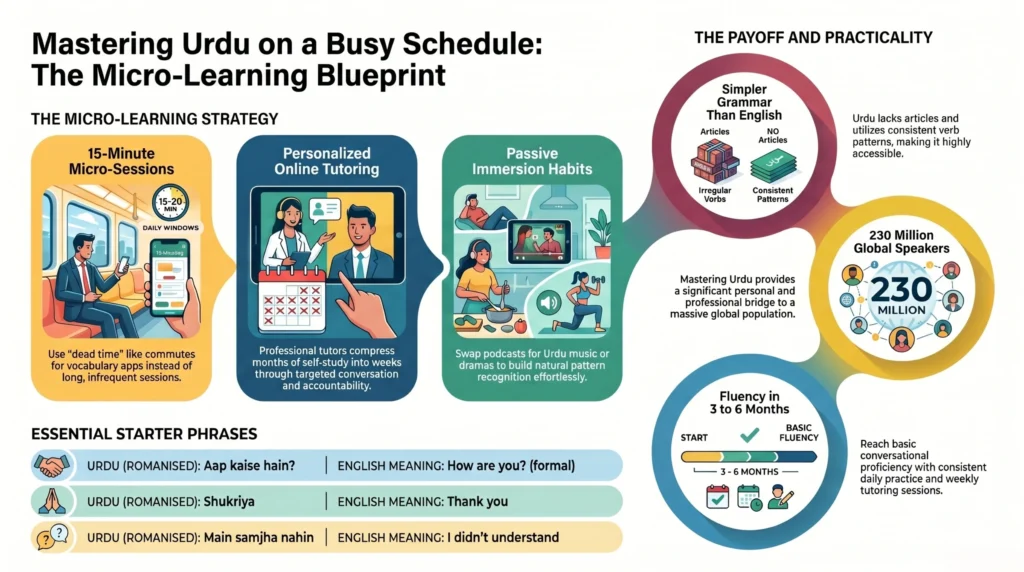
Urdu, by the way, is one of the most beautiful languages in the world. Rich in poetry, warm in everyday conversation, and spoken by over 230 million people globally. There’s a real payoff here, both personally and professionally. Let’s get into it.
Why Urdu Is Actually a Practical Choice for Time-Strapped Learners
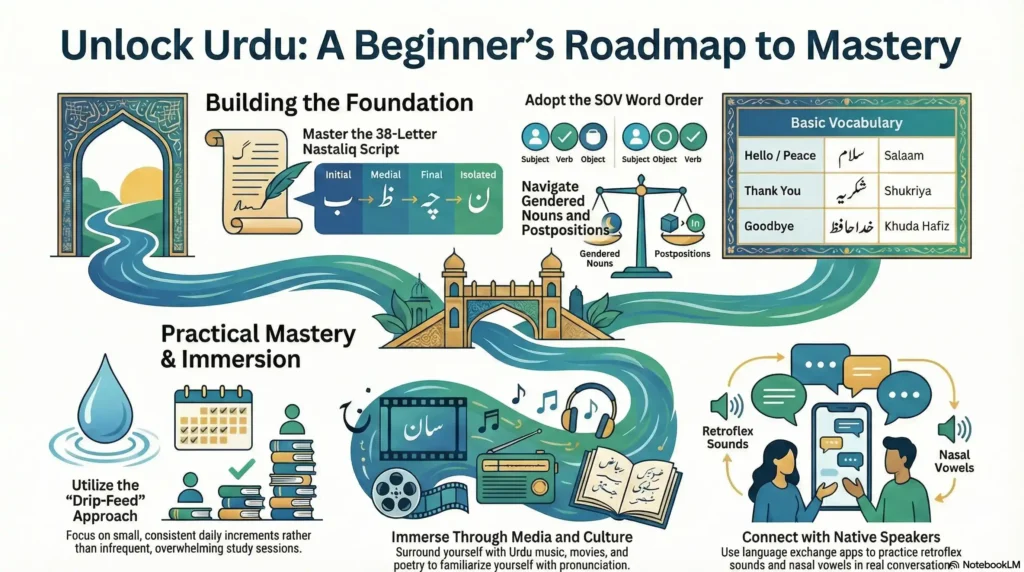
People often assume Urdu is wildly difficult for English speakers. The script looks intimidating, sure. But here’s what most people don’t mention Urdu grammar is, in many ways, simpler than English grammar. There are no articles (no ‘a’, ‘the’). Verb conjugation follows consistent patterns. And if you already know any Hindi, well, you’re probably halfway there in terms of spoken vocabulary.
The script (Nastaliq, written right-to-left) is a genuine challenge. But for practical spoken Urdu? You can bypass the script entirely at first using Romanised Urdu and still hold real conversations. Most modern online tutors, including those at DesiLingua, teach this way for beginners.
The Real Problem: It’s Not Time, It’s Structure
I think the biggest mistake most busy people make is waiting for a “good block of time” to start learning. That block never comes. What actually works is micro-learning breaking your study into short, consistent sessions that fit inside the gaps you already have.
Research in language acquisition suggests that spaced repetition reviewing vocabulary and phrases at increasing intervals outperforms long, infrequent study sessions almost every time. So your 15 minutes every day is, genuinely, better than a 2-hour session on Sunday.
Practical Strategies: How to Fit Urdu Into a Packed Day
1. Micro-Sessions During Dead Time
Your commute, your lunch break, the 10 minutes waiting for a meeting to start this is all usable time. Apps like Duolingo and Drops let you practice vocabulary in 5-minute bursts. Not ideal as your only learning method, but genuinely useful for vocabulary building and script recognition
Perhaps the easiest habit to build is simply labeling things around your workspace in Urdu. Your desk, your monitor, your coffee mug. Small, slightly silly, but it works.
2. Schedule Weekly Online Urdu Lessons (The Fastest Route)
If there’s one thing I’d prioritize, it’s this. A dedicated online tutor someone who teaches to your level, your goals, your schedule compresses months of self-study into weeks. Platforms like Preply connect you with native-speaking tutors who offer flexible, asynchronous scheduling that fits around professional lives.
At DesiLingua.net, the approach is exactly this: structured Urdu, Punjabi, and English lessons delivered online, by a real tutor, on your timeline. Whether you have 30 minutes twice a week or an hour on weekends, it’s adaptable. This is the kind of learning that actually sticks for busy people because you’re held accountable, and you’re using the language in real conversation from the very first lesson.
3. Passive Immersion: Background Learning That Adds Up
Swap your usual podcast for an Urdu-language show on YouTube. Watch a Pakistani drama with subtitles on. You’re not “studying” you’re just listening. But over time, pattern recognition kicks in and you start catching words you’ve learned, hearing how sentences flow, and building a feel for the rhythm of the language.
A few recommendations worth trying:
• Coke Studio (Pakistan) Urdu music with rich vocabulary
• Ary Digital dramas natural conversational Urdu with subtitles
• Urdu podcasts like ‘Suno’ news-based, excellent for intermediate learners
4. Use Spaced Repetition Flashcards (Anki or Similar)
Anki is free, available on mobile, and has pre-built Urdu decks. Use it while waiting in line, on the elevator, or during any 2-minute gap. It sounds trivial. It isn’t. Consistency at this scale compounds fast 10 new words a day is 300 words in a month, which is roughly what you need for basic survival conversation.
Essential Urdu Phrases for Professionals
Start here. These are the phrases that actually come up in real life. Written first in Urdu script, then Romanised Urdu, then English.
| اردو (Urdu Script) | Urdu (Romanised) | English Meaning |
| السلام علیکم | Assalam-o-Alaikum | Peace be upon you / Hello |
| آپ کیسے ہیں؟ | Aap kaise hain? | How are you? (formal) |
| میں ٹھیک ہوں | Main theek hoon | I am fine / I’m well |
| شکریہ | Shukriya | Thank you |
| معاف کیجیے | Maaf kijiye | Excuse me / I’m sorry (formal) |
| کیا آپ انگریزی بولتے ہیں؟ | Kya aap Angrezi bolte hain? | Do you speak English? |
| میں سمجھا نہیں | Main samjha nahin | I didn’t understand |
| برائے مہربانی | Baraay-e-meherbani | Please |
| خداحافظ | Khuda Hafiz | Goodbye |
| ملتے ہیں | Milte hain | See you / We’ll meet again |
Quick Reference: Urdu Numbers and Greetings for Daily Use
| اردو (Urdu) | Romanised Urdu | English |
| ایک | Aik | One (1) |
| دو | Do | Two (2) |
| تین | Teen | Three (3) |
| چار | Chaar | Four (4) |
| پانچ | Paanch | Five (5) |
| صبح بخیر | Subah bakhair | Good morning |
| شب بخیر | Shab bakhair | Good night |
| آپ کا نام کیا ہے؟ | Aap ka naam kya hai? | What is your name? |
| میرا نام … ہے | Mera naam … hai | My name is … |
| مجھے اردو سیکھنی ہے | Mujhe Urdu seekhni hai | I want to learn Urdu |
Common Mistakes Busy Learners Make (And How to Avoid Them)
Waiting for a “perfect time” to start. There isn’t one. Start with 5 minutes today.
Relying only on apps. Apps are useful supplements but weak as a primary method. Without actual conversation practice, you’ll plateau fast.
Trying to learn the script on day one. Urdu script is beautiful and worth learning but it’s not urgent. You can be speaking confidently in Romanised Urdu while the script catches up.
Inconsistency. Two sessions this week, nothing for two weeks, one session next week that’s not language learning, that’s dabbling. Even 10 minutes every single day beats an hour once a week.
No speaking practice. Reading vocabulary is not the same as speaking Urdu. You need to hear yourself say the words, make the mistakes, get corrected. A tutor is irreplaceable for this.
Why Online Tutoring Is the Best Investment for Busy Urdu Learners
I’ll be honest I’m a bit biased toward the tutoring approach because I’ve seen it work where everything else stalls. The reason is simple: accountability plus personalisation.
When you book a session with a real tutor, you show up. When you download an app, you might. That difference alone explains a lot. Beyond that, a good Urdu tutor tailors every lesson to where you are your pronunciation gaps, your vocabulary holes, your specific goals (business Urdu vs. conversational Urdu vs. understanding your in-laws, genuinely all different skill sets).
At DesiLingua.net, sessions are fully online, available at flexible hours to suit international time zones and professional calendars. If you’re based in the UK, the US, Canada, or anywhere else with a South Asian connection, this is exactly the kind of resource built for you.
Frequently Asked Questions
How long does it take to learn conversational Urdu?
With consistent practice 20 to 30 minutes daily plus weekly tutoring most adult learners can reach basic conversational fluency in 3 to 6 months. Advanced proficiency takes longer, obviously, but you’d be surprised how quickly you can hold a real conversation.
Is Urdu hard to learn for English speakers?
The US Foreign Service Institute classifies Urdu as a Category III language meaning it takes more effort than Spanish or French but less than Japanese or Arabic. The script is the hardest part. Spoken Urdu, however, is more accessible than people assume.
Can I learn Urdu without learning the script?
Yes, at least for spoken fluency. Romanised Urdu (Urdu written in the Latin alphabet) is widely understood and is often used in texts, social media, and casual messaging. You can have full conversations in Urdu without reading Nastaliq script though eventually, learning the script opens up literature, signage, and a much richer cultural world.
Final Thoughts: Small Habits, Real Progress
Learning Urdu with a packed schedule is genuinely possible. Not easy, maybe. But entirely possible. The key isn’t finding three free hours, it’s building a system of small, consistent habits that add up quietly over time.
Start with five phrases this week. Book one trial lesson. Install one app. The momentum builds faster than you’d think, and one day you’ll realize you understood something without translating it in your head first. That moment is worth every five-minute session you put in.
If you’re ready to start, DesiLingua.net offers flexible, online Urdu lessons designed around real lives and real schedules. Book a trial session and see how quickly things can move when you have the right teacher.