Most people who want to learn Conversational Punjabi don’t want to conjugate verbs on a whiteboard. They want to say something real, greet a grandmother, order food at a dhaba, laugh at a joke they actually understand. And honestly? That’s exactly where teaching should begin.
Grammar has its place. I’m not saying throw it out entirely. But leading with rules before a student can even say “how are you” comfortably that’s where most Punjabi learning falls apart. The student gets bored, confused, or just quietly gives up.
The good news is there’s a better way. Conversation-first teaching grounded in real situations, cultural context, and genuine listening.
Why Grammar Drills Don’t Work for Conversational Punjabi
Think about how you learned your first language. Nobody handed you a chart of verb endings. You heard words. You repeated sounds. You made mistakes and someone gently corrected you or didn’t, and you figured it out later. That natural process is still available to adult learners, and it works.
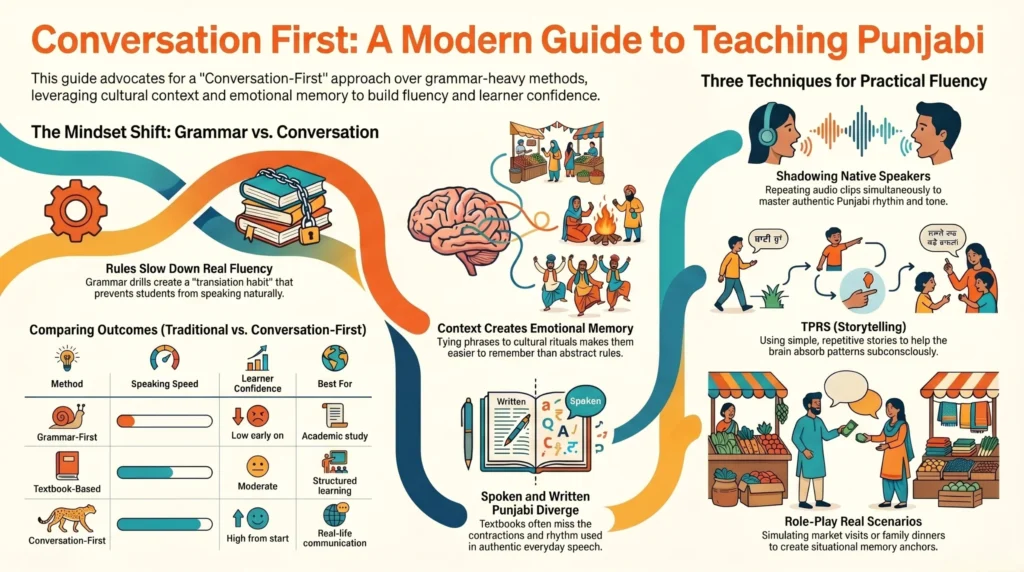
Punjabi, in particular, is a language where spoken fluency and written grammar diverge quite a bit. The Punjabi you hear in a village in Punjab, in a London kitchen, or at a wedding in Toronto it moves fast. It uses contractions, cultural references, and expressions that no textbook has ever bothered to include.
Starting with grammar actually slows learners down. It creates a mental habit of translating from English grammar rules to Punjabi sentences instead of simply speaking. That translation step is the enemy of fluency.
Conversation-First vs Grammar-First vs Textbook-Based: A Comparison
Here’s a quick look at how different teaching approaches stack up when the goal is real, everyday conversation:
| Teaching Method | Grammar-First | Textbook-Based | Conversation-First ✓ |
| Speaking Speed | Slow rules before speaking | Moderate structured but rigid | Fast speaking |
| Cultural Nuance | Rarely covered | Sometimes included | Central to every lesson |
| Learner Confidence | Low early on | Moderate | High from the start |
| Retention Rate | Low (no context) | Moderate | High (contextual memory) |
| Best For | Academic study | Structured learning | Real-life communication |
The Core Principle: Context Over Rules
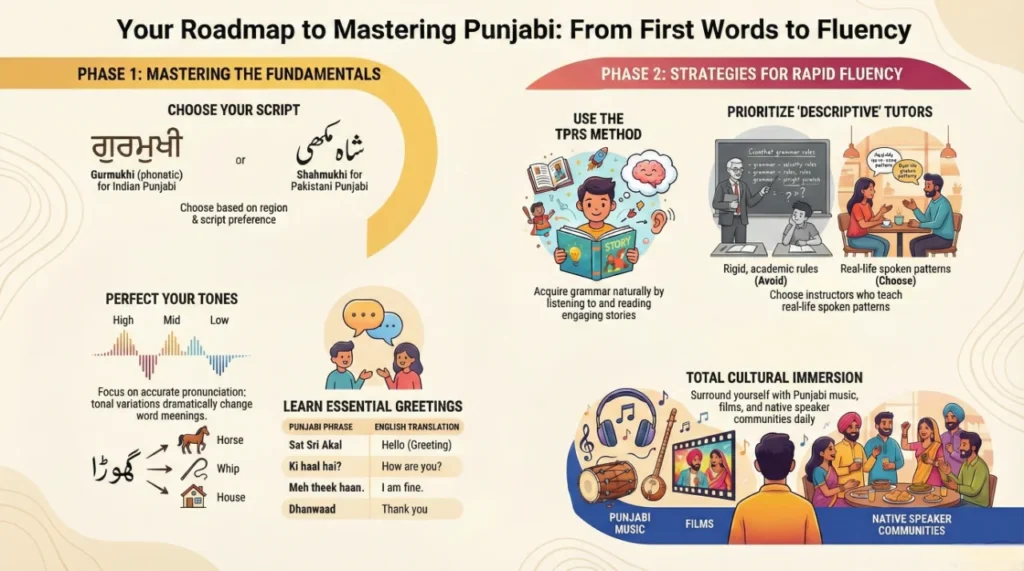
When you teach a phrase like ਸਤਿ ਸ੍ਰੀ ਅਕਾਲ (Sat Sri Akal — Hello / Blessed is God), you’re not just teaching a greeting. You’re opening a door to Sikh culture, Punjabi identity, and the warmth of a community that means it when they say it. That’s the context. That’s what makes it memorable.
Compare that to drilling “Subject + Verb + Object in Punjabi” for twenty minutes. Which one do you think a student remembers the next morning?
Context does what repetition alone cannot. It creates emotional memory and emotional memory is long-term memory.
Essential Conversational Punjabi Phrases to Start With
Before anything else, get your students comfortable with these everyday phrases. Each one comes with its Urdu script, romanised Punjabi, and English meaning:
| Gurmukhi (ਪੰਜਾਬੀ) | Romanised Punjabi | English | Context / Use |
| ਕੀ ਹਾਲ ਏ ਯਾਰ? | Ki haal ae yaar? | What’s up, man? | Casual greeting between friends |
| ਬਹੁਤ ਚੰਗਾ ਲੱਗਿਆ | Bahut changa lagya | Really liked it / Felt great | Expressing enjoyment or approval |
| ਹੁਣ ਕੀ ਕਰਨਾ ਏ? | Hun ki karna ae? | So what are we doing now? | Planning / deciding together |
| ਯਾਰ, ਸੱਚ ਦੱਸ | Yaar, sach dass | Bro, tell me the truth | Asking for honesty from a friend |
| ਚੱਲ ਛੱਡ ਯਾਰ | Chal chhad yaar | Forget it / Let it go | Brushing something off casually |
| ਥੋੜਾ ਰੁਕ | Thoda ruk | Wait a second | Asking someone to pause |
| ਕੋਈ ਗੱਲ ਨਹੀਂ | Koi gall nahi | No worries / It’s okay | Reassurance in daily conversation |
Proven Techniques to Teach Without a Textbook
So what does this look like in practice? There are a few approaches that consistently work well and I think most teachers can adapt these whether they’re working one-on-one, in a classroom, or online.
1. TPRS Teaching Proficiency Through Reading and Storytelling
TPRS sounds more academic than it is. At its core, it’s just: tell a simple, repetitive story in Punjabi, ask comprehension questions in Punjabi, and let the student’s brain absorb the patterns without explaining them.
Example story starter: “ਇੱਕ ਬੰਦਾ ਸੀ” (Ikk banda si There was a man). Build from there. Ask: “ਕਿੱਥੇ ਸੀ?” (Kitthe si? Where was he?). The student doesn’t know they’re learning past tense. They just know they’re telling a story.
2. Shadowing Native Speakers
Shadowing means playing audio of a native Punjabi speaker and repeating what you hear almost simultaneously. It feels odd at first. But it is, perhaps, the fastest way to pick up natural rhythm, tone, and authentic pronunciation.
Use clips from Punjabi YouTube channels, songs, or short podcast segments. Punjabi folk songs work especially well they’re repetitive, emotionally resonant, and full of useful everyday vocabulary.
3. Role-Play Real Scenarios
Set up conversations that your student will actually have. Meeting a relative. Shopping at a sabzi mandi. Asking for directions in Lahore or Amritsar. Refusing food politely (an important survival skill in any Punjabi household).
Role-play creates situational anchors in memory. When your student encounters that real situation later, their brain will retrieve the language because it’s already tied to a lived (or simulated) experience.
4. Listening First The Silent Period
Don’t rush a beginner to speak. Especially in the first few sessions, consider a listening-heavy approach. Let them hear Punjabi. Let their ears adjust to the sounds before their mouths are expected to produce them. This is how children learn, and it’s not something most adult language courses respect nearly enough.
5. Spaced Repetition for Phrases, Not Grammar
Tools like Anki or even simple flashcards work but only if you’re reviewing whole phrases in context, not isolated words. “Tussi kiven ho / ਤੁਸੀਂ ਕਿਵੇਂ ਹੋ” reviewed three times over a week is infinitely more useful than memorising fifty vocabulary words once.
Teaching Techniques at a Glance
| Technique | How It Works | Why It Helps |
| TPRS (Story-based) | Repeat simple stories, ask comprehension questions | Brain absorbs grammar through context, not rules |
| Shadowing | Mimic native speakers in real time | Builds natural rhythm and accent |
| Role-play Scenarios | Act out real situations: market, family, travel | Creates emotional memory and confidence |
| Spaced Repetition (SRS) | Review phrases at increasing intervals | Long-term retention without cramming |
| Listening First | Immerse in audio before speaking | Trains the ear, reduces accent and hesitation |
What to Prioritise in Your First 8 Weeks
If you’re designing a curriculum or even just informal lessons here’s roughly how I’d think about sequencing things. Not rigid. More like a rough map.
• Weeks 1–2: Greetings, self-introduction, and basic responses “ਮੈਂ ਠੀਕ ਹਾਂ” / Main theek haan / I’m fine
• Weeks 3–4: Family vocabulary, asking about others, hospitality phrases
• Weeks 5–6: Food, directions, numbers, and market conversations
• Weeks 7–8: Emotions, opinions, telling simple stories in past tense
Notice there are no grammar units in that list. That doesn’t mean grammar doesn’t get addressed; it absolutely does, naturally, as questions come up. But it’s never the starting point.
A Note on Punjabi Dialects and Regional Variation
Punjabi isn’t one thing. The Majhi dialect spoken around Lahore and Amritsar is considered the prestige form, but Doabi, Malwai, and Pothohari are all widely spoken. If your student has a specific community or family connection, lean into that dialect early.
This is something textbooks almost never account for. A student learning to connect with Pakistani Punjabi relatives will encounter different vocabulary, rhythm, and even script than someone learning to speak with Indian Punjabi colleagues. That difference matters, and it’s worth acknowledging in your teaching.
The Role of Culture in Language Fluency
You cannot really teach Punjabi without teaching Punjabi culture. The two are woven together in ways that are hard to separate. The way elders are addressed, the rituals around food, the importance of hospitality, these aren’t side notes. They’re embedded in the language itself.
So use that. Bring in Punjabi music from classic folk to modern Punjabi pop. Watch clips of Punjabi weddings. Talk about Vaisakhi. Cultural immersion isn’t a bonus; it’s arguably the fastest path to genuine fluency.
Common Mistakes Teachers Make (And How to Avoid Them)
A few things I’ve seen trip up even well-intentioned teachers:
• Starting with Gurmukhi or Shahmukhi script too early script is important, but conversational fluency can be built through romanised Punjabi first
• Correcting every mistake this kills confidence fast; let small errors pass and correct patterns, not every instance
• Using English as a crutch aim for 70%+ Punjabi in lessons from Week 2 onward
• Skipping cultural context language divorced from culture becomes vocabulary, not fluency
• Moving too fast slower, deeper is almost always better than rushing through content
Resources Worth Using (And a Few to Avoid)
For audio and listening practice, YouTube is genuinely excellent search for Punjabi talk shows, cooking channels, or family vlogs. Real, unscripted Punjabi conversation is out there in abundance.
What to avoid? Probably any app that doesn’t offer Punjabi at all, or isolated vocabulary builders that never connect words to conversation. Knowing fifty words isn’t speaking a language.
Final Thoughts: Fluency Is Built in Conversation, Not Classrooms
There’s something that gets said in language teaching circles that I think is genuinely true: conversation is learned, not taught. The best a teacher can do is create the conditions for it to happen through context, repetition, cultural anchoring, and a lot of patience.
Punjabi is a beautiful, expressive, deeply human language. It deserves to be taught as it is actually spoken fast, warm, full of feeling, and not at all like a grammar exercise.
Start with phrases. Build with stories. Ground everything in culture. And trust that the grammar will sort itself out, the way it always has, when humans just talk to each other.