Why Learning Even Basic Urdu Changes Your Pakistan Trip
Pakistan is one of those places that surprises people. Completely. You arrive expecting one thing, probably whatever version of it you’ve absorbed through news headlines or distant stories and then the country just rewires your assumptions within the first few hours. The food alone is worth the trip. But here’s the thing most travel guides don’t tell you enough: knowing even a handful of Urdu phrases turns a polite tourist experience into something genuinely warm, occasionally hilarious, and a lot more memorable.
Urdu is Pakistan’s national language, spoken and understood across the country from the bustling streets of Lahore and Karachi to the quieter towns of the north near Gilgit or Hunza. English does work in hotels and bigger cities, sure. But the moment you try even a broken “Shukriya” (thank you) or a clumsy “Kahan hai?” (where is it?), something shifts. People smile differently. They lean in. You’ve made an effort, and that effort genuinely matters in Pakistani culture.
This guide covers the most practical Urdu phrases a traveller needs organised by situation, written in Urdu script, Romanised Urdu, and English. No linguistic background required. Just curiosity and a willingness to mispronounce things with confidence.
What You’ll Learn: A Quick Overview
Before diving in, here’s roughly what this guide covers. Think of it as a phrasebook built for real situations, not textbook exercises.
• Greetings and polite expressions
• Getting around transport and directions
• Ordering food and navigating restaurants
• Shopping and bargaining at local markets
• Emergency phrases and asking for help
• Accommodation and hotel vocabulary
• Urdu script vs Romanised Urdu which to use
1. Greetings and Polite Expressions
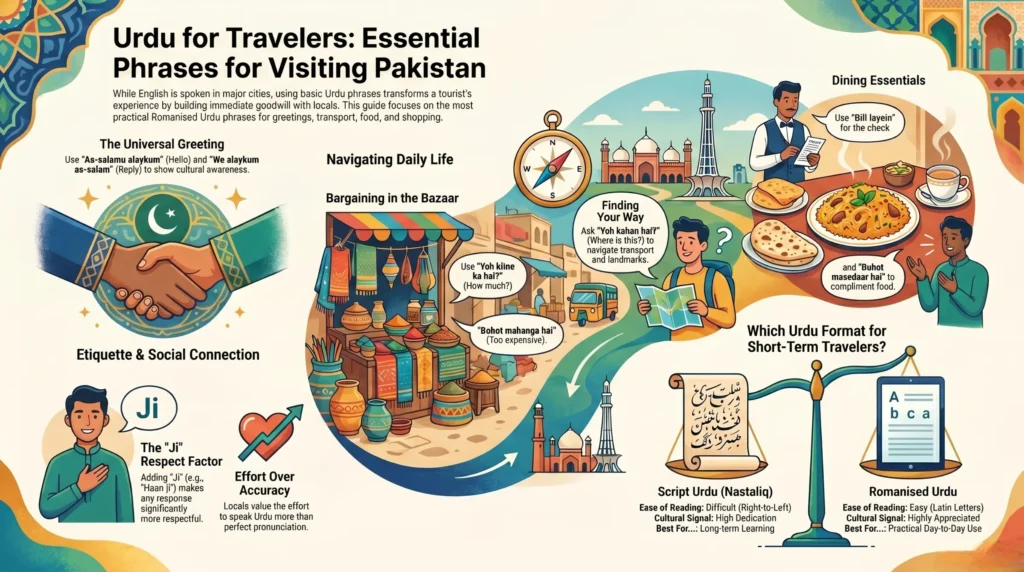
Pakistani culture places enormous value on greetings. It’s not just a formality it’s almost an art form. The standard greeting, “As-salamu alaykum”, is used everywhere, by almost everyone, regardless of how well they know you. Responding with “Wa alaykum as-salam” shows basic cultural awareness and will earn you immediate goodwill.
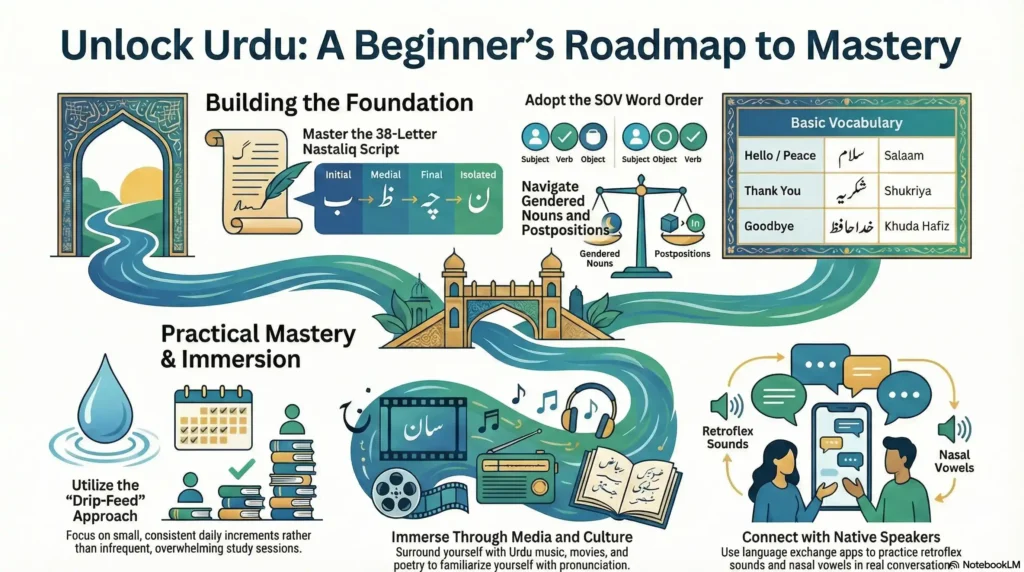
A few notes before the table: Urdu is written right-to-left in the Nastaliq script, which can look intimidating. But the Romanised versions below are perfectly usable for speaking. Most locals will understand you fine they won’t expect perfect pronunciation, and frankly, your attempt is the point.
| اردو (Urdu) | Romanised | English |
| السلام علیکم | As-salamu alaykum | Peace be upon you (Hello) |
| وعلیکم السلام | Wa alaykum as-salam | And upon you peace (Reply) |
| خوش آمدید | Khush amdeed | Welcome |
| شکریہ | Shukriya | Thank you |
| معاف کریں | Maaf karein | Excuse me / Sorry |
| کوئی بات نہیں | Koi baat nahi | No problem / You’re welcome |
| خدا حافظ | Khuda hafiz | Goodbye |
| ہاں | Haan | Yes |
| نہیں | Nahi | No |
Pro tip: Adding “Ji” (جی) to almost anything makes it more respectful. “Haan ji” instead of just “Haan” it’s a small touch that locals notice and appreciate.
2. Getting Around Pakistan
Transport in Pakistan is wonderfully chaotic in the best possible way. You’ll encounter rickshaws, local buses, Uber (yes, it works in major cities), intercity coaches, and the occasional camel in rural areas. Knowing how to ask about fares, directions, and destinations will save you both time and money because without Urdu, you are almost certainly going to be quoted a tourist price.
Bargaining over rickshaw fares is completely normal, expected even. Nobody is offended. It’s part of the exchange. Have these phrases ready before you hop in.
| اردو (Urdu) | Romanised | English |
| یہ کہاں ہے؟ | Yeh kahan hai? | Where is this? |
| ٹیکسی کہاں ملے گی؟ | Taxi kahan milay gi? | Where can I get a taxi? |
| بس اسٹاپ کہاں ہے؟ | Bus stop kahan hai? | Where is the bus stop? |
| کتنا کرایہ ہے؟ | Kitna kiraya hai? | How much is the fare? |
| مجھے ہوٹل جانا ہے | Mujhe hotel jaana hai | I need to go to the hotel |
| یہاں رکیں | Yahan rukein | Stop here |
| سیدھا جائیں | Seedha jayein | Go straight |
| بائیں مڑیں | Baein murain | Turn left |
| دائیں مڑیں | Dayein murain | Turn right |
| ہوائی اڈہ | Hawai adda | Airport |
| ریلوے اسٹیشن | Railway station | Train station |
One thing worth mentioning: if someone gives you directions, they may say “bas thodi door hai” literally, “it’s just a short distance away.” This is… optimistic. “Thodi door” can mean anywhere from two minutes to forty-five. Proceed with gentle scepticism and maybe confirm with Google Maps.
3. Food and Restaurants Ordering Like a Local
Pakistani food deserves its own travel category. Biryani, nihari, karahi, haleem honestly, the food situation in Pakistan is one of the best-kept secrets in South Asian travel. And navigating it is much easier when you can communicate basic preferences, ask about ingredients, and handle the bill without confusion.
Most restaurants outside of major hotels won’t have English menus. Some won’t have menus at all they’ll just tell you what’s available. This is actually quite common at dhabas (roadside eateries), which are often the most delicious options anyway.
| اردو (Urdu) | Romanised | English |
| یہ کیا ہے؟ | Yeh kya hai? | What is this? |
| مجھے گوشت نہیں چاہیے | Mujhe gosht nahi chahiye | I don’t want meat |
| بل لائیں | Bill layein | Please bring the bill |
| پانی لائیں | Pani layein | Please bring water |
| بہت مزیدار ہے | Bohot mazedaar hai | This is very delicious |
| تھوڑا تیکھا کم کریں | Thora teekha kam karein | Make it a little less spicy |
| کھانا کب تک ملے گا؟ | Khana kab tak milay ga? | How long will the food take? |
If you have dietary restrictions, be specific. Saying “mujhe gosht nahi chahiye” (I don’t want meat) is helpful, but follow it up with what you do want. Vegetarian options exist, particularly in larger cities and Punjab region, but they’re not always the default assumption.
4. Shopping and Bargaining at Markets
The bazaars of Pakistan Anarkali in Lahore, Zainab Market in Karachi, the old bazaars of Peshawar are genuinely spectacular. Overwhelming in the best way. But they do require a certain comfort with negotiation. Fixed prices are the exception, not the rule, in traditional markets.
The approach that works: ask the price, express mild (or dramatic) shock, counter-offer at around 50-60% of the quoted price, and meet somewhere in the middle. It’s a social ritual more than a confrontation. Smiling helps. A lot.
| اردو (Urdu) | Romanised | English |
| یہ کتنے کا ہے؟ | Yeh kitne ka hai? | How much does this cost? |
| بہت مہنگا ہے | Bohot mahanga hai | This is very expensive |
| مجھے یہ لینا ہے | Mujhe yeh lena hai | I want to buy this |
| کیا کوئی اور رنگ ہے؟ | Kya koi aur rang hai? | Do you have another colour? |
| میں بعد میں آؤں گا | Main baad mein aoonga | I’ll come back later |
| رسید دیں | Raseed dein | Please give me a receipt |
One phrase that works almost universally: “Yaar, itna mahanga?” “Friend, that expensive?” The word “yaar” (buddy/friend) immediately softens the interaction and gets a laugh more often than not.
5. Emergency Phrases Better to Have Them, Never Need Them
Pakistan is, by most travellers’ accounts, considerably safer than international media suggests particularly for visitors who take basic precautions. That said, emergencies happen anywhere. Knowing how to ask for help in the local language can make a real difference when things go wrong.
| اردو (Urdu) | Romanised | English |
| مجھے ہسپتال جانا ہے | Mujhe hospital jaana hai | I need to go to the hospital |
| میں گم ہو گیا ہوں | Main gum ho gaya hoon | I am lost |
| میرا پاسپورٹ گم ہو گیا | Mera passport gum ho gaya | My passport is lost |
| کیا آپ انگریزی بولتے ہیں؟ | Kya aap angrezi boltay hain? | Do you speak English? |
| مجھے سمجھ نہیں آئی | Mujhe samajh nahi aayi | I don’t understand |
Pakistan’s emergency number is 115 (rescue/ambulance) and 15 (police). Keep these saved in your phone. Most urban police officers in Pakistan’s major cities speak at least some English, but in smaller towns and rural areas, Urdu is your best option.
6. Accommodation Hotels, Guesthouses, and Staying Comfortable
Pakistan’s accommodation ranges from budget guesthouses at around 3,500 PKR per night to upscale international hotels in Lahore and Islamabad. Outside of the five-star bracket, English proficiency can be limited which is where having a few key phrases genuinely helps.
| اردو (Urdu) | Romanised | English |
| کمرہ بک کرنا ہے | Kamra book karna hai | I want to book a room |
| کمرے کا کرایہ کتنا ہے؟ | Kamre ka kiraya kitna hai? | What is the room rate? |
| چیک آؤٹ کب ہے؟ | Check out kab hai? | When is check-out? |
| کمرہ صاف کریں | Kamra saaf karein | Please clean the room |
| ایک اضافی تکیہ چاہیے | Ek izafi takiya chahiye | I need an extra pillow |
7. Urdu Script vs Romanised Urdu Which Should You Use?
This is a fair question, and the honest answer is: for most travellers, Romanised Urdu is the more practical starting point. Learning Nastaliq script takes time. It’s a beautiful script, right-to-left, with letters that change form depending on position in a word. Worth learning eventually, but probably not before a two-week trip.
| Feature | Script Urdu (Nastaliq) | Romanised Urdu |
| Reading ease for foreigners | Difficult right-to-left script | Easy familiar Latin letters |
| Used by locals | Yes official written form | Yes widely used in texts & signs |
| App keyboard support | Requires special keyboard | Works on any standard keyboard |
| Pronunciation accuracy | Requires training to decode | Approximates sounds well |
| Best for travellers | Learning slowly over time | Day-to-day practical use |
| Cultural respect signal | High shows dedication | Moderate still appreciated |
That said, even recognising a few written Urdu words like “ہوٹل” (hotel), “بازار” (bazaar), or “پانی” (water) can be genuinely useful when reading signage. And locals always appreciate it when you try.
Quick Reference: The Most Important Urdu Phrases for Travellers
If you only memorise a handful of phrases before your trip, make it these:
• السلام علیکم / As-salamu alaykum | Hello
• شکریہ / Shukriya | Thank you
• معاف کریں / Maaf karein | Excuse me / Sorry
• یہ کتنے کا ہے؟ / Yeh kitne ka hai? | How much is this?
• بہت مہنگا ہے / Bohot mahanga hai | Too expensive
• یہ کہاں ہے؟ / Yeh kahan hai? | Where is this?
• مجھے سمجھ نہیں آئی / Mujhe samajh nahi aayi | I don’t understand
• کیا آپ انگریزی بولتے ہیں؟ / Kya aap angrezi boltay hain? | Do you speak English?
• بل لائیں / Bill layein | Please bring the bill
• پانی لائیں / Pani layein | Please bring water
• بہت مزیدار ہے / Bohot mazedaar hai | Very delicious
• خدا حافظ / Khuda hafiz | Goodbye
• کوئی بات نہیں / Koi baat nahi | No problem
Final Thoughts
Here’s the thing about learning Urdu phrases for travel you don’t need to be fluent. Not even close. A few genuine attempts at the language, delivered with a smile and no particular embarrassment about your accent, will open doors that fluent English simply won’t. Pakistanis are, in this writer’s experience, among the most genuinely hospitable people you’ll encounter anywhere. And language even broken, mispronounced, enthusiastically attempted language is the fastest way to that hospitality.