If you have ever heard Urdu spoken and thought how do people make some of those sounds? you are not alone. Urdu is genuinely beautiful to listen to, but for English speakers, some of its sounds feel almost alien at first. The good news is that Urdu pronunciation is actually more systematic than English in many ways. Once you understand the building blocks, things start clicking surprisingly fast.
This guide is designed with English speakers specifically in mind. We will not just list sounds and move on, we will explain where each sound comes from, why it feels strange to English ears, and perhaps more usefully how to actually practise producing it. Whether you are an absolute beginner or someone who can hold basic conversations but wants to refine their accent, there is something here for you.
1. Why Urdu Pronunciation Feels Challenging for English Speakers
Let’s be honest about the challenge here. Urdu has around 36–39 consonants depending on how you count them. English has roughly 24. That is a meaningful gap. Several of those additional Urdu sounds are technically present in other languages that use Arabic or Persian scripts, but they simply do not appear anywhere in standard English phonology.
There are a few specific categories that cause the most trouble:
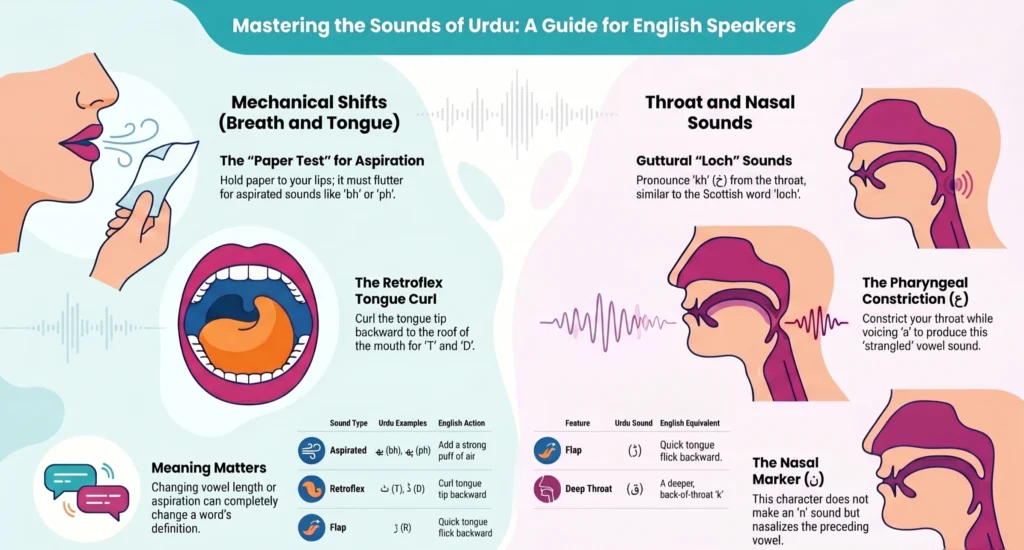
• Aspirated consonants sounds like bh, ph, dh, th (not the English ‘th’) where you add a puff of air
• Retroflex consonants made by curling the tongue back (ٹ، ڈ، ڑ)
• Deep throat / pharyngeal sounds – ع and ح, which originate from Arabic
• Guttural sounds خ and غ, again from the Arabic influence
• The nasal marker ں which subtly nasalises the vowel before it
None of these are impossible for English speakers to learn. It just takes deliberate practice and a clear understanding of what your mouth, tongue, and throat should be doing. That is exactly what this guide covers.
2. The Urdu Script and Writing Direction: A Brief Overview
Urdu is written in the Nastaliq style of the Arabic script, running right to left. If you are learning primarily for spoken communication, you do not strictly need to master the script first. However, even a basic familiarity helps you understand why romanised Urdu transliteration can be inconsistent. Different sources use different conventions for the same sounds.
Throughout this guide, all Urdu content is presented in three columns: first the Urdu script, then the romanised form, and then the English meaning. That format helps you connect the script, the sound, and the meaning simultaneously, which in my experience at least speeds up retention considerably.
3. Urdu Vowels: Short, Long, and Everything In Between
3.1 The Eight Core Vowel Sounds
Urdu vowels are more clearly defined than English vowels in many ways. English is notorious for vowel ambiguity the letter ‘a’ sounds different in ‘cat’, ‘cake’, ‘care’, and ‘calm’. Urdu is more regular. There are essentially eight vowel positions, each with a predictable sound.
| Urdu Script | Romanised | English Sound | Example (Urdu → Roman → English) |
| اَ | a | Like ‘a’ in about | اَب → ab → now |
| آ | aa / ā | Like ‘a’ in father | آم → aam → mango |
| اِ | i | Like ‘i’ in bit | علم → ilm → knowledge |
| ی | ee / ī | Like ‘ee’ in feet | ایک → aik → one |
| اُ | u | Like ‘u’ in put | اُدھر → udhar → there |
| او | oo / ū | Like ‘oo’ in moon | اون → oon → wool |
| اے | e / ay | Like ‘a’ in say | اے → aea → hey |
| او | au | Like ‘ow’ in now | اور → aur → and |
4. Unique Urdu Consonants: The Ones English Does Not Have
This section is probably the most important part of the whole guide. These are the sounds that really distinguish Urdu pronunciation from anything you already know as an English speaker.
| Urdu Letter | Romanised | Sound Description | Word Example (Urdu → Roman → English) |
| ق | q | Deep throat ‘k’ further back than English | قلم → qalam → pen |
| خ | kh | Guttural sound like Scottish ‘loch’ | خبر → khabar → news |
| غ | gh | Gargling ‘r’ voiced version of خ | غریب → ghareeb → poor/humble |
| ع | ‘a / ‘i / ‘u | Pharyngeal voiced constriction rare in English | علم → ‘ilm → knowledge |
| ح | H (capital) | Breathy ‘h’ from deep in the throat | حال → Haal → condition/state |
| ص | s / S | Emphatic ‘s’ like saying ‘s’ with pressed tongue | صبر → sabr → patience |
| ز | z | Like English ‘z’ – many variants in Urdu | زندگی → zindagi → life |
| ڑ | R (retroflex flap) | Tongue flicks back no English equivalent | بڑا → baRa → big |
| ں | n (nasal) | Nasalises the preceding vowel | ہاں → haaN → yes |
A Note on the Letter ع (Ayn)
This is possibly the hardest sound for English speakers. The ع is a voiced pharyngeal fricative – produced by narrowing the pharynx (the back of your throat) while voicing. It sounds a bit like a strangled vowel. The best way to approximate it is to say ‘a’ while gently constricting the throat, as if you are slightly straining. It will sound odd at first. That is normal. Over time it becomes more natural.
5. Aspirated Consonants: Urdu’s Distinctive ‘Puff’ Sounds
This is something that genuinely surprises most English learners when they first encounter it. Urdu distinguishes between plain consonants and aspirated consonants consonants followed by a visible puff of air. In English, aspiration happens automatically in some contexts (the ‘p’ in ‘pin’ is aspirated) but it is never phonemically meaningful. In Urdu, it changes the meaning of words.
Here is a breakdown of the key aspirated pairs:
| Urdu (Script) | Romanised | How to Pronounce | Example (Urdu → Roman → English) |
| پھ | ph | ‘p’ with a puff of air not like English ‘f’ | پھول → phool → flower |
| بھ | bh | ‘b’ with simultaneous breath | بھائی → bhaai → brother |
| تھ | th | ‘t’ + breath NOT like English ‘th’ in ‘the’ | تھالی → thaali → plate |
| دھ | dh | ‘d’ + breath voiced aspirated | دھوپ → dhoop → sunlight |
| کھ | kh | ‘k’ with strong exhale NOT the خ guttural | کھانا → khaana → food |
| گھ | gh | ‘g’ + breath voiced aspirated | گھر → ghar → home |
Practical test: Hold a thin piece of paper in front of your lips. For aspirated sounds (bh, ph, th, dh, kh, gh), the paper should flutter. For plain sounds (b, p, t, d, k, g), it should barely move.
6. Retroflex Consonants: Curling the Tongue Back
Retroflex sounds are made by curling the tongue tip upward and back to touch the roof of the mouth. Urdu has four retroflex consonants that do not exist in standard British or American English at all:
• ٹ (T) – retroflex unaspirated ‘t’
• ڈ (D) – retroflex unaspirated ‘d’
• ڑ (R) – retroflex flap – tongue flicks backward
• ٹھ (Th) – retroflex aspirated ‘t’
If you have ever tried American English with a very heavy accent, you might have unconsciously produced something close to a retroflex ‘t’ or ‘d’. For most English speakers though, this requires deliberate training. The key is to start with your tongue curled back before you make the sound, rather than placing it on the teeth or alveolar ridge as in standard English.
7. Common Everyday Phrases with Pronunciation Notes
Theory is useful. Practice is essential. Here are some of the most commonly used Urdu phrases, with specific notes on the pronunciation points that catch English speakers out.
| Urdu (Script) | Romanised | English | Pronunciation Note |
| السلام علیکم | As-salāmu ‘alaykum | Peace be upon you (greeting) | The ‘ع is a soft glottal catch |
| شکریہ | shukriyah | Thank you | ‘sh’ like in ‘shoe’ |
| معاف کریں | mu’aaf karein | Please forgive / excuse me | Soft glottal on ‘mu’aaf’ |
| آپ کیسے ہیں؟ | Aap kaise hain? | How are you? (formal) | ‘k’ in ‘kaise’ is plain, not aspirated |
| خوش آمدید | Khush aamdeed | Welcome | ‘Kh’ = guttural خ sound |
| ٹھیک ہے | Theek hai | That’s fine / OK | Retroflex ‘T’ + aspirated ‘h’ |
| پانی | paani | Water | Long ā vowel – ‘paaa-nee’ |
| کہاں جا رہے ہو؟ | Kahaan jaa rahe ho? | Where are you going? | Long ‘aa’ in kahaan |
8. Urdu vs Hindi Pronunciation: Key Differences
Many English speakers wonder how different Urdu and Hindi really are in practice. The short answer: spoken conversational Urdu and Hindi, especially in informal settings, are often mutually intelligible. Formal registers diverge more sharply Urdu draws heavily on Persian and Arabic vocabulary, Hindi on Sanskrit. Pronunciation-wise though, here are the meaningful differences.
| Feature | Urdu Pronunciation | Hindi Pronunciation | Why It Matters |
| Arabic-origin words | Retains full Arabic sounds (ع، ح، ق) | Often softened or replaced | Urdu speakers notice mispronunciation |
| Nasal vowels | Distinct anunaasik (ں) nasalisation | Similar but written differently | Changes word meaning entirely |
| Retroflex consonants | ٹ، ڈ، ڑ fully retroflex | Same shared feature | Both languages share this – good news! |
| Tone / Pitch | Not tonal – stress-based | Not tonal either | Unlike Chinese – no tones to worry about |
| Script | Nastaliq (right-to-left Arabic) | Devanagari (left-to-right) | Affects reading but not speech |
The practical implication: if you can already speak some Hindi, your Urdu pronunciation foundation is solid. The main adjustment is learning to produce the Arabic-derived sounds (ع، ح، خ، غ، ق) authentically, rather than substituting them with the softer Hindi equivalents.
9. Stress, Intonation, and the Rhythm of Urdu
One thing that formal pronunciation guides sometimes skip over is the rhythm and intonation of Urdu. It is genuinely important perhaps more than any individual sound. Urdu has a flowing, somewhat musical quality in natural speech, and a lot of that comes from how stress falls within words and sentences.
Word Stress
Urdu generally stresses the second-to-last (penultimate) syllable of a word, though there are exceptions, especially in words borrowed from Arabic. For instance, کتاب (kitāb – book) is stressed on the second syllable: ki-TAAB. Understanding this pattern prevents that choppy, syllable-by-syllable sound that marks a non-native speaker.
Sentence Intonation
Urdu questions tend to rise at the end, similar to English. Statements generally fall. However, Urdu is not a tonal language pitch differences carry emotional information (emphasis, surprise, politeness) rather than changing the fundamental meaning of words the way they do in Mandarin or Vietnamese.
10. Practical Tips for Improving Your Urdu Pronunciation
Let’s bring this all together with some actionable recommendations. These are approaches that tend to actually work for English speakers specifically.
1. Start with vowel length. Before worrying about exotic consonants, get the short vs long vowel distinction right. It is foundational.
2. Record yourself. It sounds tedious, but hearing the gap between your pronunciation and a native speakers is genuinely revealing. Most smartphones have perfectly good voice recorders.
3. Focus on aspirated pairs early. The bh/b, ph/p, kh/k distinctions come up constantly. Getting these right makes a big difference to intelligibility.
4. Do not skip the ع and ح. Even an approximation of these sounds is better than substituting a plain ‘a’ or ‘h’. Native speakers really do notice.
5. Use minimal pairs for practice. Pairs like پال (paal – to raise/nurture) vs پھال (phaal blade) isolate the aspiration distinction in a memorable way.
6. Immerse even passively. Urdu dramas, news broadcasts, and podcasts all help. You do not need to understand everything the accent and rhythm absorb over time.
11. Common Pronunciation Mistakes English Speakers Make
• Pronouncing خ (kh) like the English ‘kh’ or ‘k’ it should be guttural, from the throat
• Treating ث، ص، س as all the same ‘s’ they are technically distinct (though often merged in casual speech)
• Ignoring the nasalisation marker ں it genuinely changes how the preceding vowel sounds
• Over-aspirating every consonant or under-aspirating all of them aspiration must be selective
• Placing stress incorrectly stress on the wrong syllable can cause confusion even when sounds are right
• Rushing through Arabic-origin words they often have sounds that need more deliberate articulation
12. Frequently Asked Questions
Is Urdu pronunciation hard for English speakers?
It is challenging but definitely learnable. The main difficulty lies in sounds that simply do not exist in English particularly the aspirated consonants, retroflex sounds, and Arabic-derived pharyngeal sounds. With regular practice and the right guidance, most learners achieve functional pronunciation within a few months.
How long does it take to sound natural in Urdu?
There is no single answer; it depends on your learning consistency, exposure to native speakers, and whether you have prior experience with related languages. Practically speaking, basic intelligibility can come within weeks. A natural-sounding accent in casual conversation typically takes 6–18 months of regular effort, in my rough observation.
Is Urdu pronounced the same everywhere?
No. Urdu has regional accents just like any major language. The Lahori accent differs from the Karachi accent, which differs again from Dilli (Delhi) Urdu. The standard prestige form is generally based on educated Lahori or Karachi speech in Pakistan, and Delhi Urdu in India. This guide focuses on that standard form.
Do I need to learn the Urdu script to pronounce correctly?
Technically no – you can learn pronunciation using romanisation. But learning at least the basic script helps enormously in the long run, because romanised Urdu is inconsistent across different sources. Once you recognise the letters, you know exactly what sound is intended.
What is the difference between Urdu and Hindi pronunciation?
Conversational spoken Hindi and Urdu are largely mutually intelligible. The key pronunciation differences arise in formal speech and in words borrowed from Arabic and Persian (in Urdu) versus Sanskrit (in Hindi). See the comparison table in Section 8 above for specifics.
Final Thoughts
Urdu pronunciation is one of those things where initial exposure can feel a little overwhelming, and that is completely understandable. There is a lot going on. But the structure is actually fairly logical, and once you understand the key categories – vowel length, aspiration, retroflex sounds, and the Arabic-origin consonants the whole system starts to make sense.
The most important thing, perhaps, is consistency. Even ten minutes a day of focused pronunciation practice will compound quickly. And if you can find opportunities to speak with native Urdu speakers, even occasionally take them. No guide, including this one, quite substitutes for that.