Learning Urdu to a basic conversational level typically takes 3 to 6 months of consistent practice. That’s the quick answer and, well, it’s mostly accurate. But it doesn’t tell the whole story. Because “learning Urdu” and “speaking it confidently” are slightly different things.
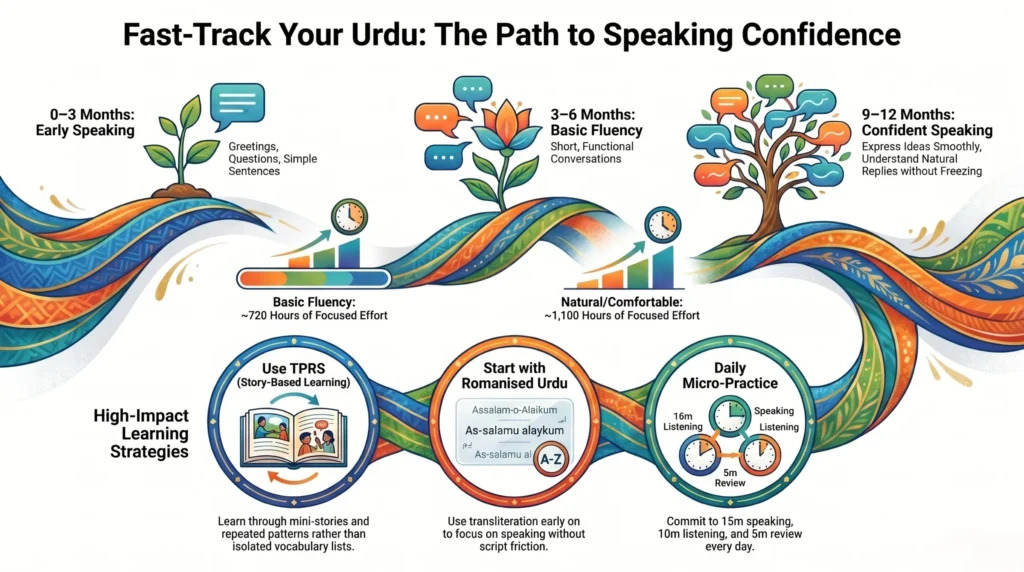
With focused effort, you might reach basic fluency in around 720 hours, and a more natural, comfortable level in about 1,100 hours. Still, those numbers can feel abstract. What actually matters is how you use those hours.
At Desilingua, we’ve seen learners start speaking simple Urdu sentences within weeks not because they mastered grammar first, but because they practiced speaking early using methods like TPRS (Teaching Proficiency through Reading and Storytelling) combined with Romanised transliteration.
And that changes things.
What Does “Speaking Urdu Confidently” Really Mean?
It doesn’t mean perfect grammar.
It doesn’t mean a huge vocabulary either.
It usually means:
- You can express basic thoughts without freezing
- You understand common replies
- You’re okay making mistakes (this one is underrated)
For example, a beginner might say:
- میں ٹھیک ہوں
Main theek hoon
I am fine
Simple. Slightly robotic at first. But it works.
And confidence builds from using sentences like this repeatedly, not from memorizing rules in isolation.
Realistic Urdu Learning Timeline
Here’s what most learners experience (with consistent effort):
| Stage | Time Required | What You Can Do |
| Beginner | 0–1 month | Learn greetings, basic phrases |
| Early Speaking | 1–3 months | Form simple sentences, ask questions |
| Basic Fluency | 3–6 months | Hold short conversations |
| Intermediate | 6–9 months | Speak more naturally |
| Confident Speaker | 9–12 months | Express ideas smoothly |
Now… this isn’t perfectly linear. Some days you’ll feel progress. Other days, not really.
That’s normal.
Learn Urdu Faster with TPRS (Story-Based Learning)
At Desilingua, one method we emphasize is TPRS (Teaching Proficiency through Reading and Storytelling).
Instead of memorizing isolated words, you learn through mini-stories and repeated patterns.
For example:
- وہ بازار جا رہا ہے
Woh bazaar ja raha hai
He is going to the market
Then you tweak it slightly:
- وہ اسکول جا رہا ہے
Woh school ja raha hai
He is going to school
Same structure. New meaning.
This repetition, almost subtle, almost unnoticeable, helps your brain absorb patterns naturally. You’re not forcing it. It just starts to click… eventually.
Why Romanised Urdu Helps (Especially Early On)
Let’s be honest. The Urdu script can slow beginners down.
So instead of stopping completely, many learners start with Romanised Urdu:
- آپ کیسے ہیں؟
Aap kaise hain?
How are you?
This approach lets you:
- Focus on speaking first
- Build confidence early
- Transition to script later
At Desilingua, we combine Urdu + Romanised Transliteration + English meaning so learners don’t feel stuck.
And that reduces friction a lot.
High-Impact Urdu Words to Learn First
Some words appear everywhere in conversation. Learning them early gives quick wins:
| Urdu | Romanised | English |
| ہاں | Haan | Yes |
| نہیں | Nahi | No |
| شکریہ | Shukriya | Thank you |
| براہ مہربانی | Barae meherbani | Please |
| کیا | Kya | What |
| کیوں | Kyun | Why |
These might seem basic. They are basic.
But they’re also powerful.
Best Strategy to Speak Urdu Faster
1. Start Speaking Immediately
Even small phrases count:
- میرا نام علی ہے
Mera naam Ali hai
My name is Ali
You don’t need full sentences at first. Just start.
2. Use Daily Micro-Practice
Instead of long sessions, try:
- 10–15 minutes speaking
- 10 minutes listening
- 5 minutes reviewing
It sounds minimal… but it compounds.
3. Learn Through Context, Not Lists
Memorizing vocabulary lists can feel productive but often fades quickly.
Learning in context sticks better:
- مجھے چائے پسند ہے
Mujhe chai pasand hai
I like tea
Now you’ve learned:
- “mujhe” (to me)
- “pasand hai” (like)
Common Mistakes That Slow You Down
Some learners don’t realize this, but:
- Waiting too long to speak
- Focusing only on grammar
- Avoiding repetition (because it feels boring)
These can delay progress significantly.
Ironically, the “boring” parts like repeating simple sentences are often what make you fluent faster.
A Slightly Honest Observation
You might understand Urdu before you can speak it well.
That gap can feel frustrating. You’ll recognize words, follow conversations… but hesitate to respond.
It’s a strange phase.
But it usually means progress not failure.
3-Month Urdu Learning Plan (Step-by-Step for Fast Results)
If you’re aiming to speak Urdu confidently as fast as possible, a structured plan helps. Not a rigid one that usually fails but something flexible enough to follow even on low-energy days.
At Desilingua, we often suggest a TPRS-based approach combined with Romanised transliteration, especially for beginners who want to speak early without getting stuck in grammar rules.
Here’s a realistic 3-month roadmap.
Month 1: Build the Foundation (Listening + Speaking First)
Focus less on perfection. More on exposure.
Daily Focus:
- Learn 5–10 phrases
- Listen to simple Urdu conversations
- Repeat out loud (this matters more than you think)
Start with core sentences:
- آپ کہاں جا رہے ہیں؟
Aap kahan ja rahe hain?
Where are you going? - میں گھر جا رہا ہوں
Main ghar ja raha hoon
I am going home
At this stage, you might feel like you’re copying rather than speaking.
That’s okay. Actually, that’s the point.
Goal by end of Month 1:
- Understand basic questions
- Respond with short phrases
- Recognize common words
Month 2: Start Forming Your Own Sentences
This is where things get… slightly uncomfortable.
You’ll start building your own sentences instead of repeating memorized ones.
Using TPRS, you expand patterns:
- وہ کھانا کھا رہا ہے
Woh khana kha raha hai
He is eating food
Now modify:
- میں کھانا کھا رہا ہوں
Main khana kha raha hoon
I am eating food
Same structure. Different subject.
Your brain begins to connect patterns instead of memorizing isolated lines.
Daily Practice Idea:
Describe simple actions:
- What you’re doing
- What someone else is doing
- What you want
Goal by end of Month 2:
- Speak in simple sentences
- Ask basic questions
- Follow slow conversations
Month 3: Build Confidence Through Real Conversations
This is where confidence begins not perfectly, but noticeably.
Start practicing real-life dialogue:
- کیا آپ میری مدد کر سکتے ہیں؟
Kya aap meri madad kar saktay hain?
Can you help me? - مجھے سمجھ نہیں آئی
Mujhe samajh nahi aayi
I didn’t understand
Notice something here.
You’re not trying to sound advanced. You’re trying to keep the conversation going.
And that’s a different skill.
Daily Focus:
- 5–10 minute conversations (even self-talk counts)
- Listening to natural-speed Urdu
- Repeating phrases you hear
Goal by end of Month 3:
- Hold short conversations
- Respond without long pauses
- Understand common replies
Weekly Study Plan (Simple & Practical)
Here’s a weekly structure you can actually follow:
| Day | Focus |
| Monday | Learn new phrases + speaking |
| Tuesday | Listening + repetition |
| Wednesday | TPRS story practice |
| Thursday | Speaking + sentence building |
| Friday | Review + light conversation |
| Saturday | Watch Urdu content |
| Sunday | Relaxed revision |
This doesn’t need to be perfect.
Missing a day won’t ruin progress. But consistency, even imperfect consistency matters more than intensity.
Best Tools & Resources to Learn Urdu Faster
Let’s be honest. There are many tools out there. Not all are equally useful.
Here’s what actually helps:
1. Structured Learning (Core System)
A guided platform like Desilingua helps combine:
- TPRS storytelling
- Romanised transliteration
- Conversational focus
This reduces confusion, especially for beginners.
2. Audio-Based Learning
Listening builds instinct.
Even passive listening helps more than expected. You start recognizing patterns subconsciously.
3. Conversation Practice (Critical)
Without speaking, progress slows down.
Even basic sentences like:
- آپ کیا کر رہے ہیں؟
Aap kya kar rahe hain?
What are you doing?
Repeated daily can build surprising fluency.
Common Mistakes That Delay Fluency
Some patterns show up again and again:
Waiting Too Long to Speak
This is probably the biggest one.
You don’t need to be ready. You just need to start.
Over-Focusing on Grammar
Grammar helps but only after exposure.
Learning rules too early can actually slow speaking ability.
Avoiding Repetition
Repetition feels boring.
But it’s also how fluency is built.
There’s no real shortcut around it.
A Slight Contradiction (But Important)
You can learn Urdu fast.
But you can’t rush comfort.
Even after 3 months, you might hesitate sometimes. That doesn’t mean you’re not progressing.
In fact, hesitation often means your brain is processing more deeply.
Final Thoughts
If you:
- Practice daily (even briefly)
- Speak early (even imperfectly)
- Use TPRS and real sentences
- Stay consistent (not perfect)
You can start speaking Urdu confidently within a few months.
Not flawlessly. But confidently enough to hold real conversations.
And that’s where fluency actually begins.