Urdu greetings are more than just words they carry culture, politeness, and, in some cases, even a bit of identity. If you’ve ever tried speaking Urdu with a native speaker, you’ve probably noticed something: people don’t just say “hello” and move on. There’s a rhythm to it. A slight pause. A response expected. Sometimes even a follow-up question.
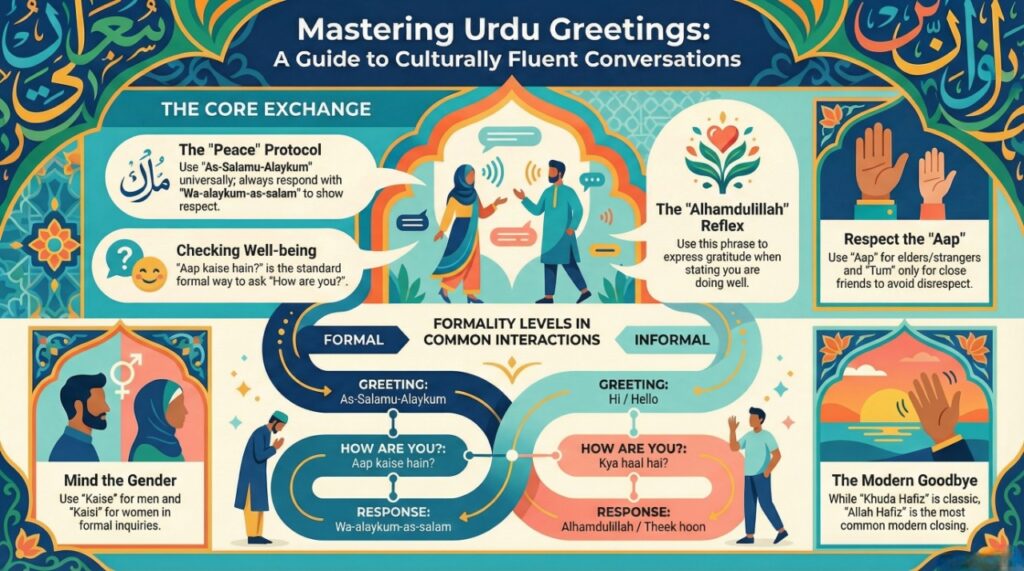
The most common greeting, As-Salamu-Alaykum (peace be upon you), sets the tone for respectful interaction. And it’s not optional you’re expected to respond with Wa-alaykum-as-salam. Skip that, and… well, it feels incomplete.
But here’s the thing. Urdu greetings aren’t limited to just one or two phrases. There’s a whole range depending on:
- Time of day
- Formality level
- Relationship between speakers
- Cultural or religious context
In this guide, we’ll break down 25 essential Urdu greetings and responses used in daily conversations. Not in a textbook way but in a way that actually reflects how people speak.
Why Learning Urdu Greetings Actually Matters (More Than You Think)
You might think greetings are basic. And yes, technically they are. But in Urdu, they carry disproportionate weight.
For example:
- Saying “Hello” instead of “As-Salamu-Alaykum” isn’t wrong… but it feels slightly distant
- Using informal tone with elders? That can come off as disrespectful
- Missing a response? That’s noticeable
I’ve seen learners memorize vocabulary but still struggle socially just because they didn’t get greetings right.
So, before jumping into full conversations, it makes sense to get this part solid.
Common Urdu Greetings (Daily Use Phrases)
Let’s start with the most frequently used greetings. These are what you’ll hear almost everywhere homes, markets, offices, even WhatsApp chats.
1. Basic Everyday Greetings
| Urdu | Romanised Urdu | Meaning | Usage Context |
|---|---|---|---|
| السلام علیکم | As-Salamu-Alaykum | Peace be upon you | Universal greeting |
| وعلیکم السلام | Wa-alaykum-as-salam | And peace be upon you | Response |
| ہیلو | Hello | Hello | Casual / modern |
| ہائے | Hi | Hi | Informal |
Now, here’s something people don’t always tell you:
Even though “Hello” and “Hi” are widely used, As-Salamu-Alaykum still dominates in most real-life situations—especially in Pakistan.
So if your goal is fluency, not just understanding, prioritize that.
2. Time-Based Greetings
These feel slightly more polished. Not always necessary but useful.
| Urdu | Romanised Urdu | Meaning |
|---|---|---|
| صبح بخیر | Subh bakhair | Good morning |
| دوپہر بخیر | Dopehar bakhair | Good afternoon |
| شام بخیر | Shaam bakhair | Good evening |
| رات بخیر | Raat bakhair | Good night |
Now, honestly Subh bakhair is used. But others like Dopehar bakhair? Not as common in daily Pakistani conversations.
People often default back to:
- As-Salamu-Alaykum
- Or just skip time-specific greetings altogether
So yes, learn them but don’t overuse them.
3. Cultural & Formal Greetings
This is where Urdu gets interesting. These phrases carry tradition, and sometimes… a bit of personality.
| Urdu | Romanised Urdu | Meaning | Tone |
|---|---|---|---|
| آداب عرض ہے | Aadab arz hai | Respectful greetings | Formal/traditional |
| خوش آمدید | Khush Aamdeed | Welcome | Formal |
| نمستے | Namaste | Hello | Cultural (less common in Pakistan) |
Aadab arz hai feels almost poetic. You’ll hear it more in formal settings or older generations. Not everyday speech but still important for depth.
How People Actually Use These (Real-Life Flow)
Here’s a realistic interaction:
- Person A: As-Salamu-Alaykum
- Person B: Wa-alaykum-as-salam
- Person A: Kya haal hai?
Notice something? The greeting is rarely standalone. It almost always leads into a question.
That’s why learning greetings without responses is… incomplete.
Urdu Inquiry Phrases (How Are You & Beyond)
These are the bridge between greeting and conversation.
1. Asking About Well-being
| Urdu | Romanised Urdu | Meaning | Formality |
|---|---|---|---|
| کیا حال ہے؟ | Kya haal hai? | How are you? | Informal |
| آپ کیسے ہیں؟ | Aap kaise hain? | How are you? (male) | Formal |
| آپ کیسی ہیں؟ | Aap kaisi hain? | How are you? (female) | Formal |
| سب خیریت ہے؟ | Sab khairiyat hai? | Is everything fine? | Neutral |
A small but important detail:
Urdu distinguishes gender in formal speech. Many urdu learners ignore this and while people still understand, it slightly reduces linguistic accuracy.
2. Common Responses
| Urdu | Romanised Urdu | Meaning |
|---|---|---|
| میں ٹھیک ہوں | Main theek hoon | I am fine |
| الحمدللہ | Alhamdulillah | I’m well (grateful tone) |
| سب اچھا ہے | Sab achha hai | Everything is good |
| ٹھیک ٹھاک | Theek thaak | So-so |
Now here’s a nuance:
Alhamdulillah isn’t just a response it reflects gratitude. It’s used extremely frequently, even by people who aren’t consciously thinking about religion in that moment.
3. Continuing the Conversation
| Urdu | Romanised Urdu | Meaning |
|---|---|---|
| اور تم؟ | Aur tum? | And you? |
| اور آپ؟ | Aur aap? | And you? (formal) |
Simple but necessary. Without this, conversations feel one-sided.
Quick Comparison: Formal vs Informal Urdu Greetings
Here’s where many learners struggle. So let’s make it clear:
| Context | Formal | Informal |
|---|---|---|
| Greeting | As-Salamu-Alaykum | Hi / Hello |
| How are you? | Aap kaise hain? | Kya haal hai? |
| Response | Alhamdulillah | Theek hoon |
| Follow-up | Aur aap? | Aur tum? |
Politeness & Courtesy Phrases in Urdu (Daily Use)
If you strip Urdu of polite expressions, it starts to feel… blunt. Not rude exactly, but noticeably off. Native speakers rely heavily on softeners like “please,” “thank you,” and “sorry” often more than in English.
1. Essential Polite Expressions
| Urdu | Romanised Urdu | Meaning | Usage Context |
|---|---|---|---|
| شکریہ | Shukriya | Thank you | General |
| بہت شکریہ | Bohat shukriya | Thank you very much | Emphasis |
| براہ مہربانی | Barae mehrbani | Please | Formal |
| کوئی بات نہیں | Koi baat nahi | No problem | Casual |
| معاف کیجیے گا | Maaf kijiye ga | Excuse me / Sorry | Polite |
| آپ سے مل کر خوشی ہوئی | Aap se mil kar khushi hui | Nice to meet you | Formal |
| خدا حافظ | Khuda Hafiz | Goodbye | Common |
Now, here’s something subtle:
People don’t always use “barae mehrbani” in daily speech it sounds slightly formal. Instead, tone itself often replaces “please.”
For example:
- “Yeh de dein” (Give me this) → can sound rude
- “Yeh de dein, please” or softer tone → acceptable
So politeness in Urdu isn’t just vocabulary it’s delivery.
2. Variations You’ll Actually Hear
Let’s be honest. Real conversations aren’t textbook-perfect. People shorten things, mix languages, or adjust tone depending on context.
Here are some variations:
| Phrase | Real-life Variation | Notes |
|---|---|---|
| Shukriya | Thanks | English mix is common |
| Bohat shukriya | Thanks a lot | Informal blend |
| Maaf kijiye ga | Sorry | Often replaced |
| Khuda Hafiz | Allah Hafiz | More commonly used today |
This shift from Khuda Hafiz to Allah Hafiz is interesting. It reflects cultural evolution more than grammar.
3. When Politeness Changes Meaning
This is where learners get tripped up.
Take this sentence:
- “Tum kya kar rahe ho?” → What are you doing? (informal)
- “Aap kya kar rahe hain?” → Same meaning, but respectful
The difference isn’t vocabulary it’s relationship signaling.
Use the wrong one, and:
- You might sound too distant
- Or worse… disrespectful
There’s no strict rulebook here. It depends on age, context, and familiarity.
Goodbye & Ending Conversation in Urdu
Ending a conversation properly is just as important as starting it. Maybe even more.
1. Common Goodbye Phrases
| Urdu | Romanised Urdu | Meaning |
|---|---|---|
| خدا حافظ | Khuda Hafiz | Goodbye |
| اللہ حافظ | Allah Hafiz | Goodbye |
| الوداع | Alwida | Farewell |
| پھر ملیں گے | Phir milain ge | See you again |
Now, Alwida sounds a bit… final. Almost dramatic. It’s correct, but rarely used in casual settings.
Most people stick to:
- Allah Hafiz
- Or just a casual exit without a formal goodbye (yes, that happens a lot)
2. Soft Ending Phrases
These make conversations feel more natural:
| Urdu | Romanised Urdu | Meaning |
|---|---|---|
| اپنا خیال رکھیں | Apna khayal rakhein | Take care |
| جلدی ملتے ہیں | Jaldi milte hain | See you soon |
They’re not mandatory but they add warmth.
Mini Urdu Conversation Examples (Realistic Scenarios)
Now we connect everything.
Because isolated phrases don’t help much unless you see how they flow together.
1. Casual Conversation (Friends)
- A: Hi
- B: Hi
- A: Kya haal hai?
- B: Theek hoon, tum batao?
- A: Sab theek hai
Simple. Slightly mixed language. Very common.
2. Formal Interaction
- A: As-Salamu-Alaykum
- B: Wa-alaykum-as-salam
- A: Aap kaise hain?
- B: Alhamdulillah, main theek hoon. Aur aap?
Notice the structure clean, respectful, expected.
3. First Meeting
- A: As-Salamu-Alaykum
- B: Wa-alaykum-as-salam
- A: Aap se mil kar khushi hui
- B: Mujhe bhi
Short. But culturally complete.
4. Ending a Conversation
- A: Achha, phir milte hain
- B: Allah Hafiz
- A: Allah Hafiz
That repetition? Completely normal.
Common Mistakes (You Should Avoid These)
Let’s be direct most learners make predictable mistakes.
1. Overusing “Hello”
Yes, it works. But relying on it too much makes your Urdu feel surface-level.
2. Ignoring Formality
Using “tum” instead of “aap” in the wrong context can feel disrespectful.
3. Skipping Responses
If someone says As-Salamu-Alaykum, you must respond properly. Not optional.
4. Literal Translation Thinking
Trying to map Urdu directly to English often breaks flow.
Complete List of 25 Urdu Greetings and Responses
1. Common Urdu Greetings (1–10)
| # | Urdu | Romanised Urdu | Meaning |
|---|---|---|---|
| 1 | السلام علیکم | As-Salamu-Alaykum | Peace be upon you |
| 2 | وعلیکم السلام | Wa-alaykum-as-salam | And peace be upon you |
| 3 | ہیلو | Hello | Hello |
| 4 | ہائے | Hi | Hi |
| 5 | صبح بخیر | Subh bakhair | Good morning |
| 6 | دوپہر بخیر | Dopehar bakhair | Good afternoon |
| 7 | شام بخیر | Shaam bakhair | Good evening |
| 8 | رات بخیر | Raat bakhair | Good night |
| 9 | خوش آمدید | Khush Aamdeed | Welcome |
| 10 | آداب عرض ہے | Aadab arz hai | Greetings |
2. Inquiry & Response Phrases (11–18)
| # | Urdu | Romanised Urdu | Meaning |
|---|---|---|---|
| 11 | کیا حال ہے؟ | Kya haal hai? | How are you? |
| 12 | آپ کیسے ہیں؟ | Aap kaise hain? | How are you? (male/formal) |
| 13 | آپ کیسی ہیں؟ | Aap kaisi hain? | How are you? (female/formal) |
| 14 | میں ٹھیک ہوں | Main theek hoon | I am fine |
| 15 | الحمدللہ | Alhamdulillah | I’m well |
| 16 | سب خیریت ہے؟ | Sab khairiyat hai? | Is everything fine? |
| 17 | سب اچھا ہے | Sab achha hai | Everything is good |
| 18 | اور آپ؟ | Aur aap? | And you? |
3. Politeness & Courtesy (19–25)
| # | Urdu | Romanised Urdu | Meaning |
|---|---|---|---|
| 19 | شکریہ | Shukriya | Thank you |
| 20 | بہت شکریہ | Bohat shukriya | Thank you very much |
| 21 | براہ مہربانی | Barae mehrbani | Please |
| 22 | کوئی بات نہیں | Koi baat nahi | No problem |
| 23 | معاف کیجیے گا | Maaf kijiye ga | Sorry / Excuse me |
| 24 | آپ سے مل کر خوشی ہوئی | Aap se mil kar khushi hui | Nice to meet you |
| 25 | اللہ حافظ | Allah Hafiz | Goodbye |
| Situation | Best Phrase | Why It Fits |
|---|---|---|
| Meeting someone formally | As-Salamu-Alaykum | Respectful and culturally appropriate |
| Talking to a friend | Hi / Kya haal hai? | Casual tone |
| First-time meeting | Aap se mil kar khushi hui | Polite introduction |
| Ending conversation | Allah Hafiz | Widely accepted closing |
| Expressing gratitude | Shukriya | Universal and simple |
FAQ
What is the most common greeting in Urdu?
The most common Urdu greeting is As-Salamu-Alaykum, meaning “peace be upon you.” It is widely used in both formal and informal situations.
How do you respond to As-Salamu-Alaykum?
The correct response is Wa-alaykum-as-salam, which means “and peace be upon you.”
How do you say “How are you?” in Urdu?
You can say:
- Kya haal hai? (informal)
- Aap kaise hain? (formal, male)
- Aap kaisi hain? (formal, female)
What is “Thank you” in Urdu?
“Thank you” in Urdu is Shukriya. For emphasis, you can say Bohat shukriya.
How do you say goodbye in Urdu?
The most common way is Allah Hafiz. Other options include Khuda Hafiz and Alwida.