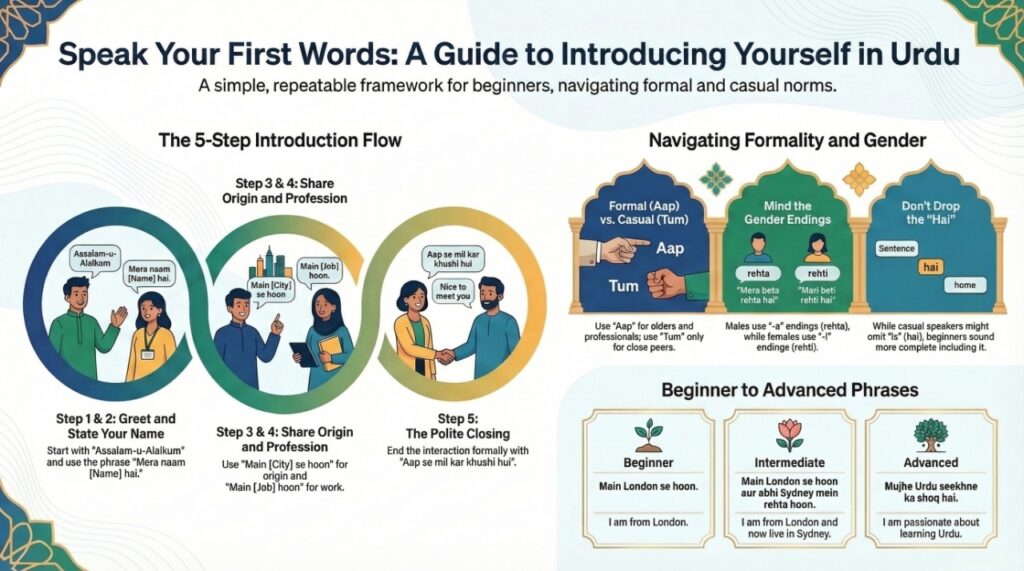
If you want to introduce yourself in Urdu, start with a polite greeting like Assalam-u-Alaikum (peace be upon you). Then say your name using Mera naam [Name] hai (My name is [Name]). You can add where you’re from with Main [City/Country] se hoon and what you do using Main [Profession] hoon.
For example:
“Assalam-u-Alaikum. Mera naam John hai. Main London se hoon aur main ek teacher hoon. Aap se mil kar khushi hui.”
Urdu introductions vary slightly depending on formality, gender, and context—but the basic structure remains simple and easy to learn.
There’s something slightly awkward about introducing yourself in a new language. Even when you know the words, it doesn’t always feel natural. You hesitate. You wonder if you sound too formal… or not formal enough.
Urdu is like that, maybe more than some other languages.
It’s polite. Structured. But also… flexible in ways that aren’t always obvious at first.
If you’re trying to introduce yourself in Urdu, especially as an English speaker from the US, UK, or Australia, you don’t need to overcomplicate it. In fact, doing too much too early is usually where learners go wrong.
This guide walks you through:
- The exact sentence structure
- Real conversation examples
- Subtle things people don’t usually explain (but should)
And yes, we’ll keep it practical. No textbook stiffness.
Basic Structure to Introduce Yourself in Urdu
At its core, a self-introduction in Urdu follows a simple pattern:
- Greeting
- Name
- Origin
- Profession
- Closing line
Let’s break that down properly.
1.Greeting
The most common greeting:
- Assalam-u-Alaikum — Peace be upon you
You can say “Hi” or “Hello”… but honestly, it feels slightly off in many Urdu-speaking contexts. Not wrong. Just… less natural.
If someone greets you first:
- Wa Alaikum Assalam — And peace be upon you
2. Saying Your Name
This part is straightforward:
- Mera naam John hai — My name is John
Structure:
- Mera naam = My name
- [Name] = Your name
- hai = is
You might think you can drop “hai” (like in casual English)… sometimes people do. But beginners shouldn’t. It sounds incomplete.
3. Saying Where You’re From
- Main London se hoon — I am from London
- Main New York se hoon — I am from New York
- Main Sydney se hoon — I am from Sydney
Key point:
- se hoon = from
This is one of those phrases you’ll use constantly. It’s worth memorizing early.
4. Saying What You Do
- Main teacher hoon — I am a teacher
- Main student hoon — I am a student
- Main software engineer hoon — I am a software engineer
There’s no “a/an” complexity like English. Simpler, in a way.
5. Closing the Introduction
- Aap se mil kar khushi hui — Nice to meet you
This is polite, and often expected in formal settings.
Full Example (Putting It Together)
Let’s combine everything:
Assalam-u-Alaikum.
Mera naam John hai.
Main London se hoon aur main ek teacher hoon.
Aap se mil kar khushi hui.
That’s it. Clean, complete, and natural.
Formal vs Casual Introductions (Important Difference)
This is where many learners slip.
Urdu has levels of politeness, and they matter.
Formal Introduction (Recommended for Beginners)
Use this in:
- Professional settings
- First-time meetings
- Older people
Example:
Assalam-u-Alaikum.
Mera naam Sarah hai.
Main Manchester se hoon aur main ek designer hoon.
Aap se mil kar khushi hui.
Notice:
- Use Aap (formal “you”)
- Tone is respectful
Casual Introduction
Used with:
- Friends
- Same-age peers
- Informal settings
Example:
Hi, main Alex hoon.
Main Melbourne se hoon.
Tumhara naam kya hai?
Here:
- “Tum” replaces “Aap”
- Greeting can be relaxed
But—small caution here—many learners overuse casual tone too early. It can come across as disrespectful without meaning to.
Common Mistakes (That Feel Small but Matter)
1. Ignoring Gender Differences
This one is subtle.
- Male: Main London mein rehta hoon
- Female: Main London mein rehti hoon
That -a vs -i ending matters.
You can get away with mistakes early on… but it does stand out.
2. Translating Directly from English
Wrong approach:
“I am from London and I am working in a company currently”
Urdu doesn’t always follow English structure neatly.
Keep it simple:
Main London se hoon aur ek company mein kaam karta hoon
3. Overloading Information
Beginners often try to say too much:
- hobbies
- life story
- detailed job explanation
That’s not how real introductions work. Even in Urdu.
Keep it minimal.
| English | Urdu Sentence | Roman Urdu |
|---|---|---|
| Hello | السلام علیکم | Assalam-u-Alaikum |
| My name is John | میرا نام جان ہے | Mera naam John hai |
| I am from London | میں لندن سے ہوں | Main London se hoon |
| I am a teacher | میں استاد ہوں | Main teacher hoon |
| Nice to meet you | آپ سے مل کر خوشی ہوئی | Aap se mil kar khushi hui |
Real Conversation Examples to Introduce Yourself in Urdu
Understanding structure is one thing. Actually using it in conversation… that’s where people hesitate.
And honestly, it’s not because Urdu is difficult. It’s because conversations don’t follow neat patterns.
Sometimes they’re abrupt. Sometimes overly polite. Sometimes inconsistent.
Let’s go through realistic scenarios.
1. Formal / Professional Introduction (Business Setting)
This is the safest format. If you’re unsure, default to this.
Example Dialogue
You:
Assalam-u-Alaikum. Mera naam David hai.
Other Person:
Wa Alaikum Assalam. Aap kaise hain?
You:
Main theek hoon, shukriya. Main London se hoon aur main ek marketing manager hoon.
You (closing):
Aap se mil kar khushi hui.
What’s Actually Happening Here (Important Insight)
- You’re not rushing
- You’re not over-explaining
- You’re allowing pauses
A lot of learners think fluency = speed. It doesn’t.
In Urdu, measured speech often sounds more natural than fast speech.
2. Casual Conversation (Meeting Someone New)
Here, things loosen up.
Example Dialogue
You:
Hi, main Emma hoon.
Other Person:
Hi! Main Ali hoon.
You:
Main Sydney se hoon. Tum kahan se ho?
Other Person:
Main Lahore se hoon.
Subtle Reality
You’ll notice something slightly inconsistent here:
- English + Urdu mix
- Shorter sentences
- Less structure
That’s normal.
Trying to sound perfectly Urdu in casual settings can actually sound unnatural.
3. Classroom or Learning Environment
This is common if you’re learning Urdu formally.
Example
You:
Assalam-u-Alaikum. Mera naam James hai. Main New York se hoon. Main Urdu seekh raha hoon.
(Translation: I am learning Urdu)
Useful Add-On Sentences
- Main Urdu seekhna chahta hoon (male)
- Main Urdu seekhna chahti hoon (female)
This is powerful it shows intent, not just identity.
4. Job Interview Introduction (High-Intent Scenario)
Now this is where precision matters more.
Example
Assalam-u-Alaikum. Mera naam Michael hai. Main Manchester se hoon. Main ek software engineer hoon aur pichle 5 saalon se kaam kar raha hoon.
Why This Works
- Clear
- Slightly extended
- Still controlled
You’re adding credibility without rambling.
Beginner vs Intermediate Self-Introduction
Most blogs don’t explain this distinction properly.
Let’s fix that.
Beginner Level (Safe and Simple)
- Mera naam John hai
- Main London se hoon
- Main student hoon
👉 This is enough. Seriously.
Trying to jump ahead too fast usually leads to broken sentences.
Intermediate Level (More Natural)
- Main London se hoon aur abhi Sydney mein rehta hoon
- Main ek IT company mein kaam karta hoon
- Mujhe Urdu seekhne ka shoq hai
Now you’re:
- Connecting ideas
- Showing personality
- Sounding more human
Comparison Table (Beginner vs Advanced)
| Level | Example Sentence | Translation |
|---|---|---|
| Beginner | Main London se hoon | I am from London |
| Beginner | Main student hoon | I am a student |
| Intermediate | Main London se hoon aur ek company mein kaam karta hoon | I am from London and work in a company |
| Intermediate | Main Urdu seekh raha hoon kyun ke mujhe zabanain pasand hain | I am learning Urdu because I like languages |
Cultural Nuances (This Is Where Most Learners Struggle)
1. Respect Matters More Than Accuracy
You can make grammar mistakes.
But using the wrong tone (like “Tum” instead of “Aap”) can feel… off.
2. Slight Redundancy Is Normal
In English:
“Hi, I’m John.”
In Urdu:
“Mera naam John hai.”
It feels longer—but it’s expected.
3. People May Ask Follow-Up Questions
After your introduction, expect:
- Aap kya karte hain? (What do you do?)
- Aap kahan rehte hain? (Where do you live?)
So your introduction is just the start, not the full interaction.
Extended Self-Introduction Example (Realistic Flow)
Let’s build something closer to real life.
Assalam-u-Alaikum. Mera naam Daniel hai. Main UK se hoon aur abhi Australia mein rehta hoon. Main ek digital marketer hoon aur mujhe languages seekhna pasand hai. Main abhi Urdu seekh raha hoon. Aap se mil kar khushi hui.
This is:
- Natural
- Slightly detailed
- Not overdone
50+ Urdu Self-Introduction Sentences (High-Ranking Section)
| # | Urdu | Roman Urdu | English |
|---|---|---|---|
| 1 | السلام علیکم | Assalam-u-Alaikum | Hello |
| 2 | میرا نام جان ہے | Mera naam John hai | My name is John |
| 3 | میں امریکہ سے ہوں | Main America se hoon | I am from the USA |
| 4 | میں لندن سے ہوں | Main London se hoon | I am from London |
| 5 | میں آسٹریلیا سے ہوں | Main Australia se hoon | I am from Australia |
| 6 | میں ایک طالب علم ہوں | Main student hoon | I am a student |
| 7 | میں ایک ٹیچر ہوں | Main teacher hoon | I am a teacher |
| 8 | آپ سے مل کر خوشی ہوئی | Aap se mil kar khushi hui | Nice to meet you |
Intermediate Introduction Sentences
| # | Urdu | Roman Urdu | English |
|---|---|---|---|
| 9 | میں لندن میں رہتا ہوں | Main London mein rehta hoon | I live in London (male) |
| 10 | میں لندن میں رہتی ہوں | Main London mein rehti hoon | I live in London (female) |
| 11 | میں ایک کمپنی میں کام کرتا ہوں | Main ek company mein kaam karta hoon | I work in a company |
| 12 | میں اردو سیکھ رہا ہوں | Main Urdu seekh raha hoon | I am learning Urdu (male) |
| 13 | میں اردو سیکھ رہی ہوں | Main Urdu seekh rahi hoon | I am learning Urdu (female) |
| 14 | مجھے زبانیں سیکھنا پسند ہے | Mujhe zabanain seekhna pasand hai | I like learning languages |
Advanced / Natural Sentences
| # | Urdu | Roman Urdu | English |
|---|---|---|---|
| 15 | میں یوکے سے ہوں لیکن اب آسٹریلیا میں رہتا ہوں | Main UK se hoon lekin ab Australia mein rehta hoon | I am from the UK but now live in Australia |
| 16 | میں ایک ڈیجیٹل مارکیٹر ہوں اور آن لائن کام کرتا ہوں | Main ek digital marketer hoon aur online kaam karta hoon | I am a digital marketer and work online |
| 17 | میں اردو اس لیے سیکھ رہا ہوں کیونکہ مجھے نئی زبانیں پسند ہیں | Main Urdu is liye seekh raha hoon kyun ke mujhe nai zabanain pasand hain | I am learning Urdu because I like new languages |
| 18 | مجھے پاکستان کی ثقافت میں دلچسپی ہے | Mujhe Pakistan ki saqafat mein dilchaspi hai | I am interested in Pakistani culture |
Comparison Table: Formal vs Casual Urdu Introduction
| Aspect | Formal Urdu | Casual Urdu |
|---|---|---|
| Greeting | Assalam-u-Alaikum | Hi / Hello |
| Pronoun | Aap | Tum |
| Tone | Respectful, structured | Relaxed, flexible |
| Example | Mera naam John hai. Aap se mil kar khushi hui. | Main Alex hoon. Tumhara naam kya hai? |
Key Tips to Sound Natural (Not Textbook)
This part is usually ignored… but it matters more than grammar.
1. Don’t Try to Sound Perfect
If you aim for perfect sentences, you’ll pause too much.
Real conversations are slightly messy.
2. Keep It Short First
A mistake I see often especially with learners targeting fluency fast is overbuilding sentences.
Start with:
- 2–3 lines max
Then expand.
3. Mix English Naturally (At First)
It’s okay to say:
“Main London se hoon, I work in marketing.”
That’s actually closer to real conversations than fully rigid Urdu.
4. Repetition Is Normal
You might repeat:
- your name
- your country
It’s not inefficient—it’s clarity.
FAQ
How do you introduce yourself in Urdu?
Start with Assalam-u-Alaikum, say your name using Mera naam ___ hai, mention your origin with Main ___ se hoon, and optionally your profession using Main ___ hoon. End with Aap se mil kar khushi hui.
How to say “My name is” in Urdu?
You say:
Mera naam ___ hai
How to introduce yourself formally in Urdu?
Use polite language with “Aap” and structured sentences:
Assalam-u-Alaikum. Mera naam John hai. Main London se hoon. Aap se mil kar khushi hui.
Is Urdu introduction different for males and females?
Yes, slightly.
- Male: rehta hoon
- Female: rehti hoon
Can beginners learn Urdu introductions easily?
Yes. Urdu introductions follow a predictable pattern, and beginners can start speaking basic sentences within a few hours of practice.