There’s a quiet gap in healthcare that doesn’t get talked about enough. Many doctors speak excellent English. Their patients don’t. And somewhere between symptoms, gestures, and polite nodding, things get lost.
If you’re a doctor, nurse, medical student, or healthcare worker treating Urdu-speaking patients, learning perfect Urdu is not the goal. What matters is trust, clarity, and a sense that you’re trying. Even a few sentences in Urdu can change the entire tone of a consultation.
If your goal is to learn conversational urdu for real clinical situations, you don’t need complex grammar or advanced vocabulary. This guide is written specifically for English-speaking doctors who want to communicate with Urdu-speaking patients. No complex grammar. No script pressure. Just spoken, Romanised Urdu, focused on real medical interactions.
Why Doctors Learning Basic Urdu Actually Matters
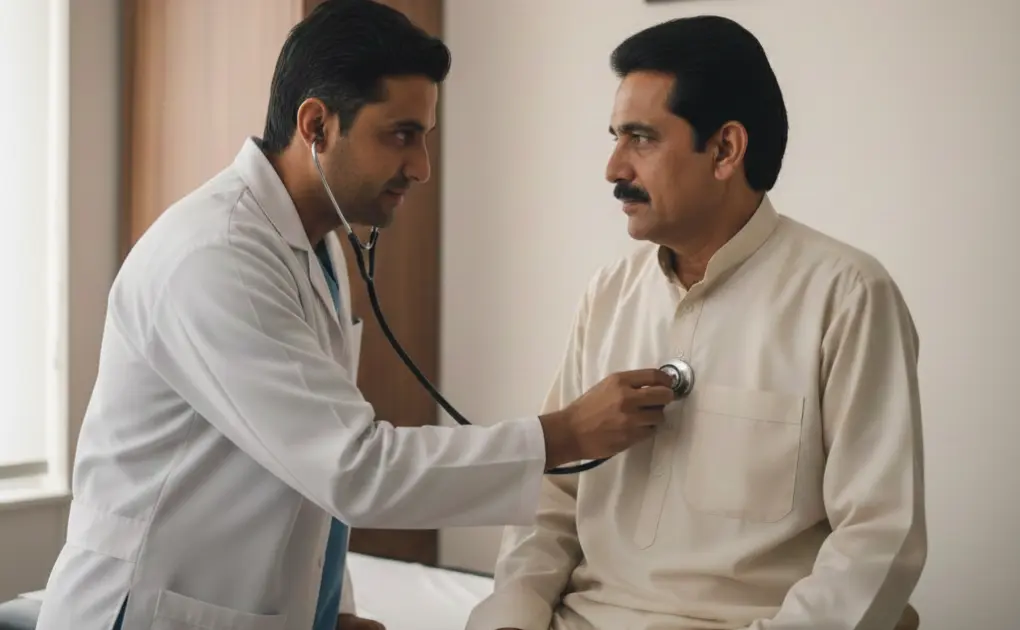
Patients explain pain differently in their native language. Sometimes emotionally. Sometimes vaguely. Sometimes with gestures instead of words. When a doctor meets that effort halfway even imperfectly it builds immediate rapport.
I’ve seen situations where a patient relaxes the moment they hear “Aap ko kahaan dard hai?” instead of a translated version. The medical outcome might not change instantly, but the conversation does.
And realistically, most doctors don’t need thousands of words. They need questions, reassurance, and instructions.
How This Guide Is Structured (Doctor-Focused)
This article focuses on:
- Urdu phrases doctors actually say
- Short, repeatable sentence patterns
- Romanised Urdu for fast recall
- Natural, slightly imperfect speech (because that’s realistic)
You’ll notice some repetition. That’s intentional. Doctors repeat themselves in real consultations.
Basic Urdu Phrases Every Doctor Can Use
Let’s start with phrases that require minimal effort but have high impact.
| Romanised Urdu | English Meaning |
| Aap ka naam kya hai? | What is your name? |
| Kya Aap theek hain? | Are you okay? |
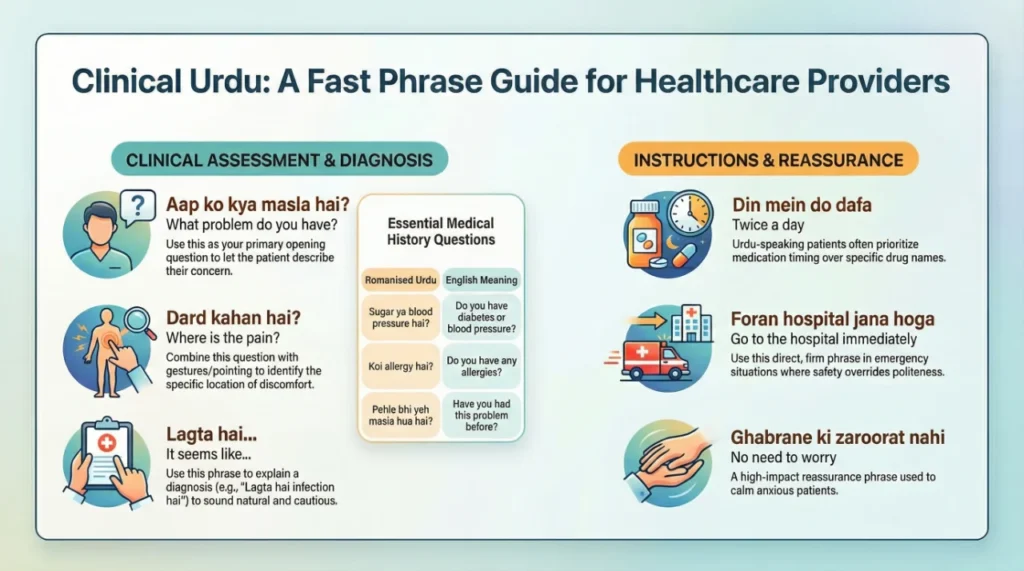
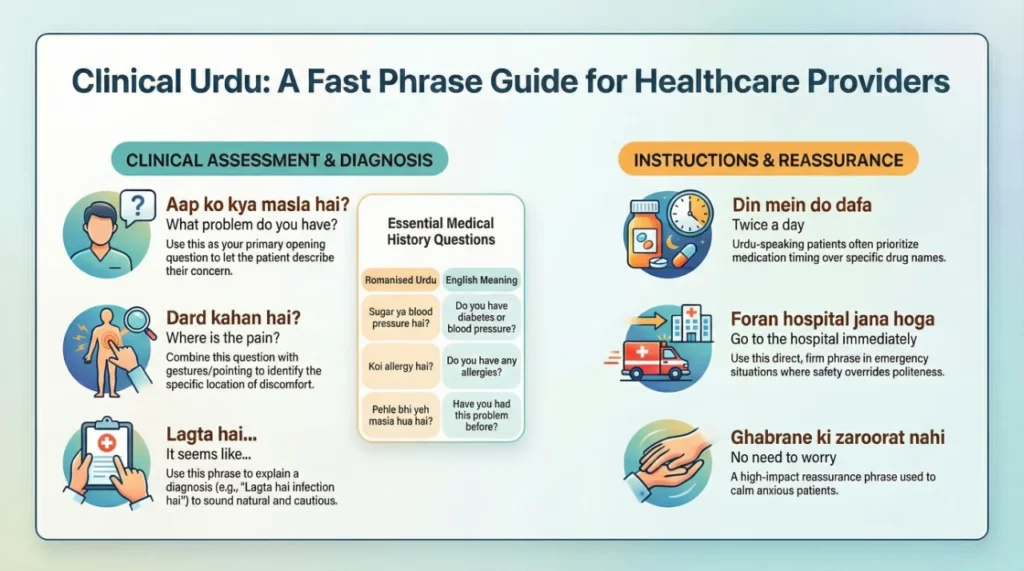
| Aap ko kya masla hai? | What problem do you have? |
| Aap ko dard kahan hai? | Where do you have pain? |
| Aap ko kab se yeh takleef hai? | Since when have you had this problem? |
Pronunciation doesn’t need to be perfect. Most patients appreciate the attempt more than accuracy.
A Simple Doctor-Patient Exchange (Doctor in Urdu)
Doctor: Assalam-o-Alaikum.
(Hello.)
Patient: Walikum Salam.
Doctor: Aap ko kya masla hai?
(What problem do you have?)
Patient: Mujhe pait mein dard hai.
(I have stomach pain.)
Doctor: Aap ko kab se dard hai?
(Since when do you have pain?)
Patient: Mujhe kal se dard ho raha hai..
(I have been in pain since yesterday.)
This conversation is basic. That’s exactly why it works.
Asking About Pain Without Medical Vocabulary
Doctors often assume they need technical language. In Urdu, they don’t.
Try these instead:
- Kya aapko dard zyada hai ya kam?
(Is the pain severe or mild?) - Kya dard yahan hai?
(Is the pain here?) (Pointing helps.)
These questions feel natural and don’t overwhelm the patient.
A Small Observation.
Urdu-speaking patients may nod even when they don’t fully understand. A gentle follow-up helps.
Doctor: Kya aap ko samajh aa gaya??
(Did you understand?)
It’s a simple question, but it opens the door for clarification.
Explaining What You Think Is Going On (Without Overpromising)
One of the harder parts of cross-language consultations is explaining a diagnosis without sounding too certain or too vague. In Urdu, doctors often speak cautiously. That works in your favor.
You don’t need long explanations. Short reassurance goes a long way.
Try phrases like:
- Mujhe lagta hai ke yeh ek infection hai.
(I think this is an infection.) - Abhi mujhe yeh zyada serious nahi lag raha hai..
(It doesn’t seem very serious right now.) - Isliye aap ka test karna zaroori hai.est karna zaroori hai.
(That’s why it is necessary to do your tests.)
That word “lagta hai” (it seems) matters. It softens the statement and feels natural to Urdu speakers.
Asking About Medical History in Simple Urdu
Medical history questions can feel sensitive, especially across languages. Keeping sentences short helps reduce confusion.
Here are some common, safe patterns:
| Romanised Urdu | English Meaning |
| Kya Pehle bhi yeh masla hua hai? | Have you had this problem before? |
| Kya Koi purani bimaari hai? | Do you have any chronic illness? |
| Kya Ap ko Sugar ya blood pressure hai? | Do you have diabetes or blood pressure? |
| Kya Ap Ko Koi allergy hai? | Do you have any allergies? |
Patients may answer with just one word. That’s normal.
- Haan (Yes)
- Nahi (No)
- Shayad (Maybe)
Don’t rush to fill the silence. Give them a moment.
Giving Medicine Instructions in Urdu (Doctor-Led)
This is where clarity really matters. Urdu-speaking patients often remember timing more than medicine names.
Doctor: Aap yeh dawa lein..
(Take this medicine.)
Doctor: Aap ko is dawa ko din mein do dafa lena hai.
(You need to take this medicine twice a day.)
Doctor: Dawa ko hamesha khana khane ke baad lena hai.
(Always take the medicine after meals.)
A Full Mini Consultation (Doctor Using Urdu)
Let’s put this together into a slightly longer, realistic exchange.
Doctor: Aap ko kya masla hai?
(What problem do you have?)
Patient: Mujhe sar mein dard ho raha hai..
(I have a headache.)
Doctor: Kab se aapko dard ho raha hai?
(Since when have you been in pain?)
Patient: Mujhe do din se dard ho raha hai..
(I have been in pain for two days)
Doctor: Kya aap ko bukhar bhi hai?
(Do you also have fever?)
Patient: Haan, thoda sa bukhar hai.
(Yes, I have a little fever.)
Doctor: Lagta hai viral infection hai.
(It seems like a viral infection.)
Doctor: Yeh dawa din mein do dafa lein.
(Take this medicine twice a day.)
Nothing complicated. Just steady, clear communication.
Reassurance Phrases That Calm Patients
Sometimes what patients need most is reassurance. Urdu has gentle ways to do this.
- Ghabrane ki zaroorat nahi.
(No need to worry.) - Inshallah ap theek ho jaein ge.
(God willing, you’ll be fine.)
(Used commonly; culturally comforting.) - Agar masla barqarar rahe, dobara aa jaien.
(If the problem continues, come back.)
These phrases don’t promise outcomes. They offer comfort. That distinction matters.
Urgent and Emergency Instructions in Simple Urdu
In urgent situations, doctors don’t need long explanations. Short, firm sentences work better. Urdu allows this without sounding aggressive, which is helpful.
Here are high-impact emergency phrases doctors can use:
| Romanised Urdu | English Meaning |
| Aap ko Foran hospital jana hoga | You must go to the hospital immediately |
| Yeh zaroori hai ke aap is baat ka khayal rakhein. | It is necessary that you take care of this |
| Abhi aapka test karna hoga, take masla sahi se samjha ja sake. | We need to do tests now so that the problem can be properly understood. |
| Dair na karein aur foran action lein. | Do not delay and take action immediately |
| Abhi dawa shuru karni hogi, take aap jaldi theek ho sakein. | You must start the medicine now so that you can recover quickly. |
Notice how direct these are. In emergencies, politeness becomes secondary to safety.
Hospital Admission and Referral Conversations
Sometimes the consultation doesn’t end with medicine. Patients need admission or referral. This can be stressful, especially across languages.
Try these phrases:
- Aap ko admit hona hoga.
(You will need to be admitted.) - Yahan ilaaj mumkin nahi.
(Treatment is not possible here.) - Main aap ko specialist ke paas bhej raha hoon.
(I am referring you to a specialist.)
Pause after these statements. Patients often need a moment.
Explaining What Happens Next (Step by Step)
Patients feel calmer when they know what comes next. Urdu works well for sequencing.
- Pehle aap ka tests honga
(First, your tests will be done.) - Phir hum aap ki report dekhein ge.
(Then we will review your report.) - Uske baad hum aapka ilaaj shuru karien ge.
(After that, we will begin your treatment..)
These simple steps reduce uncertainty.
A Realistic Emergency Dialogue (Doctor-Led)
Doctor: Aap ki saans theek nahi lag rahi.
(Your breathing doesn’t seem okay.)
Doctor: Foran hospital jana hoga.
(You need to go to the hospital immediately.)
Patient: Abhi?
(Now?)
Doctor: Ji, abhi. Dair na karein.
(Yes, now. Do not delay.)
Short. Clear. Repeated. That’s intentional.
Cultural Cues Doctors Often Miss
This part isn’t about language alone. It’s about how patients respond.
- Many Urdu-speaking patients avoid direct disagreement.
- Silence doesn’t always mean understanding.
- Family members may speak on the patient’s behalf.
A gentle check helps:
Doctor: Aap ke ghar walon ko bhi batana hai?
(Do you want to inform your family as well?)
That single question can change cooperation levels.
When You Don’t Understand the Patient
This happens. It’s better to admit it calmly.
- Ahista boliye, dobara bataien.
(Please speak slowly, tell me again.) - Main poori tarah samajh nahi paaya.
(I didn’t fully understand.)
Frequently Asked Questions: Doctors Learning Urdu for Patients
These are the kinds of questions English-speaking doctors quietly ask themselves. Not always out loud, but often enough.
Do I need to be fluent in Urdu to treat Urdu-speaking patients?
No. And honestly, aiming for fluency can slow you down. What you need is functional Urdu the ability to ask questions, explain next steps, and give reassurance.
Patients don’t expect perfect grammar. They expect effort and clarity.
What if my Urdu pronunciation is wrong?
It probably will be sometimes. That’s okay.
Urdu-speaking patients are used to accents and variations. If something sounds unclear, they’ll usually ask or respond with gestures. Repeating slowly helps more than correcting pronunciation.
Is Romanised Urdu acceptable in medical settings?
For speaking, yes. Romanised Urdu is a learning tool, not a substitute for literacy. It helps doctors remember phrases quickly, especially during busy clinics or emergencies.
Final Thoughts
Learning Urdu as a doctor doesn’t require fluency, only intention and consistency. A few well-chosen phrases can reduce confusion, build trust, and make patients feel seen. Mistakes will happen, and that’s expected. Communication in healthcare is rarely perfect, even in one’s own language. What matters is clarity, patience, and the willingness to meet patients where they are. Over time, these small efforts often lead to better cooperation and calmer consultations. And in many cases, that’s what truly improves care.