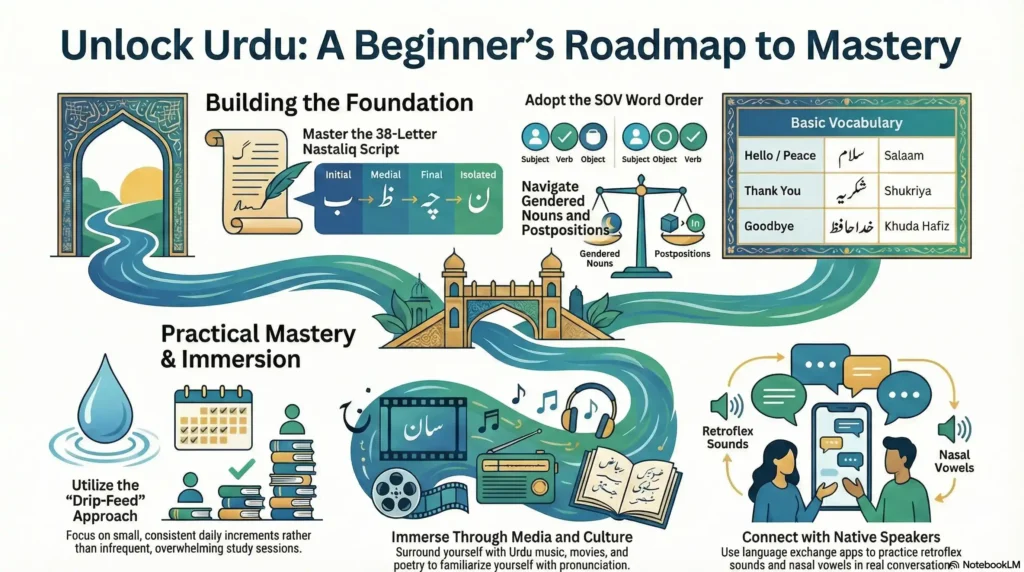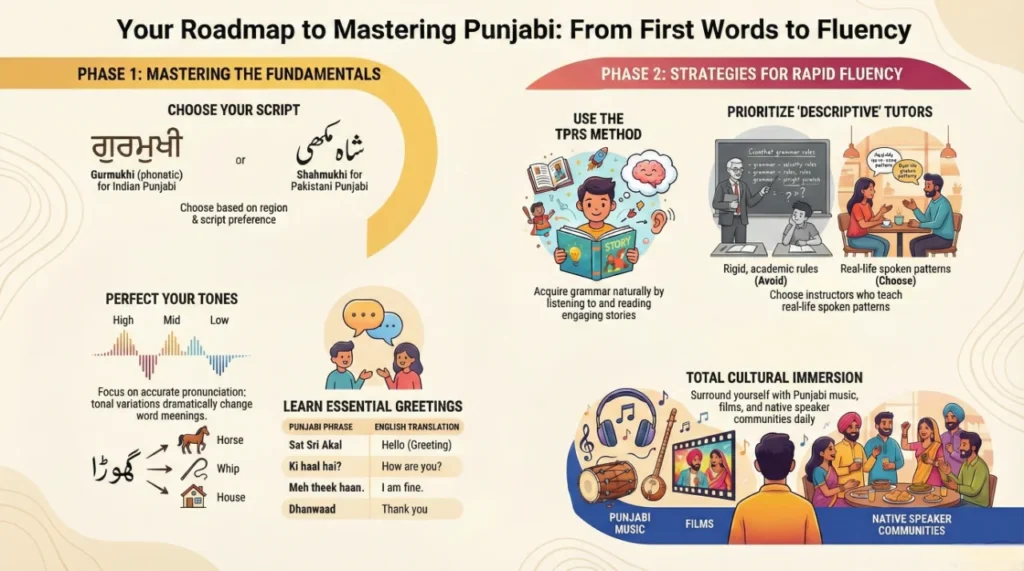
If you’ve heard Urdu spoken before, maybe from friends, family, films, or travel you might have had the same thought many learners do: It sounds beautiful… but is it hard to speak?
The short answer? Not necessarily.
For English speakers who already have some exposure to Urdu, the challenge isn’t usually understanding basic phrases. It’s confidence. Pronunciation. Flow. And sometimes the hesitation that comes from not knowing how words are structured when spoken naturally.
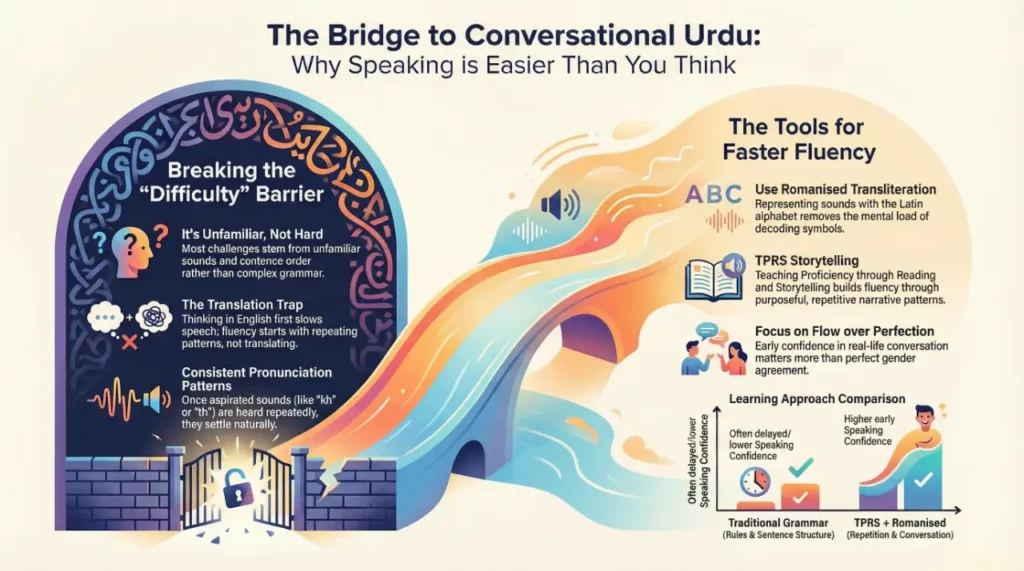
Here’s what many learners discover: Urdu is often easier to speak than they expect, especially when they use romanised urdu supported by Romanised Transliteration.
Let me explain.
Is Urdu Hard to Speak for English Speakers?
When people ask whether Urdu is difficult, they often mix up speaking with other language skills. But speaking conversational Urdu is a different experience altogether.
For English speakers with some exposure, here’s what usually feels challenging:
- Certain sounds that don’t exist in English (like soft aspirated consonants)
- Gender agreement in casual speech
- Word order adjustments during longer sentences
- Speaking naturally instead of translating in your head
And yet… pronunciation patterns are consistent. Many everyday Urdu words already feel familiar because of shared vocabulary with Hindi and exposure through media.
So is it hard? Maybe at first. But “hard” isn’t quite the right word. It’s unfamiliar. And unfamiliar often feels harder than it is.
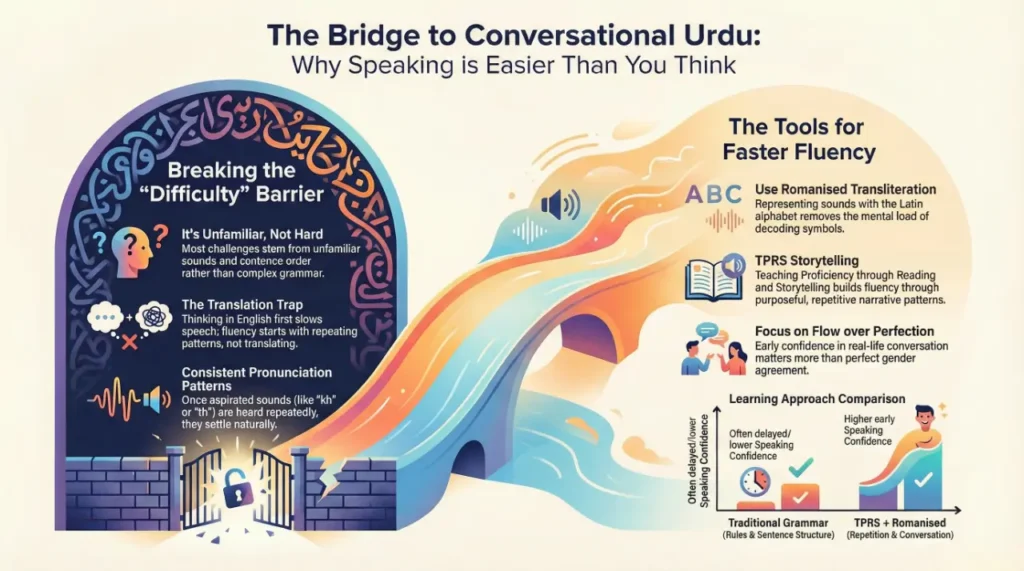
Why Speaking Feels Easier Than You Think
One thing I’ve noticed and many learners quietly admit is that spoken Urdu tends to repeat patterns. Once you understand a conversational structure, you start hearing it everywhere.
For example:
- “Aap kaisay hain?”
- “Main theek hoon.”
- “Kya kar rahay ho?”
These aren’t complex constructions. They’re rhythmic. Predictable. Built on reusable patterns.
And this is where romanised urdu with Romanised Transliteration becomes powerful for English speakers.
Instead of struggling with unfamiliar script, learners focus purely on:
- Sound
- Pronunciation
- Intonation
- Conversation flow
You remove one mental barrier. And suddenly, speaking feels… lighter.
What Is Romanised Urdu (in a Conversational Context)?
Romanised urdu simply means representing spoken Urdu sounds using the Latin alphabet. It’s not about formal writing systems. It’s about practical speaking support.
For conversational learners, Romanised Transliteration acts as a pronunciation bridge.
Instead of seeing:
- میں ٹھیک ہوں
You see:
- Main theek hoon
And immediately, you can say it.
Is it perfect? No. There isn’t one universal standard. The same word might be written slightly differently depending on pronunciation habits. But for speaking practice especially at beginner-to-intermediate levels it works surprisingly well.
Why Romanised Transliteration Helps English Speakers Speak Faster
There’s a psychological shift that happens.
When English speakers use romanised urdu:
- They don’t freeze trying to decode symbols.
- They focus on repeating sounds correctly.
- They build conversational muscle memory.
And maybe this is just an observation, but learners often become more willing to speak imperfectly. Because the barrier feels lower.
That matters.
Fluency doesn’t start with perfection. It starts with repetition.
| Learning Approach | Focus Area | Confidence in Speaking | Speed of Conversation Practice |
| Without Romanised Transliteration | Decoding unfamiliar script + pronunciation | Often slower at first | Moderate to slow |
| With Romanised Urdu | Pronunciation & speaking patterns | Higher early confidence | Faster conversational practice |
Common Speaking Challenges (And Why They’re Not as Bad as They Seem)
Even if you’ve heard Urdu before, speaking it yourself can feel slightly… awkward. I’ve seen learners pause mid-sentence, not because they don’t know the words, but because they’re unsure about the sound.
A few common sticking points:
1. Aspirated Sounds
Urdu distinguishes between “k” and “kh,” “t” and “th,” “p” and “ph.”
At first, English speakers either overdo it or ignore it completely. But the good news? These sounds follow consistent patterns. Once you hear them repeatedly, they settle naturally.
2. Gender in Conversation
Yes, Urdu uses masculine and feminine forms. But in real-life casual speech, mistakes rarely block understanding. People still understand you. Communication continues.
And honestly that’s what speaking is about.
3. Thinking in English First
This might be the biggest one. Translating in your head slows everything down.
This is exactly why romanised urdu with Romanised Transliteration works so well for conversational learners. It reduces friction. You start repeating patterns instead of constructing sentences from scratch.
How TPRS Storytelling Makes Urdu Easier to Speak
If you’re not familiar, TPRS (Teaching Proficiency through Reading and Storytelling) focuses on repetition through simple, engaging stories. It’s conversational. Natural. Slightly repetitive on purpose.
And it works beautifully for Urdu speaking practice.
Instead of memorizing vocabulary lists, you build fluency through mini stories. You hear the same structure multiple times. You answer simple questions. You respond without overthinking.
Let’s try a short example.
Mini TPRS Story Example (Conversational Focus)
Step 1: Introduce Simple Statements
He lives in Lahore.
→ Woh Lahore mein rehta hai.
→ وہ لاہور میں رہتا ہے۔
He drinks tea every day.
→ Woh har roz chai peeta hai.
→ وہ ہر روز چائے پیتا ہے۔
He speaks Urdu with his friends.
→ Woh apne doston ke saath Urdu bolta hai.
→ وہ اپنے دوستوں کے ساتھ اردو بولتا ہے۔
Notice something? The structure repeats:
Woh + location/action + hai
That repetition builds rhythm.
Step 2: Add Questions (Core of TPRS)
Now we slightly expand the story.
Does he live in Karachi?
→ Kya woh Karachi mein rehta hai?
→ کیا وہ کراچی میں رہتا ہے؟
No, he lives in Lahore.
→ Nahi, woh Lahore mein rehta hai.
→ نہیں، وہ لاہور میں رہتا ہے۔
Does he drink coffee?
→ Kya woh coffee peeta hai?
→ کیا وہ کافی پیتا ہے؟
No, he drinks tea.
→ Nahi, woh chai peeta hai.
→ نہیں، وہ چائے پیتا ہے۔
The repetition is intentional. You’re not memorizing randomly. You’re internalizing patterns.

Why This Method Feels Easier
TPRS reduces mental load.
Instead of thinking, “What’s the grammar rule here?”
You think, “Oh, I’ve heard this pattern before.”
And when you combine TPRS with romanised urdu, something interesting happens. English speakers begin speaking earlier. Faster. Slightly imperfectly but confidently.
That confidence matters more than accuracy in early stages.
Conversational Pattern Drill (Using Romanised Transliteration)
Let’s build another short story, slightly more personal.
There is a girl.
→ Ek larki hai.
→ ایک لڑکی ہے۔
The girl likes music.
→ Larki ko music pasand hai.
→ لڑکی کو میوزک پسند ہے۔
She listens to music every night.
→ Woh har raat music sunti hai.
→ وہ ہر رات میوزک سنتی ہے۔
Now expand it conversationally:
Does the girl like sports?
→ Kya larki ko sports pasand hai?
→ کیا لڑکی کو اسپورٹس پسند ہے؟
No, she likes music.
→ Nahi, usay music pasand hai.
→ نہیں، اسے میوزک پسند ہے۔
See the structure forming?
- Ek ___ hai
- ___ ko ___ pasand hai
- Woh ___ karti hai
These are conversational building blocks.
Is Urdu Still “Hard” After This?
Here’s the thing and maybe this sounds slightly contradictory. Urdu can feel difficult when you try to master everything at once. Pronunciation. Vocabulary. Formal rules. Perfect sentences.
But when you narrow the goal to speaking simple, conversational Urdu, especially using:
- Romanised Transliteration
- TPRS storytelling repetition
…it becomes manageable. Even enjoyable.
Some learners even say it starts to feel intuitive. Not immediately. But gradually.
And that gradual shift is what fluency looks like.
Building Real Conversational Flow in Urdu
At some point, learners stop asking, “Is Urdu hard to speak?” and start asking something slightly different:
“Why do native speakers sound so smooth?”
The answer isn’t vocabulary size. It’s rhythm.
Urdu conversation flows through repetition, soft connectors, and emotional tone. Words like:
- acha (okay)
- lekin (but)
- phir (then)
- to (so/then)
These tiny connectors make speech natural.
Let’s see this in action using a longer TPRS-style conversational story.
Extended TPRS Story (Conversational Fluency Practice)
Step 1: Introduce the Character
There is a boy named Ali.
→ Ek larka hai jiska naam Ali hai.
→ ایک لڑکا ہے جس کا نام علی ہے۔
Ali wants to learn Urdu.
→ Ali Urdu seekhna chahta hai.
→ علی اردو سیکھنا چاہتا ہے۔
Ali speaks English at home.
→ Ali ghar mein English bolta hai.
→ علی گھر میں انگلش بولتا ہے۔
Step 2: Add Motivation
Ali feels nervous when he speaks Urdu.
→ Ali Urdu bolte waqt ghabrata hai.
→ علی اردو بولتے وقت گھبراتا ہے۔
But he practices every day.
→ Lekin woh har roz practice karta hai.
→ لیکن وہ ہر روز پریکٹس کرتا ہے۔
He uses romanised urdu to practice speaking.
→ Woh romanised urdu istemal karta hai bolne ki practice ke liye.
→ وہ رومنائزڈ اردو استعمال کرتا ہے بولنے کی پریکٹس کے لیے۔
Step 3: Add Repetition Through Questions
Does Ali practice once a week?
→ Kya Ali haftay mein aik baar practice karta hai?
→ کیا علی ہفتے میں ایک بار پریکٹس کرتا ہے؟
No, he practices every day.
→ Nahi, woh har roz practice karta hai.
→ نہیں، وہ ہر روز پریکٹس کرتا ہے۔
Does he stop because he is nervous?
→ Kya woh ghabra kar ruk jata hai?
→ کیا وہ گھبرا کر رک جاتا ہے؟
No, he continues speaking.
→ Nahi, woh bolna jari rakhta hai.
→ نہیں، وہ بولنا جاری رکھتا ہے۔
See how we’re circling the same structures?
That’s the power of TPRS storytelling. You’re not memorizing isolated sentences. You’re building automatic responses.
Speaking Drill: Replace and Respond
This drill builds spontaneous speech.
Base sentence:
I drink tea in the morning.
→ Main subah chai peeta hoon.
→ میں صبح چائے پیتا ہوں۔
Now change one word each time.
I drink coffee in the morning.
→ Main subah coffee peeta hoon.
→ میں صبح کافی پیتا ہوں۔
I drink tea at night.
→ Main raat ko chai peeta hoon.
→ میں رات کو چائے پیتا ہوں۔
You’re training your brain to manipulate patterns instead of translating from English.
And that’s when speaking becomes fluid.
| Approach | Main Focus | Speaking Confidence | Speed of Fluency Development |
| Traditional Grammar Method | Rules, sentence structure, corrections | Often delayed | Moderate to slow |
| TPRS + Romanised Transliteration | Repetition, storytelling, conversation | Builds early | Faster conversational fluency |
FAQ
Is Urdu hard to speak for English speakers?
Urdu is not inherently hard to speak for English speakers, especially those with some exposure. The main challenge is pronunciation and sentence order adjustment, not conversational structure. Using romanised urdu with Romanised Transliteration reduces hesitation and increases speaking confidence.
Does romanised urdu help with speaking fluency?
Yes. Romanised Transliteration allows learners to focus on pronunciation and conversation patterns without being distracted by unfamiliar script. It accelerates early speaking confidence and supports TPRS-style repetition.
What is the fastest way to speak Urdu confidently?
The fastest way is consistent conversational practice using storytelling (TPRS method), repetition drills, and structured speaking exercises in romanised urdu. Fluency develops through pattern familiarity, not memorization.
Final Thought
So… is Urdu hard to speak?
If you approach it trying to perfect everything at once maybe.
If you approach it conversationally, using TPRS storytelling and romanised urdu probably not.
It becomes a rhythm. A habit. A daily repetition.