If you search how to learn Punjabi fast, you’ll see the usual advice: memorize vocabulary, study grammar, practice writing, maybe download an app. And yes… those things can help. But if your real goal is to speak Punjabi confidently in real conversations, there’s a smarter way.
Fluency doesn’t come from memorizing rules. It comes from interaction. From responding. From hesitating mid-sentence and still finishing your thought. I’ve noticed that learners who start with conversation, even if it’s messy at first, progress faster than those who wait until they “feel ready.”
So instead of asking, “How can I study Punjabi?”
Ask: “How can I start speaking Punjabi today?”
That shift changes everything.
Why Conversation-First Works for Punjabi Fluency
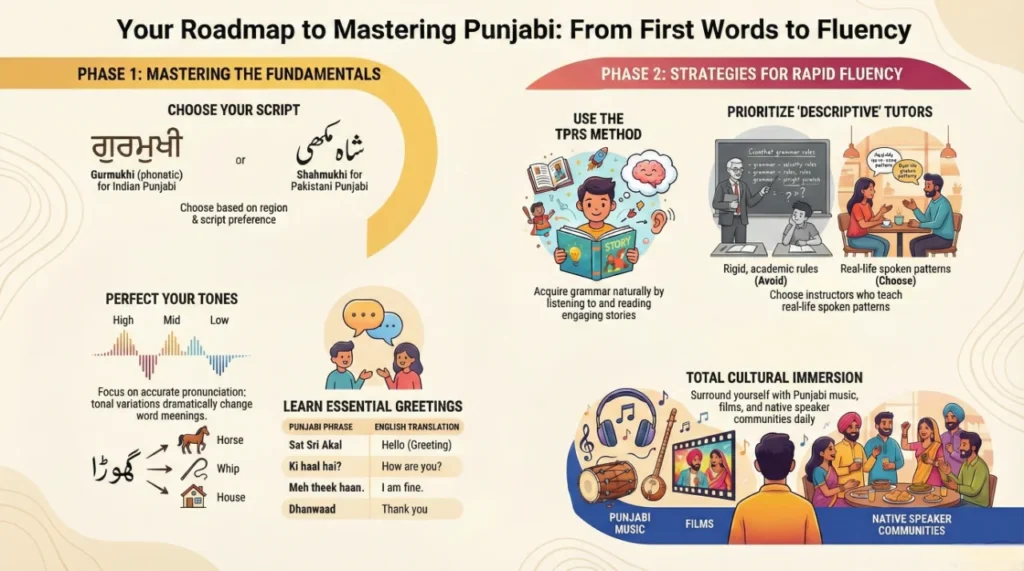
Punjabi, whether spoken in India (Gurmukhi script) or Pakistan (Shahmukhi script) is a highly expressive, rhythm-driven language. It’s emotional. Musical. Fast.
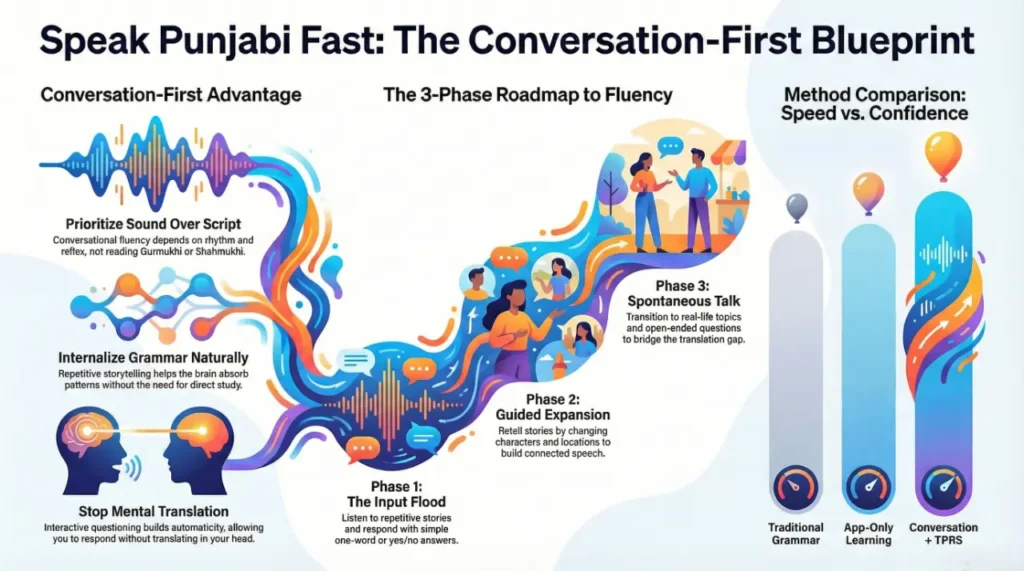
And honestly, you don’t need to read either script to speak naturally.
Many heritage learners speak Punjabi fluently without ever learning Gurmukhi or Shahmukhi formally. So if your goal is conversational fluency, family communication, travel, cultural connection, business speaking and listening should dominate your learning time.
Conversation-first learning works because:
- Your brain learns patterns through repetition in context.
- You internalize grammar without studying it directly.
- You build reflexes instead of translating in your head.
- You develop pronunciation naturally through listening + responding.
Grammar explanations? Helpful sometimes. Necessary at the beginning? Not really.
The Smartest Method: TPRS for Punjabi Conversation
TPRS Teaching Proficiency Through Reading and Storytelling might sound academic. It isn’t complicated. At its core, it’s about learning through simple, repetitive stories and interactive questioning.
Instead of memorizing “I am going, you are going, he is going,” you hear:
“Ali goes to Lahore.”
“Does Ali go to Lahore or Karachi?”
“Why does Ali go to Lahore?”
“Is he happy?”
And you answer. Out loud.
The repetition feels natural because it’s inside a story. Not a chart.
In Punjabi conversation practice, this becomes:
“Ali Lahore janda hai.”
“Ali Lahore janda hai ya Karachi?”
“Ali khush hai?”
You respond. You think. You laugh maybe. It sticks.
There’s something surprisingly powerful about hearing the same structure 10 times in different questions. Your brain stops analyzing and just… accepts it.
And that’s when fluency begins.
Why Romanised Transliteration Makes Conversational Punjabi Easier
For many English speakers and heritage Punjabi learners, the biggest challenge in learning Punjabi isn’t pronunciation it’s the script. That’s why romanised transliteration Punjabi learning using the English alphabet to represent Punjabi sounds can make conversational learning much smoother. When learners see “Tusi kiven ho?” instead of a completely new script, they immediately focus on sound, rhythm, and response. They speak faster. They engage sooner. They hesitate less.
For conversational fluency, that confidence shift is powerful. The goal is to respond naturally, build reflexes, and participate in real interaction. Romanised transliteration reduces the initial barrier and allows English, Punjabi, Desi, or partner language speakers to concentrate fully on pronunciation, listening patterns, and speaking flow. And when conversation is the priority, removing that early friction can make progress feel not just faster, but more achievable.
Why It Works for Conversational Fluency
- Removes hesitation at the very beginning
- Allows faster speaking practice from day one
- Keeps focus on pronunciation and rhythm
- Encourages immediate conversation instead of delay
- Builds confidence for partner-based learning
- Supports mixed-language households or intercultural relationships
- Makes daily conversational practice feel more accessible
When the goal is real-life Punjabi conversation with family, friends, or a partner, reducing barriers matters. Romanised transliteration simply makes that first step easier.
Speaking Before Reading: Why It Matters
Some learners worry: Should I learn Gurmukhi first? What about Shahmukhi?
If your goal is conversational fluency, reading is secondary.
Scripts matter if you want to:
- Read Punjabi literature
- Write formally
- Take language exams
But speaking? Listening? Daily communication?
Those depend on sound patterns, rhythm, and reflex not script recognition.
In fact, delaying conversation until you “finish learning the alphabet” often slows progress. I’ve seen learners spend weeks on letters and still struggle to form basic spoken sentences.
The Conversation Approach (Step 1: Start Before You Feel Ready)
Here’s the slightly uncomfortable truth: you will feel unprepared at first.
That’s normal.
Conversation-based Punjabi learning follows this sequence:
- Listen to simple, repetitive spoken Punjabi.
- Respond with short answers.
- Gradually expand into full sentences.
- Retell short stories in your own words.
- Have guided conversations around familiar topics.
7-Day Punjabi Conversation Starter Plan (No Grammar Overload)
This isn’t magic. You won’t be fluent in seven days. But you will feel momentum and that matters more than people admit.
The goal here is simple: build speaking reflexes fast.
Day 1–2: Micro Conversations Only
Focus on:
- Greetings
- Introducing yourself
- Very basic questions
Examples:
- “Tusi kiven ho?” (How are you?)
- “Main theek haan.” (I am fine.)
- “Tuhada naam ki hai?” (What is your name?)
- “Mera naam Ali hai.”
Say them out loud. Not silently. That part is important.
And don’t aim for perfection. Aim for flow.
You might feel awkward repeating the same lines ten times. Good. That repetition is doing something in your brain. It’s building automaticity.
Day 3–4: TPRS Mini Story Practice
Now we introduce a simple story.
Example:
“A girl lives in Lahore. She loves chai. Every day she drinks chai at 5 pm.”
Now ask questions:
- Does she live in Lahore or Islamabad?
- Does she love coffee or chai?
- When does she drink chai?
Answer out loud. Even one-word answers are fine at first.
Then retell the story:
“She lives in Lahore. She loves chai. She drinks chai every day.”
This feels almost too simple. But simplicity is the power of TPRS.
You aren’t memorizing. You’re internalizing.
Day 5: Controlled Conversation
Now expand slightly.
Talk about:
- Your city
- Your daily routine
- What you like
Example prompts:
- “Tusi kithe rehnde ho?”
- “Tusi roz ki karde ho?”
- “Tuhanu ki pasand hai?”
At this stage, don’t panic if you mix English and Punjabi. That blending code-switching is actually how many bilingual speakers communicate naturally.
Fluency is not purity.
Day 6–7: Retelling + Free Talk (Even If It’s Messy)
Take your earlier story. Change details.
Maybe now:
“A boy lives in Karachi. He hates chai. He drinks juice.”
It sounds childish. But variation creates flexibility.
Then move into open-ended conversation:
- Describe your weekend.
- Talk about your family.
- Explain your favorite food.
If you hesitate, that’s fine. Don’t switch back to English immediately. Try to rephrase.
That small struggle builds real fluency.
| Approach | Focus | Speed to Speaking | Confidence Level | Best For |
| Traditional Grammar-Based | Rules, writing, vocabulary lists | Slow | Often low at first | Academic learners |
| App-Only Learning | Recognition, reading, repetition | Moderate | Medium | Casual learners |
| Conversation + TPRS (DesiLingua Method) | Listening, speaking, storytelling | Fast | High early confidence | Fluency-focused learners |
Notice something? Only one approach trains spontaneous response early.
That’s the key difference.
Gurmukhi & Shahmukhi | Where They Fit
Let’s be honest here.
If your family speaks Punjabi at home, they likely never studied the script formally. They absorbed it through sound.
So for conversational fluency:
- Learn pronunciation first.
- Learn common spoken patterns.
- Learn filler words (“acha”, “theek hai”, “haanji”).
Later if you want add:
- Gurmukhi (used in Indian Punjab)
- Shahmukhi (used in Pakistani Punjab)
But don’t delay speaking because of script anxiety.
Speech comes from sound exposure, not letters.
Designing a Full Conversational Punjabi Fluency System
If you zoom out for a second, conversational fluency isn’t about knowing more words. It’s about reducing hesitation.
That’s it.
The learners who progress fastest aren’t necessarily smarter. They just spend more time responding in real time. Sometimes incorrectly. Sometimes awkwardly. But consistently.
So what would a full conversation-based Punjabi curriculum look like?
Not chapters. Not grammar units.
Instead:
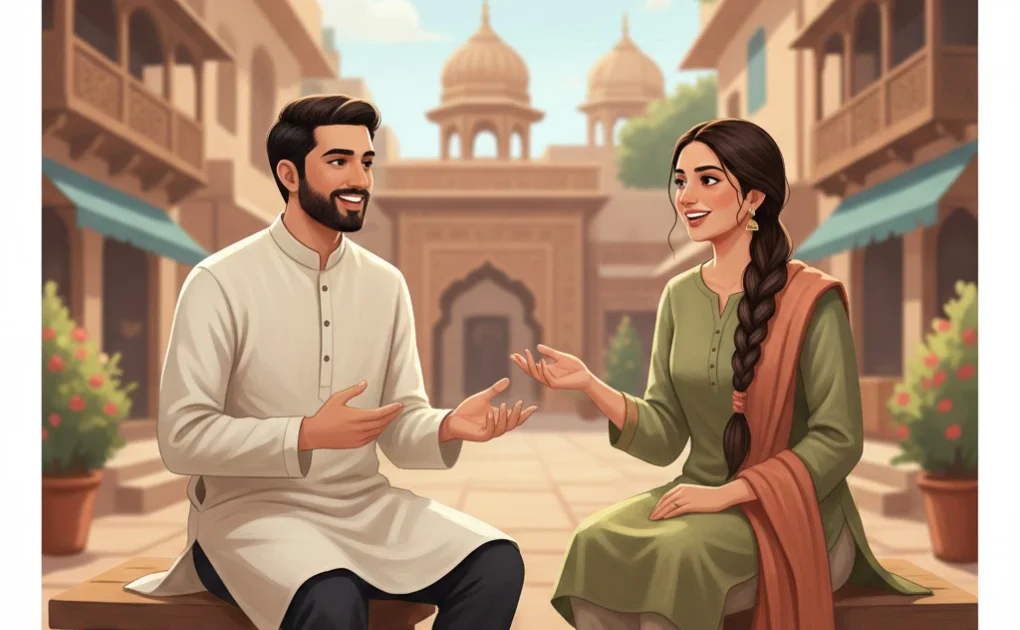
Phase 1: Input Flood (Weeks 1–2)
- Daily listening to slow, repetitive Punjabi stories
- Yes/No questions
- Either/Or questions
- Short answer responses
You don’t explain grammar. You expose patterns.
You hear:
“Oh Lahore janda hai.”
“Oh Lahore janda hai ya Karachi?”
After hearing that 30 times in different contexts, your brain stops analyzing “janda.” It just understands it means “goes.”
That shift from analyzing to recognizing is the beginning of fluency.
Phase 2: Guided Story Expansion (Weeks 3–4)
Now learners:
- Change characters
- Change locations
- Change emotions
- Add small details
For example:
Original:
“A girl lives in Amritsar.”
Expanded:
“A girl lives in Amritsar. She loves Punjabi music. Every Sunday she visits her grandmother.”
Suddenly, you’re building connected speech.
And interestingly… hesitation decreases when content becomes personal.
When learners talk about their real city, real family, real routine fluency accelerates.
Phase 3: Spontaneous Conversation
This is where it gets uncomfortable again.
You remove the script.
Now you ask:
- “Why do you like that?”
- “What happened yesterday?”
- “What would you do if…?”
And the learner has to think in Punjabi.
At first, they pause. They translate.
Then something changes. Slowly.
The translation gap shrinks.
Common Mistakes That Slow Punjabi Speaking Fluency
Some of these might sound familiar.
1. Waiting to Be “Ready”
There’s no moment where you suddenly feel fluent enough to speak.
You start speaking and fluency grows from that.
Not the other way around.
2. Over-Focusing on Script (Gurmukhi or Shahmukhi)
Reading has value. Cultural value. Academic value.
But conversational fluency comes from:
- Listening exposure
- Repetition in context
- Emotional engagement in stories
Script can support pronunciation. It should not replace conversation time.
3. Memorizing Vocabulary Without Context
If you memorize 100 isolated words, you may still freeze in conversation.
But if you practice 20 words repeatedly inside stories and conversations, you can use them naturally.
Depth beats volume.
Advanced Conversation Strategies (For Intermediate Learners)
If you already understand basic Punjabi but struggle to speak fluidly, here’s what works:
1. Time-Pressure Speaking
Set a 2-minute timer.
Talk without stopping.
Even if you repeat ideas. Even if you correct yourself.
That pressure builds automatic speech.
2. Emotion-Based Storytelling
Instead of describing facts, describe feelings:
- “I was nervous.”
- “I was excited.”
- “I felt embarrassed.”
Emotion vocabulary creates more natural speech patterns.
And honestly, conversation feels more human that way.
3. Retell Real-Life Events
Don’t invent stories forever.
Retell:
- Your day
- A funny memory
- A disagreement
- A travel experience
Real memory forces deeper processing than textbook scenarios.
Why This Approach Works Better for DesiLingua
For a platform like DesiLingua.net, focusing on:
- Live guided conversations
- TPRS storytelling sessions
- Controlled repetition
- Gradual expansion into free talk
Q1: What is the fastest way to learn Punjabi speaking?
The fastest way to learn Punjabi speaking is through daily conversation practice, repetitive storytelling (TPRS), and guided speaking sessions that focus more on listening and responding rather than studying grammar rules.
Q2: Can I learn Punjabi fluently without learning Gurmukhi or Shahmukhi?
Yes. Many learners become fluent in spoken Punjabi by focusing on listening and speaking first. Learning the script helps with reading and writing, but it is not necessary for conversational fluency.
Q3: How long does it take to speak Punjabi fluently?
With regular conversation-based practice, you can start speaking simple Punjabi within a few weeks. Becoming fully fluent depends on how consistently you practice and how much real conversation exposure you get.
Conclusion: Speak First, Fluency Follows
If you strip everything back, learning Punjabi fast isn’t about mastering Gurmukhi or Shahmukhi, memorizing endless vocabulary lists, or understanding every grammar rule. It’s about speaking. About responding, even when you’re unsure. About hearing a sentence enough times that it starts to feel natural instead of foreign. A conversation-first approach especially using storytelling methods like TPRS works because it mirrors how language is actually used: in context, in emotion, in real interaction. You don’t wait to be perfect. You start, you repeat, you adjust, and slowly the hesitation fades. Fluency doesn’t arrive all at once. It builds quietly, through stories, questions, and everyday conversations. And if your goal is to truly speak Punjabi with confidence, then perhaps the smartest move isn’t to study more it’s simply to start talking.